
Equating telecom compliance with risk intensity is incorrect, as the two are significantly different. Global telecom compliance refers to the rules and regulatory standards that govern the telecommunications industry in a particular country. Meanwhile, risk intensity is related to the possibilities that arise from technological complexity, market competition, and cybersecurity threats.
To market telecom devices in many countries, global compliance must be met. This is a type of access that allows devices to be brought into the country. Obtaining access means that the product meets the applicable technical, safety, and spectrum usage standards.
This article provides comprehensive information regarding global compliance for telecommunications. This will enable telecommunications equipment manufacturers to understand the practical steps for entering each country with different regulations. This will facilitate the smooth trade of products in the international market.
What Is Global Compliance?
Global compliance covers all business practices. Its scope is comprehensive, ranging from compliance with environmental regulations, tax rules, labor laws, data protection standards, and laws governing trade in the company’s country of origin and across borders.
In the telecommunications industry, global compliance refers to the product certification process, commonly known as type approval. This process is carried out to meet technical, safety, and radio frequency compatibility standards. Type approval certification is key to the use, trade, and import of devices into a country.
Certification is required for every device that uses radio frequencies. This is to ensure the safe use of the device and to prevent interference with existing networks.
Why Is This Important?
Global compliance in the telecom sector is necessary to ensure legal compliance, protect consumers, and maintain corporate integrity. By complying with regulations in each country, companies will avoid the following consequences.
- Suspension of goods in circulation
- Recall of goods in circulation
- Detention of goods at customs
- Fines and penalties
- Loss of trust in international markets
- Damage to brand reputation
The Need for International Business
International business requires global compliance. This is not an easy task, as complying with domestic regulations alone is difficult enough. Businesses that operate across borders must learn and comply with new rules and regulations to ensure their operations are in line with them.
To foster a culture of compliance and corporate accountability, it is essential to comply with all applicable laws in every location where your business is conducted. Global compliance is proof that a company has integrity and adheres to established regulations.
The Difference in Compliance in Every Country
The regulatory landscape related to global compliance for telecommunications varies from country to country. What exactly are the differences that prevent a single regulation from covering licensing in all countries?
The differences arise due to rapid technological changes, complex interactions between national security interests, and a fragmented global regulatory environment. The telecommunications sector is also regulated by various authorities, including the International Electrotechnical Commission (IEC) and the Federal Communications Commission (FCC) at the global level.
At the local level, each country has an authority responsible for handling telecommunications licensing. The regulations still refer to the IEC and FCC internationally. Here are some examples of compliance authorities around the world:
- Brazil: Agência Nacional de Telecomunicações (ANATEL)
- Cambodia: Telecommunication Regulator of Cambodia (TRC)
- India: Wireless Planning & Coordination (WPC) Equipment Type Approval (ETA) and Telecommunication Engineering Centre (TEC) Mandatory Testing and Certification of Telecom Equipment (MTCTE)
- Malaysia: Standard and Industrial Research Institute of Malaysia (SIRIM)
- Mexico: Norma Oficial Mexicana (NOM)
- Philippines: National Telecommunication Commission (NTC)
- Singapore: Infocomm Media Development Authority (IMDA)
- Thailand: National Broadcasting and Telecommunications Commission (NBTC)
- Vietnam: Ministry of Science and Technology (MoST)
Required Processes
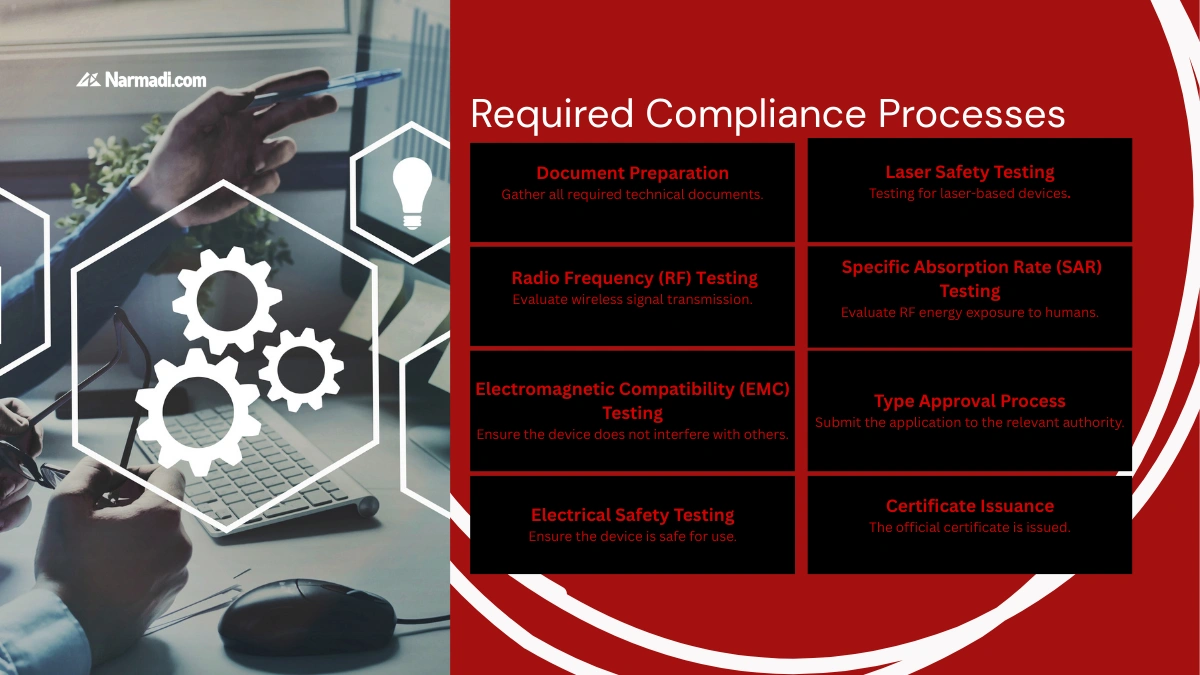
To obtain telecommunications type approval certification, several requirements must be met. This process ensures that every device complies with the requirements applicable in all countries. Each country has its own certification application process, which may vary slightly.
However, there is a standard process that will be followed when applying for global compliance in the telecommunications sector. Here is the process:
Technical document preparation
Technical document preparation is a necessary step that must be completed before submitting a certification application. Technical files must be prepared thoroughly, including user manuals, circuit diagrams, detailed information about the manufacturer, product specifications, technical details, and test reports. The smoothness of the process will depend on the completeness of these documents.
Radio Frequency (RF) Testing
Radio Frequency (RF) testing is a process that measures the wireless transmission characteristics of a device. The goal is to ensure that the device operates within the frequency, power, and bandwidth parameters permitted by local regulations. This testing is important for devices such as mobile phones, Wi-Fi, Bluetooth, and IoT devices.
Electromagnetic Compatibility (EMC) Testing
Electromagnetic Compatibility (EMC) testing is a process of testing a device’s emissions and immunity. The process ensures that a device does not emit electromagnetic interference that could affect other electronic devices.
In addition, the device is also immune to interference from external sources. The purpose of this test is to ensure that the device can function safely in its environment without causing problems.
Electrical Safety Testing
Electrical Safety Testing is a process that ensures that a device does not emit electrical interference that could affect other electronic devices. In addition, the device is also immune to interference from external sources.
The purpose of this process is to ensure that the device is protected from electric shock and fire, thereby maintaining its durability as a product. It even ensures that the product is reliable and acceptable in the international market.
Laser Safety Testing
Laser Safety Testing is a process that is specifically carried out for devices that use laser technology (for example, optical transceivers, fiber optic products). In this process, it is ensured that laser emissions are within the safe limits set by international standards. This test aims to prevent eye or skin injuries to users.
Specific Absorption Rate (SAR) Testing
Specific Absorption Rate (SAR) testing is the process of measuring the amount of radio frequency (RF) energy absorbed by the human body when using wireless devices. This test is typically performed only on cell phones and tablets.
The aim is to ensure that RF radiation exposure remains below the established safety limits, thereby preventing interference with human health.
Type approval process
The type approval process involves submitting all prepared documents and test reports to the telecommunications regulatory authority in the destination country. These documents will be reviewed to ensure that the device complies with applicable technical standards and regulations.
The processing time for type approval varies from country to country. For example, Indonesia has a waiting period of around 5 weeks for the Local Test Approach. On the other hand, the lead time for paperwork is about 1 week.
Certificate issuance
Certificate issuance is the process by which the regulatory authority issues an official certificate after the application process has been approved. This certificate is proof that the product has met all technical and regulatory requirements. This allows the product to be legally marketed in that country.
Certificates often have a specific validity period and may need to be renewed. However, some certificates do not have a validity period. Therefore, certificate renewal will only occur if there are changes and modifications to the previously submitted device.
Challenges for Manufacturers in Multi-Market Compliance
Global compliance for telecommunications poses unique challenges for manufacturers in multi-market marketing. One of the well-known challenges is the differences in regulations between countries. In addition, regulatory changes often occur suddenly in each country.
Certification and testing costs are also something that needs to be prepared for global marketing. Since manufacturers must meet certification requirements in each country, cost allocation also presents a challenge. However, this has been made easier with testing reports that can be used in several countries.
The global compliance process cannot be taken lightly; it is an integral part of planning for every telecommunications device distribution. Failure to obtain certification will cause obstacles to distribution in that country.
Effective Strategies That Can Be Implemented
To avoid obstacles in the distribution of telecommunications devices in a country, a global compliance strategy is necessary. This strategy will certainly make the international marketing process more effective.
These effective strategies are closely tied to regulatory research, meticulous planning, and collaboration with trusted product compliance specialists. The following are effective strategies that can be implemented:
- Identify regulations: It is necessary to understand all relevant laws, regulations, and guidelines at the local and international levels.
- Establish clear policies: Global compliance policies and procedures must align with applicable regulations to ensure effective implementation and adherence.
- Early global compliance planning: Integrate planning modules from the Research and Development (R&D) stage to ensure seamless integration throughout the process.
- Collaborate with global certification labs: For testing requirements that meet international standards.
- Collaborate with product compliance specialists: To facilitate certification applications in each country and become a Local Representative (LR) if needed.
Ultimately, global compliance for telecom is not just a matter of bureaucracy. It is part of a market strategy to distribute products internationally. It is time to develop a comprehensive plan and establish clear policies.
Do not hesitate to contact a product compliance specialist to help you identify regulations and facilitate the compliance process. You can even stay updated on regulations in each country, which are subject to change at any time. [UN].