
Telecom certification is essential for entering the global market. This process may seem straightforward, but it should not be taken lightly. Underestimating the type approval application process can lead to mistakes.
Common mistakes in telecom certification applications include a lack of knowledge about the process. To avoid delays in device distribution, it is important to understand the requirements and avoid mistakes.
This article will help you understand common mistakes in telecom certification applications. That way, you can avoid them and ensure a smooth application process.
What is Telecom Certification?
Telecom certification is a process that manufacturers must undergo to meet technical, safety, and radio frequency compatibility standards. Every device that uses radio frequencies must undergo this certification.
Certification varies from country to country. Usually, each country has its own authority. So, to bring telecom products into various countries, it is necessary to obtain certification in the target countries.
The purpose is to enable the use, trade, and import of devices into a country. Moreover, this is to ensure that the device is safe to use and does not interfere with existing networks.
The Applicant
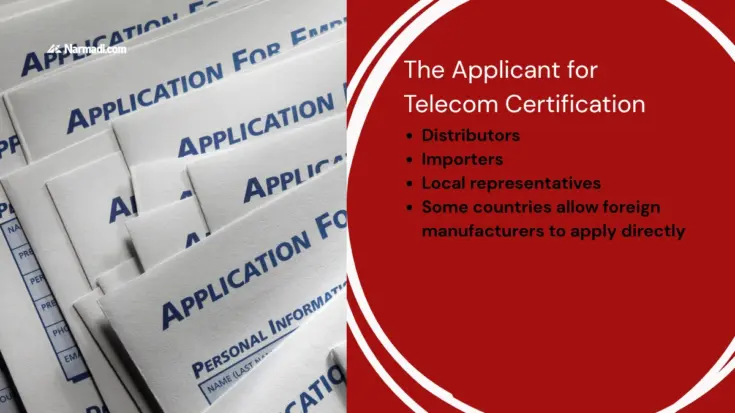
Applicants for telecom certification vary from country to country. However, they are generally distributors, importers, or local representatives. Some countries do not require local representatives, as they allow foreign manufacturers to apply directly.
Regardless of who the applicant is, several responsibilities fall under their purview. The following are some of the responsibilities of the applicant:
- Identifying applicable standards
- Monitoring regulatory updates
- Reviewing technical documents
- Preparing application documents
- Managing communication with regulators
- Arranging EMC, RF, SAR, and Safety testing in nationally and internationally accredited laboratories
- Submitting the documents
The Process
The telecom certification application process is not overly complicated, but it must still be completed by every applicant. The application process is generally divided into two parts: local testing and paperwork.
The two processes require different lead times. Each country has a different waiting period for each process. Generally, paperwork has a shorter lead time than local testing.
Local testing
Local testing is a process that must be carried out for telecom certification applications. This testing requires samples to be tested in the target country. Some countries also collaborate with international laboratories for certification purposes.
This testing stage is intended to ensure that every device that uses radio frequencies complies with applicable restrictions, is safe to use, and does not interfere with other devices. Some of the laboratory tests that need to be carried out include:
- Radio Frequency (RF) Testing: The process of evaluating wireless signal transmission.
- Electromagnetic Compatibility (EMC) Testing: The process of testing devices to ensure that they do not interfere with other devices.
- Electrical Safety Testing: The process of ensuring that devices are safe to use.
- Laser Safety Testing: The process of testing laser-based devices.
- Specific Absorption Rate (SAR) Testing: The process of evaluating RF energy exposure to humans.
This process generally takes several weeks. Each lab will have a different waiting period according to its own policy.
Paperwork
Paperwork is the process of applying for telecom certification that does not require local testing. However, this does not mean that laboratory testing is not required at all. Companies still need to obtain RF test reports and other necessary tests from accredited laboratories.
Next, the test documents will be collected together with the certification application documents to be submitted to the authorities. Each country will have different documents that are required. You can view the requirements through the official website or through Product Compliance Specialists’ services.
This process is generally shorter than local testing, because it only involves evaluating the submitted documents. Once the documents are approved, all that remains is to wait for the certificate to be issued.
The Challenge
Telecom certification cannot be taken lightly. There are unique challenges in applying for this process. Here are some common challenges in the certification process:
- Regulatory requirements that need to be understood: Each country has different regulations for telecommunications products that need to be understood.
- Complete documentation: Test reports, product specifications, company details, and other technical details must be complete and detailed to avoid rejection.
- Testing requirements: Products must undergo rigorous testing in accredited laboratories to ensure compliance with national standards related to safety, quality, and performance.
- Regulatory updates: Policies for telecommunications products are often updated periodically in accordance with the policies of each authority in a country.
- Need for coordination with stakeholders: The certification process often involves coordination with consultants, testing facilities, and government agencies to avoid misunderstandings.
- Rejection and resubmission of applications: Applications may be rejected due to inaccurate details or non-compliance with relevant authority standards.
Common Mistakes

Common mistakes in telecom certification applications are often due to a lack of thorough preparation. Therefore, it is important to be aware of the mistakes that are often made to avoid them in the future.
Incomplete Documentation
Documentation requirements cannot be underestimated, as they are part of the certification application process. Submitting incomplete documents is one of the most common mistakes made. Therefore, it is important to thoroughly review the telecommunications regulatory requirements and compile all the necessary documents.
Ignoring RF Parameters
Every telecommunications product must undergo device testing as one of the requirements for applying for telecom certification. To pass the RF test report, several item parameters must be completed. These parameters refer to the European Telecommunications Standards Institute (ETSI) EN 300 328 – V2.2.2.
These parameters are frequency range, output power, bandwidth, and spurious emission. These four parameters must generally be complete and must not exceed the specified maximum limits.
Incorrect Test Samples
Each test requires a product sample. The purpose is to conduct direct testing on telecommunications device modules. There are two types of samples required: tested samples and irradiated samples.
For countries that require local testing, the number of samples required may vary. Often, many applicants are unaware that product samples are required in this process.
Missing Local Representative
As explained above, applicants for telecom certification will differ in each country. Generally, they are distributors, importers, or local representatives.
Foreign manufacturers often do not know that a local representative is required if they do not have a distributor, importer, or local brand representative. Therefore, it is important to be able to work with Product Compliance Specialists who can act as local representatives.
Those are some common mistakes that often occur in telecom certification applications. Being aware of these common mistakes will help you prepare your application documents more carefully.
Avoiding these mistakes will ensure that your certification application is not rejected or delayed. This will allow you to smoothly distribute your telecommunications products in your target country.