
As is well known, marketing telecom and wireless products requires going through the telecommunications compliance cycle. Therefore, it is important to create early compliance planning for the smooth running of the entire process.
Compliance is often only considered as a cost at the end of a project. However, early compliance planning can be a long-term cost-saving strategy, not just a regulatory obligation.
This article will explain how early compliance planning reduces costs in wireless product development. This allows manufacturers to better allocate costs from the outset for the entire process. This will certainly avoid cost overruns at the end.
The True Cost of Late Compliance in Wireless Product Development

Products that do not meet the telecom compliance lifecycle have the potential to incur high costs in the end. The actual costs of delayed compliance in the development of new wireless products are felt in the form of market delays, rework, and retesting.
Compliance that is only considered at the final stage carries a higher risk of additional costs. Therefore, it is important to invest in compliance planning to avoid high hidden costs later on.
- Re-testing RF & EMC: Products that fail at the testing stage because they do not meet the required testing parameters will need to be retested.
- Hardware redesign: Problems discovered after testing have the potential to result in costly and time-consuming rework.
- Delay in certification: Failure during testing delays the type approval certification process.
- Loss of revenue: Delays in certification delay product distribution, causing products to be held up at customs and resulting in lost revenue.
- Missed opportunities: Delayed product launches mean lost sales opportunities.
- Financial penalties and legal action: Non-compliance can result in heavy fines, legal action, and operational restrictions.
- Loss of customer trust: A single product failure can destroy customer trust in the product and damage the company’s reputation.
Common Mistakes When Compliance Is Not Considered Early
Compliance that is not considered from the outset often leads to mistakes. Here are some common mistakes companies make:
- Delaying compliance until the last minute
- Reactive strategies
- Inadequate documentation and record-keeping
- Failure to keep up with ever-changing regulations
- Lack of good communication between divisions
- Inadequate internal auditing and monitoring
Key Ways Early Compliance Planning Reduces Costs
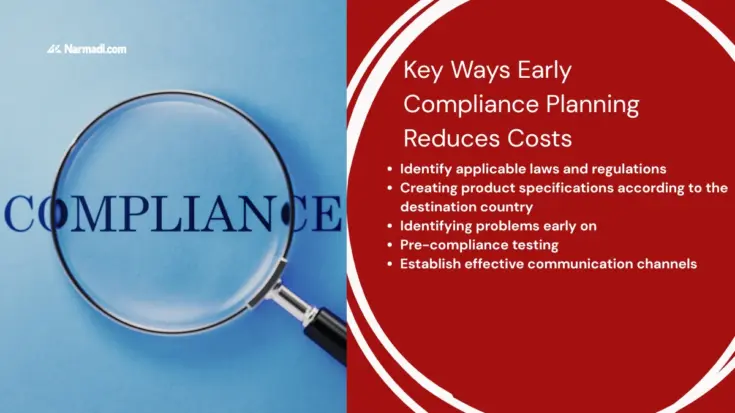
There are several ways to avoid costs at the final stage. Integrating requirements from the outset will result in substantial savings.
This is, of course, because it avoids the actual costs of delayed compliance in wireless product development. Therefore, it is important to plan for early compliance planning.
Identify applicable laws and regulations
Understanding the specific regulations, laws, and standards related to telecommunications products is fundamental. This is not an easy task, as regulations can change quickly in a country depending on local authorities.
Therefore, you may need to consult with a product compliance specialist for proper guidance. This is especially important in highly regulated sectors such as healthcare, finance, or construction.
Creating product specifications according to the destination country
Compliance regulations vary from country to country. Therefore, manufacturers need to be able to prepare products with frequency specifications that are permitted in the destination country.
Products are also ready to be tested in several destination countries on a mass scale. That way, multi-country product marketing can be carried out quickly.
Identifying problems early on
Problems identified at the end of the development cycle, such as electromagnetic compatibility (EMC) issues or antenna performance problems, are disastrous. They will result in significant mechanical and electrical redesigns, new equipment, and additional prototyping.
Problems identified early on during the design and prototype evaluation phases are easier to fix. That way, there is no need to fix the entire finished product.
Pre-compliance testing
Early planning allows for pre-compliance testing. Although this is an optional step, it is highly recommended, especially during the Research and Development (R&D) process.
Companies can internally conduct assessments using specialized equipment to detect potential failures. This provides valuable insights and allows for efficient adjustments before investing in costly official certification laboratory time.
Establish effective communication channels
Effective communication channels between employees will make it easier to resolve many issues. Create a mechanism for employees to report potential compliance issues anonymously and without fear of retaliation.
Establish clear reporting channels to senior management. This will encourage employees to actively provide feedback on products being manufactured. This provides an opportunity to identify problems quickly from the outset.
Implementing a monitoring and audit system
Another thing that can be done to identify problems early on is to implement a monitoring and audit system. Internal monitoring and periodic audits will check whether controls are functioning effectively.
Implementing this system will ensure that the control process runs smoothly. Additionally, when problems are found, they can be addressed, and solutions found more quickly before testing in the lab, which can be quite costly.
The Benefits
Using key early compliance planning methods reduces costs. Early compliance planning will free you from the high costs of retesting and redesign. Additionally, there are several other benefits of early compliance planning that you will experience.
- Financial savings: Significantly reduce development and repair costs by preventing late-stage modifications, fines, and legal fees.
- Accelerate product launch time: By avoiding delays caused by compliance issues, you can speed up your product’s time to market.
- Improved operational efficiency: Clear processes will result in increased operational efficiency and higher first-time approval rates.
- Risk mitigation: Allows ample time to effectively address potential issues, non-compliance problems, and reputational damage.
- Enhanced reputation and trust: Commitment to quality and safety builds reliability and trust among customers, partners, and regulators.
The Future of Compliance Culture
In the future, telecom compliance will no longer be a matter of regulatory responsibility, but rather part of the overall corporate culture. This is driven by technological innovation and rapid regulatory change.
In the future, compliance planning management may be aided by artificial intelligence (AI), machine learning, regulatory technology (RegTech), and in-depth data analysis. This will make the compliance reporting, monitoring, and assessment processes more efficient and reduce manual workloads.
Continuous technological innovation also encourages regulations to continue to adapt to create regulations that may not have existed before. Regulations will continue to evolve rapidly in various countries, requiring companies to be constantly adaptive.