

To market telecom and wireless products in every country, global compliance must be met. To obtain type approval, testing must be conducted, one of the most commonly used being Radio Frequency (RF) testing. Other tests include Electromagnetic Compatibility (EMC) testing, Electrical Safety Testing, Laser Safety Testing, and Specific Absorption Rate (SAR) Testing.
Submitting RF test reports is a mandatory requirement for type approval in every country. This process involves certain dos and don’ts.
Therefore, every manufacturer, importer, and distributor needs to understand all aspects of obtaining an RF test report. This article will provide in-depth information about this testing, from its definition, requirements, and process to the publication of its results.
What Is an RF Test?
Radio Frequency (RF) is a form of electromagnetic energy that propagates through space as radio waves. Radio and telecommunications equipment must be measured through RF testing. Technologies that require this testing include WiFi, Bluetooth, NFC, Zigbee, RFID, MPR radio, GPS, cellular technology, and others.
Essentially, any electronic device or component with wireless communication must comply with radio frequency requirements. The purpose is to determine whether the equipment uses the radio spectrum appropriately, does not exceed the permitted transmission power, and does not cause interference with other devices.
The parameters of RF test reports vary from country to country. Internationally, they refer to the European Telecommunications Standards Institute (ETSI) EN 300 328. However, some countries that require local testing may have some adjusted references.
Why Is This RF Test Report Important?

An RF test report is important for companies that manufacture wireless devices or incorporate wireless devices into their products. It is one of the compliance requirements that must be met when applying for type approval. The aim is to comply with the regulations of the target market.
If the RF test is not passed, several risks may occur:
- Issues cannot be detected early on
- Possibility of costly rework
- Products cannot be sold legally
- No access to global markets
Requirements to Prepare
To obtain an RF test report, you must first prepare the requirements before testing. The requirements that must be prepared are:
- Sample: There are two types of samples required, namely conducted samples and radiated samples. For countries that require local testing, the number of samples required may vary.
- Documents: Collect technical specifications, photos, and manual books.
- Test Standard Operating Procedure (SOP): A step-by-step testing guide, which generally contains instructions on how to transmit the device. For software tests, it is necessary to provide instructions on how to use the software.
- Software Test: Software used to transmit sample frequencies.
The above requirements are general requirements that need to be prepared. For sample testing administration, some laboratories may have slight differences depending on their respective policies.
Testing Process
An RF test report will be issued if telecom and wireless products pass the testing process. This process will determine whether the device meets the specified parameters. The test parameters are frequency range, output power, bandwidth, and spurious emission.
The test was conducted by transmitting frequencies on a single channel. The frequencies used were low and high, with continuous transmission and modulation conditions. The reference was based on the types of samples provided, namely, conducted samples and radiated samples. Both have different characteristics and processes. The differences are as follows.
Conducted sample
Conducted samples are required for products with RF features, such as:
- Bluetooth, ANT+, Zigbee, and Other SRD devices operating in the 2.4 GHz band
- RLAN/WLAN 2.4 GHz and 5 GHz
- RFID with a frequency of 920–923 MHz
- Cellular (2G, 3G, 4G, 5G)
- LPWA/IoT
The conducted sample testing process does not have to be carried out in a chamber. Testing can be done in a regular room by simply turning on the sample device. The process is carried out by following the Test SOP steps so that the device transmits.
Conducted samples have a simpler process compared to radiated samples due to the ease of measurement. This process is carried out using a spectrum analyzer as a measuring tool. This tool will produce the test parameters.
Radiated sample
Radiated samples are required for products with RF features, such as:
- NFC
- SRD 125 KHz
- SRD 134 KHz
- RFID 13.56 MHz
- Low Power 433 MHz
- Radar 24 GHz
- Radar 77 GHz
Radiated sample testing at frequencies below 433 MHz must be conducted in a chamber. For frequencies above this, testing can be performed in a standard room.
Radiated sample testing follows the same process as conducted sample testing. However, the process requires more time to generate the test parameters.
Dos and Don’ts
When submitting RF test reports for type approval, certain dos and don’ts must be taken into consideration. Knowing these is important in order to avoid RF test failure. The following are the dos and don’ts that must be taken into consideration:
Do this!
In order to pass the RF test report, there are several things that must be done. The following are some guidelines:
The lab is recognized by global and local authorities
Global authorities:
- International Telecommunication Union (ITU)
- Comité International Spécial des Perturbations Radioélectriques (CISPR) or, in English, the International Special Committee on Radio Interference
Examples of local authorities:
- Brazil: Agência Nacional de Telecomunicações (ANATEL)
- Cambodia: Telecommunication Regulator of Cambodia (TRC)
- Indonesia: Directorate General of Digital Infrastructure (DJID)
- India: Wireless Planning & Coordination (WPC) Equipment Type Approval (ETA) and Telecommunication Engineering Centre (TEC) Mandatory Testing and Certification of Telecom Equipment (MTCTE)
- Malaysia: Standard and Industrial Research Institute of Malaysia (SIRIM)
- Mexico: Norma Oficial Mexicana (NOM)
- Philippines: National Telecommunication Commission (NTC)
- Singapore: Infocomm Media Development Authority (IMDA)
- Thailand: National Broadcasting and Telecommunications Commission (NBTC)
- Vietnam: Ministry of Science and Technology (MoST)
Test reports are published globally or locally
For tests conducted through international laboratories, test reports will be published in English. For global testing, test reports will refer to the standards of the authorities in each country. Tests must be conducted by laboratories that are accredited and meet international standards.
Test reports are published in accordance with technical standards
Examples of technical standards:
- Bluetooth: EN 300 328
- NFC: EN 300 330
- RFID: EN 300 330
- WiFi: EN 300 328
Don’t Do This!

To pass the RF test report, several item parameters must be completed. These parameters refer to the European Telecommunications Standards Institute (ETSI) EN 300 328 – V2.2.2.
These parameters are frequency range, output power, bandwidth, and spurious emission. These four parameters must generally be complete and must not exceed the specified maximum limits.
Frequency range
| Service frequency bands | |
| Transmit | 2400 MHz to 2483,5 MHz |
| Receive | 2400 MHz to 2483,5 MHz |
Output power and Bandwidth
The RF output power for the equipment must be equal to or less than 20 dBm. The channel bandwidth used for each frequency hopping must be within the frequency range listed in the frequency range table. Additionally, for non-adaptive equipment with an e.i.r.p. greater than 10 dBm, the channel bandwidth used for each frequency hopping must be equal to or less than 5 MHz.
Spurious emission
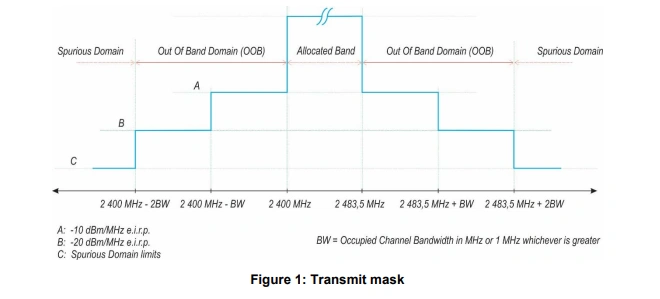
Spurious emissions have three types of parameters that need to be measured, namely unwanted emissions from transmitters in domains outside the band, unwanted emissions from transmitters in spurious domains, and spurious emissions from receivers. The maximum limits for each are as follows:
Transmitter unwanted emissions in the out-of-band domain
Transmitter unwanted emissions in the spurious domain
| Frequency range | Maximum power | Bandwidth |
| 30 MHz to 47 MHz | -36 dBm | 100 kHz |
| 47 MHz to 74 MHz | -54 dBm | 100 kHz |
| 74 MHz to 87,5 MHz | -36 dBm | 100 kHz |
| 87,5 MHz to 118 MHz | -54 dBm | 100 kHz |
| 118 MHz to 174 MHz | -36 dBm | 100 kHz |
| 174 MHz to 230 MHz | -54 dBm | 100 kHz |
| 230 MHz to 470 MHz | -36 dBm | 100 kHz |
| 470 MHz to 694 MHz | -54 dBm | 100 kHz |
| 694 MHz to 1 GHz | -36 dBm | 100 kHz |
| 1 GHz to 12,75 GHz | -30 dBm | 1 MHz |
Receiver spurious emissions
| Frequency range | Maximum power | Bandwidth |
| 30 MHz to 1 GHz | -57 dBm | 100 kHz |
| 1 GHz to 12,75 GHz | -47 dBm | 1 MHz |
Products that have passed testing will receive an RF test report containing test parameters, product information items, and the applicant. Generally, test results will be available within a maximum of two weeks after testing. However, some labs may have different policies.
The test report will be compiled with other tests, such as EMC, Electrical Safety Testing, Laser Safety Testing, and SAR Testing, if required by local authorities. Subsequently, all documents will be submitted to the authorities for the type approval process.
Once the process is complete, the company will receive RF certification that can be used to distribute devices in the destination country. This will enable you to distribute your telecom and wireless products in the international market.