

Companies or individuals wishing to bring telecommunications equipment to the Indonesian market must understand the document requirements for DJID certification.
The DJID, or Directorate General of Digital Infrastructure, is the agency that regulates Indonesian type approval certification. This certification serves as proof of approval for the safety of telecommunications equipment entering or circulating in Indonesia.
Having DJID certification ensures that distributed equipment meets Indonesian safety and quality standards.
The DJID certification requirements are not difficult. There are only two main pathways: local testing and work experience.
Each pathway has its own document requirements for DJID certification that must be met for a smooth and effective process.
Let’s take a closer look at the document requirements for DJID certification for each pathway.
Local Testing Path and Document Requirements for DJID Certification
In the local testing path, devices that will receive approval must undergo testing in a laboratory approved by DJID in Indonesia.
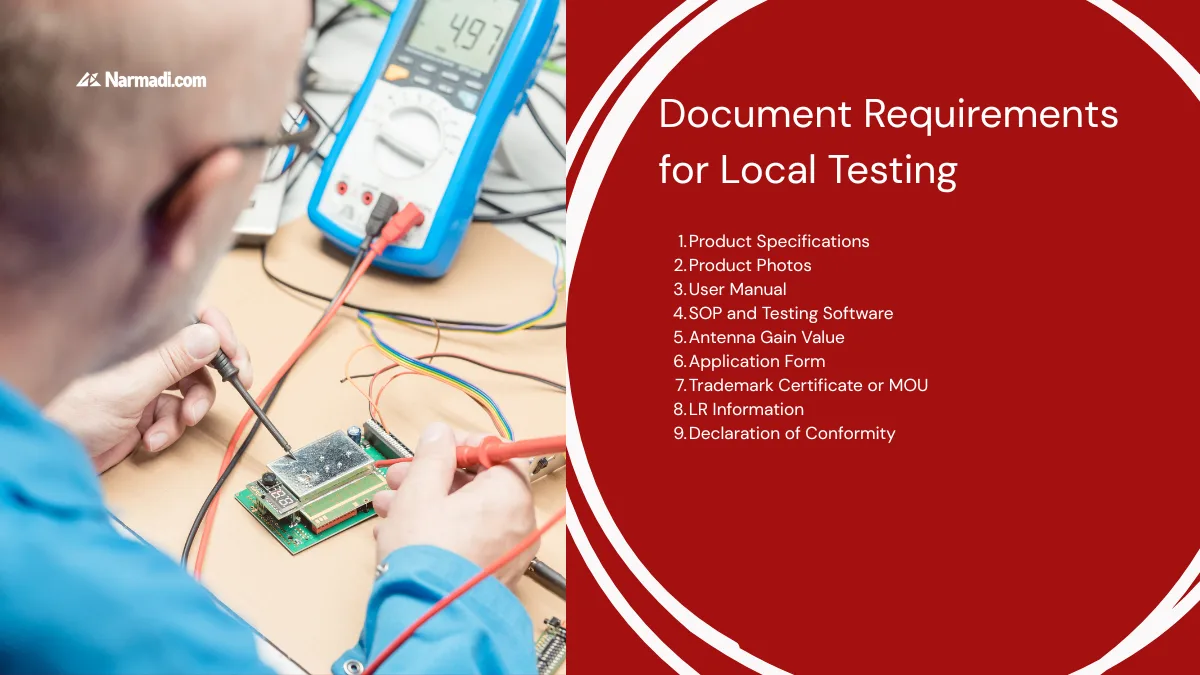
The following are the document requirements for DJID certification that need to be prepared for this path:
1. Product Specifications: This document lists the complete product specifications, such as model and features. It is important to ensure the model name in this document matches the one submitted to the DJID.
2. Product Photos: Clear photos showing the device, including its external appearance and essential components, are required for visual identification.
3. User Manual: A guide for using the device, used for standard samples. This must be the same as the one included with the device to be sold.
4. SOP and Testing Software: Standard Operating Procedures (SOPs) and software used for testing are also required. This document facilitates the testing process in accordance with applicable procedures.
5. Antenna Gain Value: The antenna gain value in dBi must be included. This is part of the testing to ensure the device meets safe and effective signal requirements.
6. Application Form: This form contains applicant and product information, including technical and commercial data, which are part of the application requirements.
7. Trademark Certificate or MOU: If the applicant is a distributor or importer, a trademark certificate or Memorandum of Understanding (MOU) with the trademark holder must be included as proof of official cooperation.
8. LR Information: Information about the responsible local representative in Indonesia is also required. Typically, this is an entity or individual who will help ensure the device complies with applicable regulations.
9. Declaration of Conformity: A statement that the proposed product meets applicable technical standards and regulations. The statement must be signed by the applicant.
Paperwork Path

For devices that have undergone testing at an international laboratory recognized by DJID, the paperwork route is a simpler alternative. With this route, the device no longer needs to undergo local testing in Indonesia.
The following are the document requirements for DJID certification for the Paperwork path:
1. Product specifications and product photos: Just like on the local testing route, product specifications and photos must be complete and accurate.
2. RF test report: An RF test report from a laboratory recognized by DJID is essential. This report shows radio-frequency test results that prove the device operates at safe frequencies.
3. EMC test report: This document shows the device’s resistance to electromagnetic interference and is important to guarantee the device does not interfere with other devices.
4. Summary of test report: A summary of the results of the tests carried out must also be attached to provide an overview of the device test results.
5. CB report (if using AC power): If the device uses AC power, a CB (Certificate Body) report is required to show that the device meets electrical safety standards.
6. Application form: This form contains the same information as the local testing route and is one of the mandatory documents in the paperwork process.
7. Trademark certificate or MOU: This certificate must be included if the applicant is not the trademark holder.
8. Declaration of Conformity: A statement that the proposed product meets applicable technical standards and regulations. The statement must be signed by the applicant.
9. LR Information: Information about the responsible local representative in Indonesia is also required. Typically, this is an entity or individual who will help ensure the device complies with applicable regulations.
Meeting the document requirements for DJID certification is very important for companies or individuals who wish to bring telecommunications equipment to the Indonesian market. With two main routes, namely local testing and paperwork, DJID offers options for devices that are tested domestically or in recognized overseas laboratories.
Download Summary
Submitting the DJID Documents
Once all the required documents for DJID certification are complete, the next step is to submit an application for Indonesian type approval certification. Both local testing and paperwork applications are submitted through the DJID e-certification website.
The difference is that local testing requires first completing the testing process at a local lab. Once the test results are received, the document submission process is the same as for the paperwork process.
All submitted documents will be evaluated by the authorities within 24 hours. However, in real-world situations, the evaluation process may take up to two or three days due to waiting times.
After that, the DJID will provide a response. If there are no corrections, a Payment Notification Letter (SP2) will be issued. Payment must be made within a maximum of 14 business days.
After payment, the certificate will be issued within 24 hours. However, if the evaluation is not successful, the documents will be returned to the applicant for revision or the addition of missing documents. The revised and complete documents can then be resubmitted.
Complete document requirements for DJID certification will help the approval process run smoothly, ensuring the device meets the safety and quality standards applicable in Indonesia. If you need help in processing this certification, using our DJID certification services could be the right solution. [UN]