

We have previously discussed that marketing telecom and wireless products globally requires a clear strategy. This is where a certification path is needed to facilitate product marketing in many countries.
When a device is marketed in many countries, it will encounter type approval certification and applicable regulations. A common mistake made by many companies is not having a certification path and assuming that certification can be done one by one without planning.
The absence of a clear certification path can lead to increased costs, repeated testing, and delayed market entry. Therefore, this article will help manufacturers map out an efficient and measurable cross-border certification path.
What Is a Multi-Country Certification Path?
The multi-country certification path in the context of telecom devices is a single or coordinated process. This allows manufacturers to obtain regulatory approval for a product in multiple countries simultaneously or sequentially in an efficient manner.
A single device may require a different approach in each country. This is due to the policies of each authority in regulating the testing parameters of a device. There are two approaches to multi-country certification paths: country-by-country and structured multi-country planning.
Here, it is recommended to use the multi-country telecom certification strategy. Compared to the reactive country-by-country method, the structured multi-country method is more strategic for manufacturers with a sufficiently broad market coverage.
The certification path, product lifecycle, and go-to-market strategy are closely related and interdependent. These three elements must be managed in an integrated manner to ensure legal compliance, time efficiency, and commercial success.
Multi-Country Certification Path
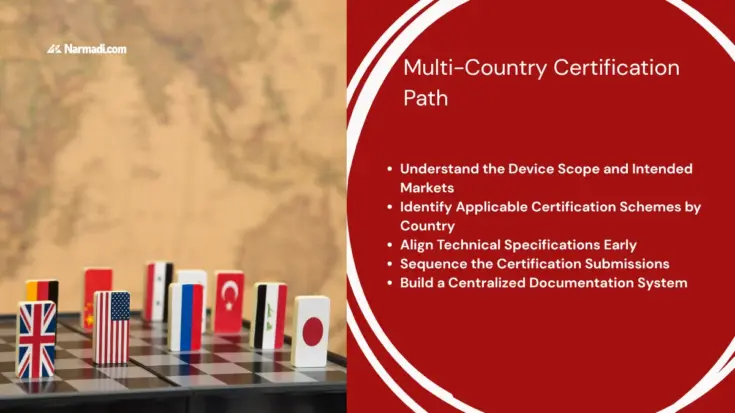
Understand the Device Scope and Intended Markets
When undertaking a multi-country certification path, it is important to understand the device scope and intended markets. The first step is to identify the types of devices that will be marketed.
This is because every telecommunications and wireless device has different regulatory requirements in each country. Next, you need to determine the target countries for product marketing, such as ASEAN, Asia, the EU, or America. This is done to identify a country as a priority country vs. a secondary market.
Understanding the device scope and intended markets will have an impact on market choices regarding technical standards, testing requirements, and documentation complexity requirements.
Identify Applicable Certification Schemes by Country
After determining the target market for the destination country, the next thing you need to do is map the authorities per country. You can start grouping countries based on similar regulatory frameworks and Mutual Recognition Arrangements (MRA).
In addition, it is important to note that some countries use shared standards for the Federal Communications Commission (FCC) or the European Telecommunications Standards Institute (ETSI). This is generally used for countries that do not conduct local testing.
For these countries, this means that one FCC or ETSI test result can be used to apply for certification in several countries. Here are some examples of compliance authorities around the world:
- Brazil: Agência Nacional de Telecomunicações (ANATEL)
- Cambodia: Telecommunication Regulator of Cambodia (TRC)
- Indonesia: Direktorat Jenderal Infrastruktur Digital (DJID)
- India: Wireless Planning & Coordination (WPC) Equipment Type Approval (ETA) and Telecommunication Engineering Centre (TEC) Mandatory Testing and Certification of Telecom Equipment (MTCTE)
- Malaysia: Standard and Industrial Research Institute of Malaysia (SIRIM)
- Mexico: Norma Oficial Mexicana (NOM)
- Philippines: National Telecommunication Commission (NTC)
- Singapore: Infocomm Media Development Authority (IMDA)
- Thailand: National Broadcasting and Telecommunications Commission (NBTC)
- Vietnam: Ministry of Science and Technology (MoST)
Align Technical Specifications Early
Once you understand the various authorities and regulations in the country, you can then understand the technical specifications early on. This is important for determining a common technical baseline, such as frequency bands, output power limits, and Electromagnetic Compatibility (EMC) parameters.
That way, manufacturers can adjust specifications to be accepted in many countries and reduce hardware variants. Here, the role of engineering and compliance collaboration with trusted partners is very much needed.
Sequence the Certification Submissions
After knowing the requirements of the destination country and the technical specifications needed, it is time to determine the sequence of certification submissions. The order of countries is important to understand the efficiency of submissions with marketing time and risk mitigation.
One approach is to consider the anchor country first and weigh fast-approval markets against complex markets. You can use a flowchart to submit to primary approval, secondary markets, and local deviations.
Build a Centralized Documentation System
One thing that should not be overlooked in the multi-country certification path is building a centralized documentation system. You must control documents such as test reports, technical descriptions, Declarations of Conformity (DoC), and certificates.
This is, of course, to avoid the risks of scattered documentation, inconsistency, and rejection by authorities. Version control can ensure the use of the most recent documentation, which is very important for cross-border approvals. Different versions may be processed simultaneously for several countries.
Common Mistakes

Mistakes are bound to happen when planning for multi-country certification. Therefore, it is important to be aware of common mistakes so that they can be avoided. Here are some of the most common mistakes made in multi-country certification:
- Delaying compliance until the product is ready for sale
- Ignoring variant impact
- Not taking authority timelines into account
- Direct impact on costs and launch schedule
These are some of the things manufacturers need to understand when mapping out a multi-country certification path for a single device. Multi-country certification may not be easy, but it can be achieved using the right certification path.
The best path will enable your product to be marketed well and on time in the target country. Understanding the device scope and intended markets, identifying applicable certification schemes by country, and aligning technical specifications early is the path you should take.
Don’t forget to sequence the certification submissions and build a centralized documentation system. Enjoy your path and have a good product going global!