

On December 30, 2025, India, through the Department of Telecommunications (DoT), Ministry of Communications, implemented the National Frequency Allocation Plan 2025 (NFAP-2025) in the Wireless Planning and Coordination (WPC) Wing.
India’s spectrum usage, based on the 2024 edition of the International Telecommunication Union (ITU) Radio Regulations, is aligned with the NFAP-2025. This policy is crucial for regulating the management and allocation of radio frequency spectrum across India.
The NFAP-2025 regulates spectrum availability but does not grant usage rights. The WPC Wing will assign frequencies to entities, unless otherwise specified in licensing provisions.
What is India NFAP-2025?
The National Frequency Allocation Plan 2025 (NFAP-2025) is a key policy document from the Department of Telecommunications (DoT) that regulates the use of radio spectrum. This allocation plan provides a comprehensive regulatory framework, identifying the frequency ranges available for various radiocommunication services.
NFAP-2025 provides radio frequency spectrum allocations for various radio communication services in the frequency range of 8.3 kHz to 3000 GHz. This document serves as an important reference for spectrum managers, wireless operators, and telecommunications equipment manufacturers.
With this document, India declares that the future of connectivity is no longer two-dimensional. Three-dimensional digital networks encompassing fiber optics, radio, air, and space will take over land-based systems networks.
Frequency Allocations
Frequency allocation assigns bands for use by radiocommunication services. This is done so that all services can access frequencies effectively. The spectrum will be divided into frequency bands, and each band will be allocated to one or more services.
Under the framework of the International Telecommunication Union (ITU), it is divided into three regions, namely Region 1, Region 2, and Region 3. India itself is part of Region 3.
NFAP-2025 ensures that all frequency allocations comply with ITU global standards. Frequency allocation includes operational or technical restrictions for specific frequency bands internationally and specifically in India.
The table categorizes services as “primary” or “secondary,” with secondary services required to avoid interference with primary users.
Regulatory Highlights
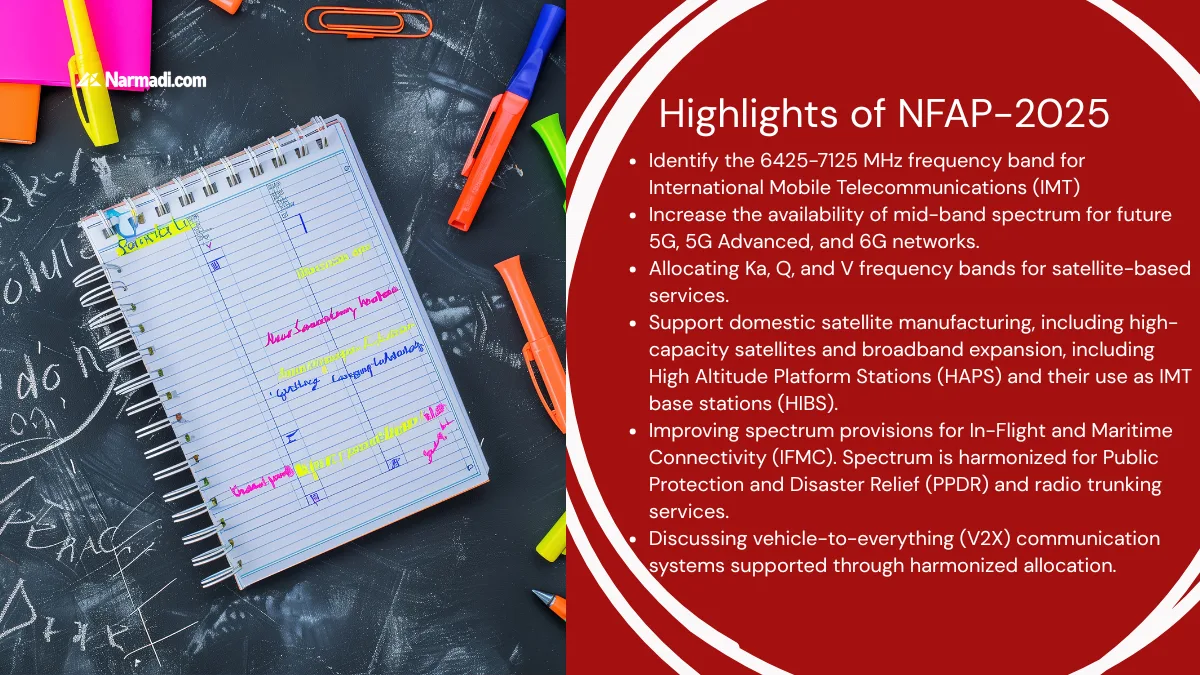
The highlights of NFAP-2025 are new plans to identify the 6425-7125 MHz frequency band for International Mobile Telecommunications (IMT). This will increase the availability of mid-band spectrum for future 5G, 5G Advanced, and 6G networks.
The plan also allocates Ka, Q, and V frequency bands for satellite-based services. This will support domestic satellite manufacturing, including high-capacity satellites and broadband expansion. This includes High Altitude Platform Stations (HAPS) and their use as IMT base stations (HIBS).
NFAP-2025 also improves spectrum provisions for In-Flight and Maritime Connectivity (IFMC). Spectrum is harmonized for Public Protection and Disaster Relief (PPDR) and radio trunking services. Additionally, this document also discusses vehicle-to-everything (V2X) communication systems supported through harmonized allocation.
What is the Purpose of This New Regulation?
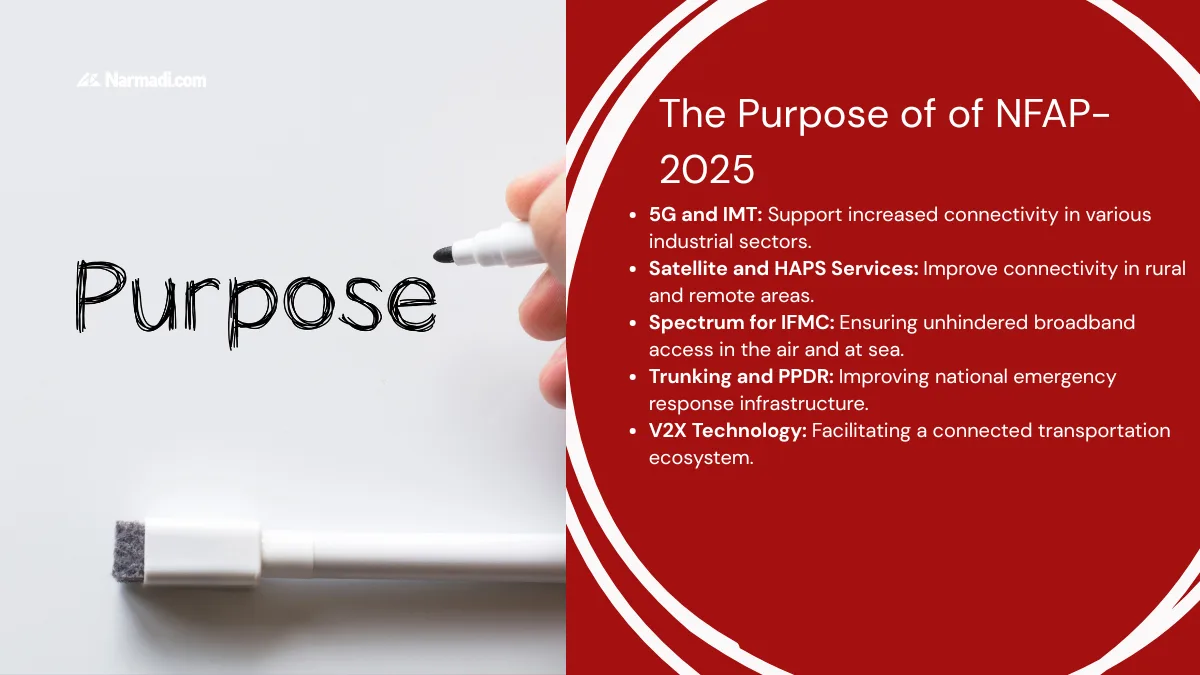
NFAP-2025 was certainly implemented with good intentions by the Indian government. Here are the objectives of each point.
- 5G and IMT: Support increased connectivity in various industrial sectors.
- Satellite and HAPS Services: Improve connectivity in rural and remote areas.
- Spectrum for IFMC: Ensuring unhindered broadband access in the air and at sea.
- Trunking and PPDR: Improving national emergency response infrastructure.
- V2X Technology: Facilitating a connected transportation ecosystem.
Exclusions from Licensing Requirements
NFAP-2025 includes exemptions for innovative consumer and industrial devices such as medical implants, ground-penetrating radar, and wireless sensors. Considering that short-range devices (SRDs), ultra-wideband (UWB) technology, and IoT/M2M communication devices are increasingly using license-exempt spectrum.
The following is a list of frequencies that are exempt from licensing and frequencies that are commonly used for specific applications for India type approval certification:
Wireless equipment exempted from licensing
| No | Frequency Range | Title of the Rule |
| 1 | 9-50 kHz | The use of very low power Radio Frequency devices or equipments including the Radio Frequency Identification Devices, (Exemption from Licensing Requirements) Rules, 2014 |
| 2 | 50-200 kHz | The use of very low power Radio Frequency devices or equipments including the Radio Frequency Identification Devices, (Exemption from Licensing Requirements) Rules, 2009 |
| 3 | 9 – 148.5 kHz 3155-3400 kHz 148.5-5000 kHz 7400-8800 kHz 10200-11000 kHz 5000-30000 kHz | The use of Very Low Power Radio Frequency Devices or Equipments for Inductive Applications (Exemption from License) Rules, 2021. |
| 4 | 13.553-13.567 MHz | The use of very low power Radio Frequency devices for indoor Applications in the 13.553 –13.567 MHz frequency range (Exemption from Licensing Requirements) Rules, 2010 |
| 5 | 26.957-27.283 MHz | The use of very low power equipment in the Citizen Band 26.957 – 27.283 MHz (Exemption from Licensing Requirements) Rules, 2005 |
| Use of Low Power Equipment in the Citizen band 26.957 – 27.283 MHz (Exemption from Licensing Requirement) Amendment Rules, 2006 | ||
| 6 | 36 – 38 MHz | The use of very low power devices or equipments for Wireless Microphones (Exemption from Licensing Requirements) Rules, 2015 |
| 7 | 335.7125- 335.8375 MHz | The use of low power equipment of cranes (Exemption from Licensing Requirement) rules, 2005 |
| The use of low power equipment of cranes (Exemption from Licensing Requirement) Amendment Rules, 2006 | ||
| 8 | 402 – 405 MHz | The use of low power remote cardiac monitoring radio frequency wireless monitoring devices, medical implant communication system (MICS) or medical implant telemetry system (MITS), and other such very low power medical radio frequency wireless devices or equipments (Exemption from Licensing Requirement) Rules, 2008 |
| 9 | 433.05-434.79 MHz | The use of Low Power Radio Frequency Devices in the frequency band 433.05 to 434.79 MHz (Exemption from License) Rules, 2022 |
| 10 | 865-868 MHz | The Use of Low Power Equipment in the Frequency Band 865-868 MHz for Short Range Devices (Exemption from Licence) Rules, 2021 |
| 11 | 2.4-2.4835 GHz | The use of low power equipments in the frequency band 2.4 GHz to 2.4835 GHz (Exemption from Licensing Requirement) Rules, 2005 |
| 12 | 5150 – 5250 MHz 5250 – 5350 MHz 5470 – 5725 MHz 5725 – 5875 MHz | The use of wireless access system including radio local area network in 5 GHz band (Exemption from Licensing Requirement) Rules, 2018 |
| 13 | 76-77 GHz | The use of very low power Radio Frequency devices or equipments for Short Range Radar Systems (Exemption from Licensing Requirement) Rules, 2015 |
| 14 | 456.9-457.1 kHz 6765-6795 kHz 26957-27283 kHz 30-37.5 MHz 87.5-108 MHz 401-402 MHz 405-406 MHz 446.0-446.2 MHz 2400-2483.5 MHz 2446-2454 MHz 2483.5-2500 MHz 5725-5875 MHz 169.4 – 169.8125 MHz 24-24.25 GHz 61-61.5 GHz | The use of low power and very low power Short Range Radio Frequency Devices (Exemption from Licensing Requirement) Rules, 2018 |
| The Use of Low Power and Very Low Power Short Range Radio Frequency Devices (Exemption from Licensing Requirement) Amendment Rules, 2024 | ||
| 15 | Various frequency bands (UWB) | The use of very low power Ultrawideband devices (Exemption from Licensing Requirement) Rules, 2018 |
Commonly used frequencies
| No | Frequency | Purpose | Remarks |
| 1 | 148.5, 148.575, 166.875, 167.725 MHz | Construction and allied industries, including remote control of EOT | Channel bandwidth of 10 kHz. The maximum RF transmitter power for EOT cranes is 1 mW. |
| 2 | 150.3, 150.9 and 151.07 MHz | Onsite radio paging | In the frequency range 150.05-151.5 MHz |
| 151.15, 151.55 and 150.6 MHz | Talk back facility for onsite radio paging | ||
| 3 | 150.525, 151.250 and 166.950 MHz | O.B. Vans & film shooting | |
| 4 | 350.1625, 350.1750, 350.1875, 350.2000, 350.2125, 350.2250, 350.2375, 350.2500, 350.2625, 350.2750, 350.2875, 350.3000, 350.3125, 350.3250, 350.3375, 350.3500, 350.3625, 350.3750, 350.3875, 350.4000, 350.4125, 350.4250, 350.4375, 350.45, 350.4625, 350.4750, 350.4875, 350.5000, 350.5125, 350.5250 and 350.5375 MHz | Short-range radios |