

IP CCTV cameras have become one of the most popular solutions for smart security system needs in today’s digital age.
IP CCTV cameras are internet-based surveillance technology that offers convenience, flexibility, and significantly better image quality than conventional CCTV systems.
Are you familiar with IP CCTV cameras? This article will discuss their definition, how they work, and their advantages.
What is an IP CCTV Camera?
An IP camera, or Internet Protocol camera, is a type of digital security camera that receives and transmits video footage over the Internet.
Unlike analog CCTV cameras, which require coaxial cables and a DVR (Digital Video Recorder), IP cameras operate entirely digitally and can connect directly to a local network or the internet.
IP CCTV cameras connect to the network in the same way as a mobile phone, computer, laptop, tablet, or printer. IP CCTV cameras can be used for a variety of purposes, from homes and small offices to large-scale surveillance systems in buildings or public areas.
In terms of quality, IP CCTV cameras offer clearer footage with resolutions up to 16MP. However, this depends on the camera model used.
How Does it Work?
The following is a general overview of how an IP CCTV camera works:
- High-Quality Digital Image Capture: The camera records video in digital format with high resolution.
- Storage and Bandwidth Efficiency: The recorded video is then compressed to use more efficient bandwidth and storage space.
- Flexible Data Delivery: Video data is transmitted over a LAN (Ethernet) or WiFi network to a storage device such as an NVR, NAS, or cloud.
- Remote Access and Monitoring: Users can view live or previously recorded videos through the app on various devices such as mobile phones, tablets, or computers.
This system allows remote monitoring without needing to be on-site, as long as there is a stable internet connection.
Main Features
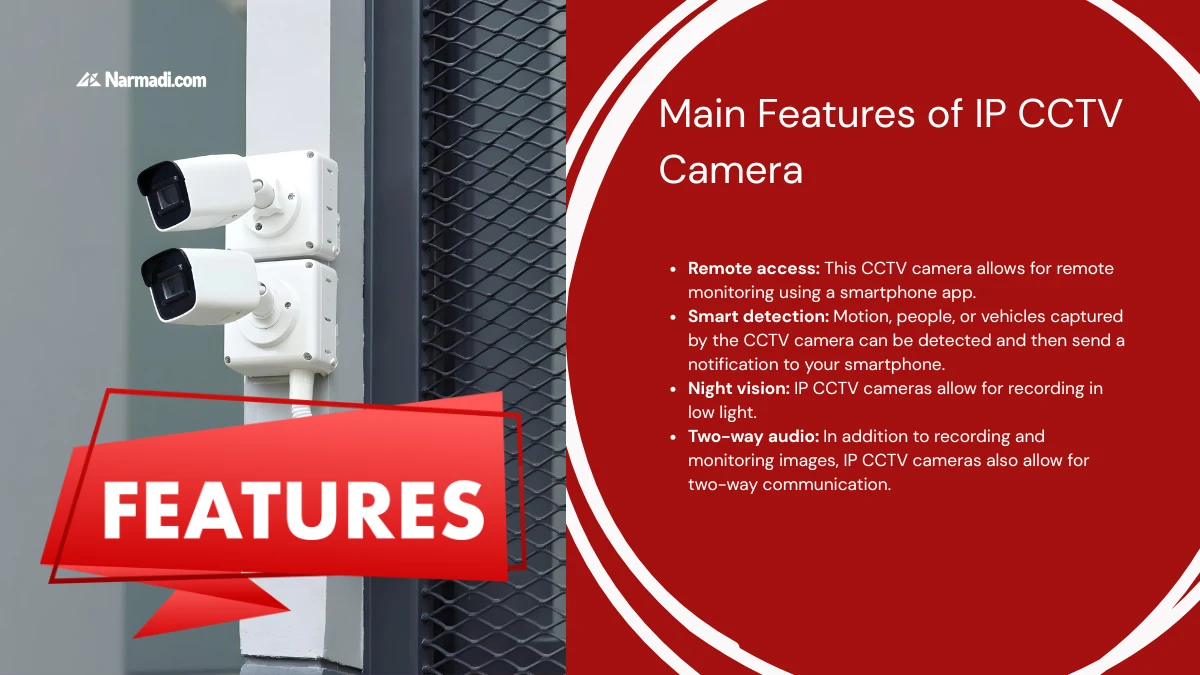
IP CCTV cameras have key features that make them a popular choice. These are the features they offer:
- Remote access: This CCTV camera allows for remote monitoring using a smartphone app.
- Smart detection: Motion, people, or vehicles captured by the CCTV camera can be detected and then send a notification to your smartphone.
- Night vision: IP CCTV cameras allow for recording in low light.
- Two-way audio: In addition to recording and monitoring images, IP CCTV cameras also allow for two-way communication.
The Advantages
Here are some of the advantages of using IP CCTV cameras:
1. High image quality
The advantage of IP CCTV cameras lies in their ability to produce high-resolution video recordings, including HD, Full HD, and even 4K. This superior image quality is very helpful in recognizing faces and important objects in detail.
2. Network connection
Relying on a wired or wireless Ethernet connection (WiFi) and Internet Protocol (IP), IP cameras offer flexible access via a local area network (LAN) or the Internet. This makes it easy for you to monitor your property from any location using internet-enabled devices such as smartphones, tablets, or computers.
3. Easier remote access
You can monitor monitored locations from anywhere via a mobile app or web browser. So, you don’t need to go to the control room to check CCTV footage. You can access CCTV footage via your smartphone or other device, anywhere, anytime.
4. Flexible Storage
IP cameras can use a variety of storage methods, including local storage on an SD card, network-attached storage (NAS), an NVR, or secure cloud storage that can be accessed at any time. You can choose the storage method that best suits your needs and ensures the security of recorded data.
5. Security System Integration Support
To enhance overall security, IP cameras can be connected to a variety of other security systems, including motion sensors, alarms, and automatic door control systems.
The Disadvantages
Here are some of the disadvantages of using IP CCTV cameras:
1. Network security
Although IP cameras are equipped with various security systems, network security remains a concern. This is because the devices are directly connected to the internet.
This makes IP cameras vulnerable to hackers or malware. Therefore, network security must be properly configured.
2. Limited internet range
IP cameras have a limited range. This can be due to limited network coverage. An unstable or slow internet connection can result in degraded image quality. Therefore, a stable and fast internet connection is required.
3. Installation cost
IP cameras are generally lower in cost than analog cameras. However, they have higher installation costs.
IP cameras require an internet connection, so additional devices are needed to connect them to the network. These additional devices include switches or routers.
Those are the definition, how they work, features, advantages, and disadvantages of IP CCTV cameras that you can consider before deciding to use one.
Another important consideration is that IP CCTV cameras on the market use WiFi technology; this technology must pass type approval certification.
This certification allows users to feel confident using devices that guarantee quality and safety. For manufacturers or importers of IP CCTV cameras, obtaining type approval certification is a mandatory step before the device can be officially marketed in each destination country.
To simplify the certification process, you can use our Type Approval Service to assist with this process as a reliable solution. [UN]