

As we all know, telecom certification is a mandatory requirement for marketing devices in a country. Marketing telecom and wireless devices in multiple countries certainly requires a special strategy.
A multi-country telecom certification strategy is needed due to changes in the market landscape, which is now designed for global distribution. The challenges are inseparable from differences in regulations, costs, time, and cross-border complexities.
Many manufacturers, importers, and distributors are unaware that there is no single telecom certification that applies to all countries. This article will help businesses better understand the multi-country strategy, which is more than just a process. By doing so, they will avoid rework, retesting, and delays in going to market.
Table of Contents
What Is a Multi-Country Telecom Certification Strategy?
A multi-country telecom certification strategy is a structured approach to managing telecom certification in multiple countries in a parallel and planned manner. This plan is a comprehensive measure for the efficiency of approvals and certifications required in a country.
The complexity of regulations in each country makes it impossible for a single certification to provide access to all global markets. This strategy unravels these complexities to simplify market access, minimize retesting, and ensure compliance with various technical standards.
Tactical certification vs strategic certification
Implementing a multi-country telecom certification strategy means mapping out the target marketing countries and their applicable regulations from the outset. This approach is planned and integrated into the telecom compliance lifecycle from the early stages.
The strategic approach makes certification planning a competitive asset for efficiency and global market access. Meanwhile, the tactical approach is only about completing certification as a reactive obligation per market.
Tactical certification does not map target markets from the outset, but is usually only prepared after the product is completed or when entering a particular market. This approach is sudden, so it may take longer and cost more.
For global launches, the tactical approach is also less efficient, as it carries a high risk in terms of the certification application process and market entry delays. The telecom certification strategy is more important than just a list of regulations, because it is not only a matter of legal compliance, but also an effort to conquer the market.
Core Pillars of an Effective Multi-Country Certification Strategy
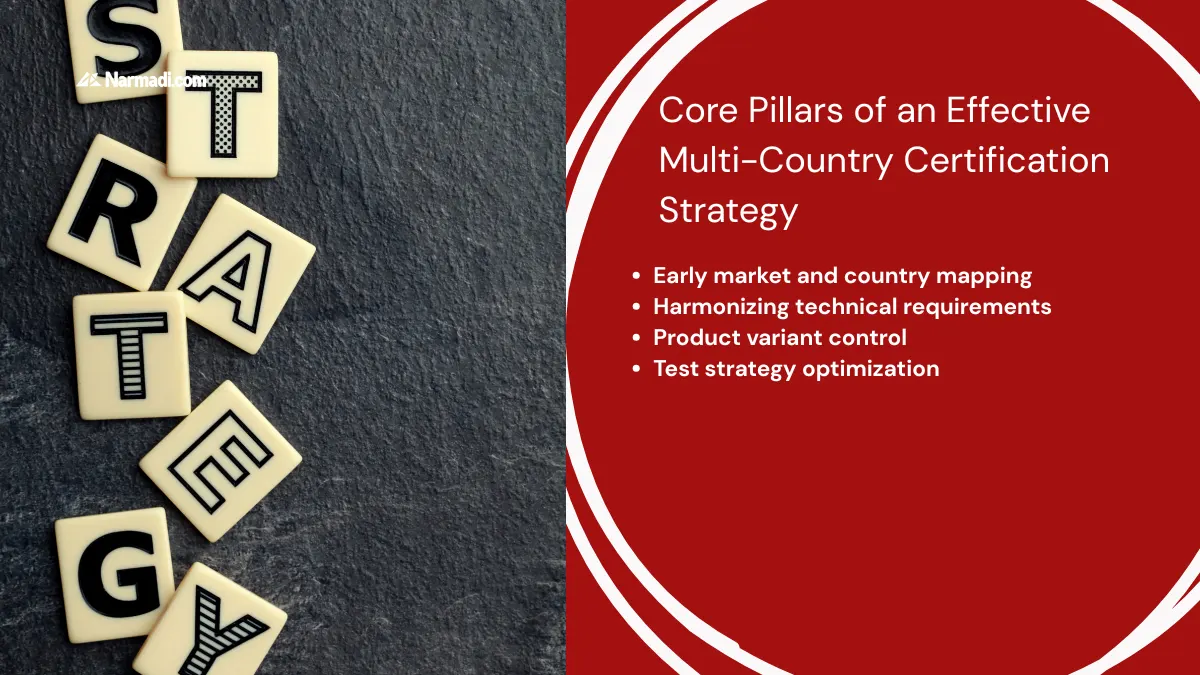
A multi-country telecom certification strategy has several pillars to make the process effective. These pillars help navigate the complexity of different regulations in each country.
This strategy is inseparable from early market and country mapping, harmonizing technical requirements, product variant control, and test strategy optimization. We will break down each pillar so you can understand the multi-country strategy in more detail.
Early market and country mapping
Early market and country mapping is a pillar that focuses on determining target countries from the product planning phase. This will be related to understanding the regulations that apply in the target countries.
This understanding will make it easier for you to obtain telecom certification in those countries. You can start grouping countries based on similar regulatory frameworks and mutual recognition possibilities.
You also need to determine priority markets and secondary markets. The goal is, of course, to accelerate market access, mitigate risks, and effectively understand the competition in those markets.
Harmonizing technical requirements
Harmonizing technical requirements is a pillar that focuses on designing products to meet the most stringent requirements. At this stage, manufacturers will harmonize radio frequency (RF) parameters, electromagnetic compatibility (EMC) design, and safety considerations.
This relates to the harmonization of technical standards for telecom devices that apply at the international level. This allows you to understand international regulations, such as those of the Federal Communications Commission (FCC) or the European Telecommunications Standards Institute (ETSI), that apply in the destination country.
Some countries that apply FCC and ETSI as standards in their countries do not usually conduct local testing. This means that one international test report can be used in several countries. This also reduces the need for redesign in each country.
Product variant control
Product variant control is a pillar that focuses on differences between product variants. At this stage, manufacturers will determine which products can be grouped and which must be tested separately.
This allows you to group the technical documentation for each product. This is key to multi-country approval, as some countries do not accept variant-based test results.
Test strategy optimization
Test strategy optimization is a pillar that focuses on laboratory testing. At this stage, manufacturers will determine which test labs are recognized by many countries and determine an efficient testing sequence. This will avoid unnecessary repetition of tests.
How a Structured Strategy Reduces Cost and Time-to-Market
Implementing a multi-country strategy for telecom certification certainly provides its own advantages for companies. One of these is reducing costs and time-to-market.
Here’s how the strategy reduces cost and time-to-market:
- Fewer retests
- Faster approval in subsequent countries
- Predictable budget & timeline
- Scalability for the next product line
- Direct impact on revenue & supply chain planning
Common Mistakes in Multi-Country Certification Planning

Mistakes are inevitable for manufacturers who do not understand a multi-country telecom certification strategy. To avoid mistakes, you need to be aware of some common pitfalls. Here are some mistakes often made in multi-country certification planning:
- Assuming that one test report is valid globally.
- Not locking in product specifications before testing.
- Ignoring firmware changes after testing.
- Delaying the strategy until the product is ready for mass production.
- Managing certification without a central compliance owner.
The Role of Partners in Multi-Country Certification Strategy
In a multi-country telecom certification strategy, product compliance specialists are needed before the market launch stage. One of the objectives is to facilitate global product marketing.
Partners will facilitate companies in submitting type certification applications. Partners with partners in various countries will make things easier for manufacturers. With just one partner, you can conduct the certification process across multiple countries.
This certainly provides cost benefits and saves time in the certification process, which would otherwise have to be handled individually and sequentially. Having partners also reduces the risk of testing and certification application process failures.
When does a manufacturer need a telecom compliance specialist?
Manufacturers need telecom compliance specialists when complexity increases as the number of target marketing countries grows.
Here are some of the things that product compliance specialists do:
- Identify applicable standards
- Monitor regulatory changes
- Review technical documents
- Prepare application documents
- Manage communication with regulators
- Suggest design changes if necessary
- Assistance with model/variant changes
- Arrange EMC, RF, SAR, and Safety testing in nationally and internationally accredited laboratories
- Provide or act as a local representative (if required by the destination country)
- Assistance for importers/distributors
- Certificate extension/renewal
These are some key points to consider when developing a multi-country telecom certification strategy. This understanding will help manufacturers market their products internationally.
Companies that implement this strategy will have high competitiveness in the global market. This is certainly inseparable from the commitment of the company and its partners, who help make the entire multi-country certification process easier. [UN]