
We born to help you in music production to produce the work you want from songwriting, arrangement, recording, mixing, and mastering.
When people hear music production services, most people think: recording.
A microphone. A studio room. A red “REC” button.
That is understandable. However it is also incomplete.
In Dimulti music production is not a single action. It is a series of decisions, made over time, that shape how a song is written until it is finished and ultimately perceived by listeners. Recording is only a part of a much larger process.
Table of Contents
- What Music Production Services Really Mean?
- The Modern Music Production Ecosystem
- Pre-Production Services: Where Most Songs Are Won or Lost
- What Pre-Production Actually Is
- Arrangement Is a Production Decision, Not a Writing Afterthought
- Tempo and Key: Invisible but Critical Choices
- Demo vs Pre-Production: Not the Same Thing
- The Producer’s Role in Pre-Production
- Why Skipping Pre-Production Costs More Later
- Pre-Production as a Trust-Building Process
- Recording Services: Capturing Performance, Not Just Sound
- Recording Is a Psychological Environment
- Vocal Recording: Where Emotion Is Most Exposed
- Instrument Recording: Precision vs Feel
- The Role of the Recording Engineer
- Recording Does Not Fix Weak Production
- When Professional Studios Truly Matter
- Editing Is Part of Recording But Not a Substitute for Performance
- Music Production & Arrangement Services: Shaping Identity, Not Just Sound
- Mixing Services: Translating Emotion into Balance
- Mastering Services: Final Translation, Not Final Fix
- Additional in the Workflow Chain: The Invisible Work That Shapes Results
- Music Production Services for Different Artist Levels
- Cost, Value, and the Investment Mindset in Music Production
- Choosing the Right Music Production Service Partner
- Music Production as a Long-Term Craft
- Why You Should Work With Dimulti Music?
- Why choose us!
What Music Production Services Really Mean?
(Beyond “Recording a Song”)
Music Production Is a Process, Not a Place.
A common misconception is that music production happens in a studio. In reality, production starts long before anyone steps into a recording room and continues long after the last take is captured.
Production includes deciding what the song is really trying to say. Translating an idea into a structure that works emotionally. Choosing sounds that support the message, not distract from it. Guiding performances so they feel honest, not forced. Refining details that listeners may never consciously notice but always feel.
A professional production does not happen because the gear is expensive.
It happens because someone is responsible for the entire arc of the song.
Recording, Production, and Post-Production Are Not the Same Thing
These terms are often used in vice versa, but they serve very different roles.
Recording is about capturing performances.
Microphones, rooms, signal chains, and technical execution matter here but recording alone does not define the song.
Production is about creative direction and decision-making.
This includes arrangement, sound choices, performance guidance, and overall artistic vibe.
Post-production (editing, mixing, mastering) is about translation.
Turning raw material into a version that works across systems, platforms, and listening environments.
When these stages are blurred or rushed, the result is often a song that sounds “fine” but feels unfinished.
Why Music Production Services Exist in the First Place
Music production services exist because most artists cannot and should not handle every role themselves.
Writing a song and shaping it into a finished record require different skill sets:
Emotional intuition vs analytical listening
Creative spontaneity vs long-term consistency
Personal attachment vs objective decision-making
A production service provides structure, perspective, and accountability.
Not to take control away from the artist. It is to help the artist arrive at a clearer version of their own intent.
Who Is Actually Involved in Music Production?
Even in a minimal setup, music production is rarely a one-person effort.
Common roles include:
- Producer: the creative decision-maker and project guardian
- Recording engineer: responsible for technical capture
- Arrangement or music director: shaping musical structure
- Editor: refining timing, pitch, and performance details
- Mixing engineer: balancing emotion and clarity
- Mastering engineer: ensuring translation across platforms
In smaller or independent projects, some roles may overlap.
But the functions still exist even if one person handles multiple responsibilities.
Understanding this prevents unrealistic expectations and helps artists communicate more effectively with music production services partners. Dimulti Music cover all roles.
Why AI Not Involved in Music Production?
Online software services, yes. AI, no.
AI may be fast, seems know what you need. However in real music production is lack of intuitive.
The broad experience of engineer and we know it is a human able to work whether with pop, rock, r&b, hip-hop and many more. But AI only looking for technical frequency. AI process with algorithm not soul.
In the end of the day we know. Which music has taste. Which one is flat.
The Real Value of Professional Music Producer
The true value of professional music production is not perfection. It is intentionality.
A professionally produced song knows what it wants to be. Make clear creative choices. Avoids accidental compromises. Ages better over time.
It is not necessarily complex. It is not necessarily expensive. But it is rarely accidental.
The Modern Music Production Ecosystem
Music production did not become complex overnight. It evolved. Slowly and often in response to technology rather than artistry.
To understand modern music production services, it helps to step back and look at the ecosystem as a whole: the people, tools, workflows, and economic realities that now shape how music is made.
1. From Centralized Studios to Distributed Workflows
For decades, music production was geographically and financially centralized.
If you wanted to produce a record, you went to the studio. Time was expensive. Access was limited. Roles were clearly defined.
Today, production is distributed.
A song might be written in a bedroom. Arranged in a producer’s home studio. Recorded partly in a professional vocal booth. Edited remotely. Mixed in another city. Mastered in another country.
This does not make production easier. It makes decision-making more important. In Dimulti Music we know that decision in the first place account to the rest stage.
When the process is fragmented, someone must still maintain it artistically. Without that, the result often feels blurry, technically polished but emotionally inconsistent.
2. Independent Artists vs Label-Backed Artists
Modern music production services exist on a wide spectrum, largely shaped by who is funding the project.
| Feature | Label-backed artists | Independent artists |
| Timeline | Structured timelines | Proceed step by step |
| Personnel | Specialized professionals | Combine multiple roles |
| Priority | Scalability and consistency | Balance artistic goals with financial limits |
| Constraints | Operate within commercial expectations | Self-fund their production |
Both methods are equally valid. But they require different production strategies. It is usual in Dimulti Music. We work both with independent and major label artists.
Trying to apply a label-style workflow to an independent budget or an indie workflow to a commercial release. Often leads to frustration on both sides.
3. The Rise of Modular Services
One of the biggest shifts in the industry is the move from fixed “packages” to modular music production services.
Instead of one all-in production deal, artists now choose production only, recording only, mixing only, consulting only, or any combination in between. This modularity gives flexibility but also places more responsibility on the artist to understand what they actually need.
The danger is not under-spending.
The danger is spending on the wrong stage at the wrong time.
Dimulti Music make sure musicians, labels, artists spend on the right decision.
4. Home Studios vs Professional Studios: A Realistic Comparison
Home studios have changed what is possible but not what is necessary.
| Home Studio Pros | Professional Studio Pros |
| Writing and experimentation | Critical vocal recording |
| Pre-production and demo development | Acoustic instruments |
| Editing and programming | Monitoring accuracy |
| Early arrangement decisions | Performance-focused sessions |
| Fast, low-stake revision | Made under strict deadlines |
The most effective modern productions often use both, strategically.
The question is no longer “Which is better?”
It is “Which stage deserves which environment?”
Emerging artists, and settle artist come into Dimulti Music.
We know which environment is right for each stages.
5. Technology Expanded Access Not Responsibility
While tools like DAWs, plugins, and affordable interfaces have made music production more accessible, they haven’t lowered the standard for quality.
Technology enables faster workflows, remote collaboration, unlimited revisions, and experimental freedom.
But it also introduces decision paralysis, endless tweaking, overproduction, loss of emotional focus.
Professional music production services exist to navigate these trade-offs, not to fight technology.
Why the Ecosystem Needs Producers More Than Ever
In a fragmented, modular, and technology-driven ecosystem, the producer’s role becomes less about control and more about cohesion.
A producer today is not just someone who chooses sounds and suggests arrangements but someone who protects the song’s identity, maintains long-term vision, knows when to stop, and understands when less is more.
As the ecosystem grows wider, the need for clear artistic leadership becomes more critical. Not less.
Pre-Production Services: Where Most Songs Are Won or Lost
Pre-production is the least visible stage of music production yet it is often the most decisive.
It does not sound impressive. It does not produce shareable content. It does not feel productive in the way recording does.
Yet many of the problems people try to “fix” later in recording, mixing, or mastering are not technical problems at all. They are pre-production problems.
What Pre-Production Actually Is
Before we actually record a song, the details in music production services give it a really close look.
It asks questions such as what is the emotional center of this song? Does the structure support that emotion? Are the tempo and key helping or fighting the vocal? Which elements are essential and which are simply habit?
This is not about perfection. It is about clarity.
A clear song is easier to record. A clear recording is easier to mix. A clear mix is easier to master.
Arrangement Is a Production Decision, Not a Writing Afterthought
Many artists treat arrangement as something that “happens naturally” once recording starts. In professional production, arrangement is intentional.
Pre-production includes song structure, section length and pacing, dynamic flow across the track, instrument roles per section, and where the listener’s attention should be focused.
A song with a strong arrangement often needs less processing later, because it already communicates clearly.
Tempo and Key: Invisible but Critical Choices
Tempo and key decisions are often underestimated because they are subtle.
A tempo that is slightly too fast can feel rushed. Slightly too slow can drain energy.
A key that is technically singable may still be emotionally wrong. Comfortable in the studio may fail live.
Pre-production allows these decisions to be tested without pressure. Once recording begins, changing them becomes expensive. Financially and psychologically.
Once we hear a song our engineer know what the tempo and key around the song. Dimulti Music involved in wide range production. Technical in music is secondary, but help artist to finish their work come in the first place.
Demo vs Pre-Production: Not the Same Thing
A demo documents an idea. Pre-production refines it.
A demo can be raw, emotional, and incomplete.
Pre-production asks whether that emotion survives repetition, layering, and arrangement.
Many professional productions begin by rebuilding the demo. Not because the demo is bad, but because its strengths need to be translated into a durable form.
The Producer’s Role in Pre-Production
This is where a producer functions less as a technician and more as a creative editor.
The producer’s job is not to impose taste, but to identify what works instinctively, question what exists by default, anticipate downstream problems, and protect the song from overproduction.
Good pre-production often feels uncomfortable.
It involves removing things the artist is attached to but that do not serve the song.
Why Skipping Pre-Production Costs More Later
Skipping pre-production rarely saves time. It postpones decisions until they are harder to change.
Common consequences include endless vocal retakes, arrangement changes during mixing, conflicting creative directions, revision fatigue, budget overruns, pre-production is not a luxury stage. It is a risk-management stage.
Pre-Production as a Trust-Building Process
Perhaps most importantly, pre-production aligns expectations.
It creates shared language between artist and producer, clear artistic boundaries, realistic timelines, and a mutual understanding of “what success sounds like”.
When this stage is done well, the rest of the production feels purposeful rather than reactive.
Recording Services: Capturing Performance, Not Just Sound
Recording is the most visible part of music production services.
This is the point where ideas become solid, measurable, and ready for repeated playback.
Because of that visibility, recording is often misunderstood as a purely technical process. In reality, recording is not about achieving perfect sound. It is about capturing a convincing performance.
Sound quality matters but performance is what listeners connect to.
Recording Is a Psychological Environment
A recording session is not neutral. It affects how an artist performs.
Room acoustics, headphone balance, talkback tone, time pressure, and even lighting influence confidence and delivery. A technically flawless setup can still produce lifeless takes if the environment is not supportive. AI does not need that and it make sense if AI cannot deliver what we are going to listen.
Professional recording in music production services account for this by creating a calm, focused atmosphere, managing session energy, knowing when to push when to stop, and protecting the artist from unnecessary distractions.
The best recordings often happen when the artist forgets they are being recorded. That is how Dimulti Music works.
Vocal Recording: Where Emotion Is Most Exposed
Vocals reveal everything such as timing, pitch, breath, emotion, and intention.
Recording vocals is not just about microphone choice, preamp quality, and noise control.
It is about coaching phrasing, managing fatigue, choosing the right moment for a take, and allowing imperfection when it serves the song.
A technically “clean” vocal that feels emotionally flat is not a successful recording.
Instrument Recording: Precision vs Feel
Instruments introduce a different challenge.
Some parts demand precision.
Others rely on feel and interaction.
Dimulti Music stand in both.
Professional recording services understand when to record live together, when to isolate for control, how to balance consistency with human variation, and how many takes are enough.
More takes do not automatically mean better results. Often, the best take is early before overthinking sets in.
The Role of the Recording Engineer
The recording engineer’s responsibility is often misunderstood.
Their job is not only to set levels, avoid clipping, and capture clean signals.
It is to ensure that nothing technical interferes with performance.
A good engineer is invisible when everything works and invaluable when something goes wrong.
Recording Does Not Fix Weak Production
Recording amplifies whatever decisions came before it.
Strong pre-production leads to efficient, focused sessions.
Weak pre-production leads to endless retakes, arrangement doubts mid-session, vocal strain, frustration disguised as “perfectionism”.
Recording cannot solve uncertainty. It can only reveal it.
When Professional Studios Truly Matter
Not every part of a song needs a professional studio. But certain moments benefit disproportionately from one.
Professional recording environments excel when capturing lead vocals, recording acoustic instruments, tracking live ensembles, making irreversible performance decisions.
These are moments where commitment matters. Professional spaces encourage commitment.
Editing Is Part of Recording But Not a Substitute for Performance
Modern recording workflows include editing, namely timing correction, comping, and cleanup. These are tools, not crutches.
Editing should support the performance, preserve natural phrasing, and still remain invisible to the listener.
When editing becomes the main method of “fixing” a recording, something earlier in the process has likely been overlooked.
Music Production & Arrangement Services: Shaping Identity, Not Just Sound
If recording captures what happened, production and arrangement decide what should happen.
This is the stage where a song stops being an idea and starts becoming an identity. Every sound choice, musical decision, and structural adjustment contributes to how the listener understands the song and often within the first few seconds.
Production vs Arrangement: Closely Related, Not Identical
| Aspect | Arrangement | Production |
| Primary Focus | Structure and musical roles. | Includes arrangement along with wider artistic components. |
| Key Activities | Instrument selection, section evolution, dynamics, tension/release. | Sound selection, tone shaping, genre interpretation, sonic references, artistic consistency. |
Arrangement answers how the song moves.
Production answers how the song feels.
Dimulti Music answers what you desire.
Genre Is a Language, Not a Formula
In music production services, every genre has a unique style but they are guidelines, not rules.
Professional music production services understand genre as a shared language. What listeners subconsciously expect, which elements signal familiarity, and where innovation is welcome yet it knows where it distracts.
Blindly copying trends often results in music that sounds dated quickly. Ignoring genre entirely often results in music that struggles to connect.
The goal is fluency, not imitation.
Sound Selection: Fewer Choices, Stronger Identity
Modern music production services offers unlimited sounds but identity is built through limitation.
Strong productions often rely on a consistent sonic palette, intentional repetition, clear contrast between sections, restraint in layering.
Adding more elements rarely increases impact.
Removing the right elements often does.
Live Instruments vs Programmed Elements
This is not a philosophical debate. It is a practical one.
| Live Instruments Offer | Programmed Elements Offer |
| Natural dynamics | Precision |
| Human interaction | Repeatability |
| Organic imperfections | Control |
Professional music production services choose based on context, not ideology. Many modern productions use both but are still carefully integrated.
Dynamics: The Most Underrated Production Tool
Dynamics are not just about loud and quiet. They are about attention.
Production decisions control when the listener leans in, when energy peaks, and when space is allowed.
Songs that feel “flat” often suffer from dynamic sameness, not poor sound quality.
Consistency Across the Song
A common mistake in arrangement is treating each section as a separate idea.
Professional arrangement maintains motif continuity, sonic cohesion, and emotional throughline.
Surprises are effective only when they feel earned.
The Producer as Artistic Gatekeeper
At this stage, the producer’s role is not to add ideas endlessly but to protect the song from dilution.
This includes saying no to unnecessary layers, maintaining clarity of direction, recognizing when the song is finished.
Finishing is a skill.
Mixing Services: Translating Emotion into Balance
Mixing is often described as “making everything sound good together.”
Let’s make it clearer.
A better way to understand mixing is this: mixing translates intention into perspective. It determines where each element sits, how it interacts with others, and how the listener experiences the song emotionally.
Each partner has unique workflow. As a music production services, Dimulti Music make sure what you need. Make the outcome can deliver to the audiences technically right and artistically well.
Mixing Is About Relationships, Not Individual Sounds
In isolation, almost any sound can be made to sound impressive.
In context, only a few elements can lead at any given moment.
Mixing establishes relationships between foreground vs background, stability vs movement, intimacy vs distance.
A mix that treats every element as equally important often feels cluttered, even if it is technically clean.
Clarity, Loudness, and Emotion Are Different Goals
One of the most persistent misconceptions is that mixing is about loudness.
Loudness is a consequence not a purpose.
Professional mixing prioritizes:
- Clarity: the message is understandable
- Balance: elements support rather than compete
- Emotion: the song feels intentional
A mix can be loud and empty.
It can also be restrained and powerful.
Monitoring Environment Matters More Than Plugins
Mixing decisions are only as good as what the engineer can hear.
Accurate monitoring allows honest balance decisions, reliable translation across systems, and confidence in low-end and dynamics.
This is why mixing is often separated from recording even in the same studio. Fresh ears and a controlled listening environment matter more than endless processing options.
Why Mixing Cannot Fix Bad Production
Mixing reveals structure. It does not redesign it.
Common issues that mixing cannot fix is overcrowded arrangements, conflicting musical roles, inconsistent performances, and unclear emotional direction.
When mixing feels like a struggle, the problem often started earlier in arrangement or production.
Revision Culture: Productive vs Destructive
Revisions are a normal part of mixing. Endless revisions are not.
| Healthy Revisions | Destructive Revisions |
| Are guided by clear references | Chase uncertain feelings |
| Address specific issues | Contradict earlier decisions |
| Move the mix forward | Strip personality in pursuit of neutrality |
In Dimulti Music we know that professional mixing services help define when a mix is finished, not just when it is “acceptable.” Music production services made the process chase clarity not blurry.
Translation: The Real Test of a Mix
A successful mix works across:
- Headphones
- Car speakers
- Phone speakers
- Professional systems
No mix sounds identical everywhere. The goal is consistency of intent, not sameness of sound.
If the emotion survives different environments, the mix has done its job.
Mastering Services: Final Translation, Not Final Fix
Mastering is the most misunderstood stage of music production.
It is often described as the step that “makes the song professional,” “makes it loud,” or “fixes the mix.” In reality, mastering does none of those things on its own.
Mastering is about final translation. Ensuring that a finished mix holds together across platforms, systems, and contexts.
What Mastering Actually Does
At its core, mastering answers one question:
Does this song behave as intended everywhere it is played?
Mastering focuses on overall tonal balance, dynamic control, loudness consistency, playback reliability, and format preparation.
It works on the song as a whole not on individual instruments.
Mastering in the Streaming Era
Streaming platforms changed the rules but not the purpose.
Normalization has reduced the loudness war, but it has not removed the need for mastering. Instead, it has shifted the focus toward dynamic integrity, clarity at normalized levels, avoiding distortion after platform processing, and consistency across a release.
A master that sounds impressive at extreme loudness but collapses when normalized is not a good master.
Mastering Is Not a Repair Tool
| Mastering Cannot | Results of Attempting Mastering as a Repair Stage |
| Fix poor arrangement | Over-compression |
| Redesign a mix | Harshness |
| Replace missing low-end | Loss of depth |
| Add emotion that isn’t there | Listener fatigue |
A good master respects the mix.
A great master preserves its intent.
The right mastering services able to do the work both in the studio and online mastering.
That is Dimulti Music.
Human Mastering vs Automated Mastering
Automated mastering tools have improved dramatically. They are useful for specific situations.
| AI Mastering | Human Mastering |
| The mix is already balanced | Artistic judgment is required |
| The goal is speed | Translation across diverse systems is critical |
| Consistency is more important than nuance | Subtle tonal decisions matter |
| Mostly lack of soul | The release has long-term value |
This is not about superiority.
It is about context and responsibility.
How come AI can be responsible. We know that the disclaimer itself, “AI can make mistake.” And musician know where the place to come, Dimulti Music.
Album and Project-Level Mastering
For multi-song releases, mastering is not just about individual tracks.
It also ensures cohesive loudness across songs, consistent tonal identity, logical flow between tracks, intentional pacing.
Skipping this perspective often results in releases that feel fragmented even if individual songs sound fine.
When Mastering Might Be Unnecessary
There are cases where mastering adds minimal value:
- Internal demos
- Early-stage references
- Non-release materials
Knowing when not to master is also part of professional judgment.
Additional in the Workflow Chain: The Invisible Work That Shapes Results
Not all music production services are obvious.
Some of the most impactful work happens quietly without recognition, without credit, and often without the artist realizing how much it influenced the final result.
These services rarely define a song on their own, but they frequently determine whether a production feels unfinished or complete.
Vocal Editing and Tuning: Support, Not Replacement
Vocal editing is often misunderstood as a shortcut or a form of deception. In professional contexts, it is neither.
Proper vocal editing includes comping multiple takes into a coherent performance, timing adjustments that preserve phrasing, pitch correction that supports expression, not sterilizes it, and breath noise management.
The goal is not perfection. The goal is listenability without distraction.
When editing draws attention to itself, it has failed.
Session Musicians: Precision, Feel, and Efficiency
Session musicians bring musical fluency, genre awareness, fast adaptation, and performance confidence.
They are not hired because artists lack talent but because certain parts demand specific execution.
A single well-played part can replace hours of layering and processing. Except the player astonishingly talented musicians. We know in the industry that some musicians are gifted.
Music Programming and Sound Design
Programming is not just about using virtual instruments. It is about intentional detail.
This includes velocity shaping, articulation control, groove refinement, layer management, and custom sound creation.
Good programming often feels invisible. Bad programming is instantly noticeable. Right programming in DImulti Music know how turn MIDI into intentional sound design.
Production Consulting and Creative Direction
Not every project needs full music production services. Some need guidance.
Production consulting can include song evaluation, direction-setting sessions, reference analysis, workflow planning, and budget prioritization.
This service is especially valuable for independent artists navigating production choices alone.
Project Management in Music Production
As productions become modular and distributed, coordination becomes critical.
Project management ensures:
- Clear timelines
- File version control
- Communication flow
- Decision accountability
This role is often overlooked until something goes wrong.
Why These Services Are Often Undervalued
These services do not produce dramatic before/after clips, are difficult to market, and work best when unnoticed.
Yet removing them often exposes weaknesses elsewhere in the music production services.
Professional releases feel effortless because someone handled the invisible work.
Music Production Services for Different Artist Levels
Not every artist needs the same music production services at the same time.
Problems arise when expectations are mismatched when the level of service does not align with the artist’s stage of development or release goals.
Professional production is not about hierarchy. It is about readiness and intent.
Beginner Artists: Learning Through Structure
Beginner artists are often focused on expression. Music production services at this stage should prioritize foundation, not polish.
What matters most is understanding song structure, developing performance confidence, learning basic production vocabulary, experiencing a complete workflow.
Overproduction at this stage can be counterproductive. The goal is not to sound expensive, it is to sound honest and coherent.
Serious Independent Artists: Building Identity and Consistency
Serious independent artists are often the most complex to serve. They have vision but limited margin for error.
Key production needs include clear artistic direction, arrangement refinement, consistent sonic identity, efficient recording workflows, strategic use of professional studios.
At this level, production choices begin to affect branding, audience perception, and long-term credibility.
Commercial and Label-Ready Artists: Scalability and Precision
For commercial releases, music production services must support repeatability and scale.
Priorities shift toward tight timelines. Clear division of roles. High translation reliability. Market awareness. And we come to the most distinctive thing, long-term catalog cohesion.
At this level, music production services is not just creative, it is operational.
Why Mismatched Services Cause Frustration
Common mismatches are beginner artists expecting commercial polish without foundational work. Independent artists skip pre-production to save costs. Commercial projects treating music production services as experimentation.
These mismatches waste time, money, and emotional. Dimulti Music can manage energy to turn the idea into right music. Work with us and save your intangible resources.
Good music production services help align ambition with process.
Growth Is Not Linear
Artists do not move cleanly from one level to the next. Growth happens in phases.
Professional music production services adapt to specific songs, not just careers. Individual strengths and weaknesses. Changing goals.
The most effective collaborations evolve over time.
Cost, Value, and the Investment Mindset in Music Production
Music production services pricing is one of the most emotionally charged topics in the industry.
Not because of its expense, but because it lacks transparency.
Two projects can cost wildly different amounts and both be justified. The confusion comes from treating production as a product, rather than a responsibility.
Why Music Production Costs Vary So Widely
There is no single “correct” price for music production because production is not a single task.
Costs are influenced by:
- Time commitment
- Level of creative responsibility
- Experience and judgment
- Revision scope
- Project complexity
- Risk carried by the production team
A producer is not just selling hours. They are accepting accountability for outcomes. The result of Dimulti Music works waiting you in the last of the article.
Time Is the Least Expensive Part
Many artists assume they are paying for studio time or technical labor. In reality, those are often the smallest components.
What costs more is decision-making under pressure. Anticipating problems before they happen. Knowing when to stop. Protecting long-term artistic direction.
These are skills built over years, not tools purchased once.
Cheap, Efficient, and Effective Are Not the Same Thing
Low cost does not equal low value. High cost does not guarantee quality.
The most expensive mistake is not paying too much, it is paying for the wrong thing.
Effective music production services spends resources where they matter most, even if that means spending less overall.
Why “Fix It in Mixing” Is an Expensive Belief
Trying to defer decisions increases costs later.
Each delayed decision made limited options, increased revision time, reduces clarity, and introduced fatigue.
Early investment in pre-production and direction often reduces total cost—even if the upfront expense feels higher.
Transparency Builds Trust
Professional music production services are clear about what is included, what is not, revision boundaries, deliverables, responsibilities.
Vague pricing often hides vague processes.
Production as an Investment, Not an Expense
An investment mindset asks:
Will this decision still make sense in five years? Does this serve the song’s identity? Does this improve long-term credibility?
Music that lasts rarely comes from rushed decisions.
Choosing the Right Music Production Service Partner
At a certain point, music production services decisions stop being technical.
They become relational.
You are no longer choosing sounds or studios. You are choosing people who will influence how your work is shaped, interpreted, and finished.
Beyond Portfolios: Compatibility Matters More Than Credits
A strong portfolio shows what someone can do. It does not show how they work with you.
A good production partner will listen before directing, asks questions instead of imposing answers, explains decisions clearly, knows when to push, and when to step back.
Misalignment rarely fails loudly. It fails quietly through misunderstandings, frustration, and compromised results.
Process Transparency Is a Professional Signal
Professional music production services partners are clear about workflow stages, decision points, revision boundaries, and communication expectations.
Transparency reduces emotional friction and protects the song from reactive changes.
If the process feels vague, the outcome often will be too.
Experience Is Not Just About Time, It’s About Exposure
Working across many projects exposes producers to patterns.
What consistently works. What fails quietly. Where artists struggle most. Which decisions matter long-term.
This kind of experience cannot be learned from a single successful release.
A Real-World Perspective: Dimulti Music
In practice, long-term production insight comes from volume, diversity, and responsibility.
Through handling hundreds of projects, both domestically and internationally, Dimulti Music has been involved in a wide range of music production services contexts such as independent artists building identity, serious releases requiring consistency and scalability, cross-border collaborations with different workflows and expectations.
Novia Bachmid – YaLLa
Afrobeat and Southeast Asian music blended in one song. We work with one of the most big artist in Indonesia to turn the team idea into music. The major label team want to blend both elements. Dimulti Music do what they need.
Novia Bachmid – Get It Wrong
From Afrobeat to EDM. Dimulti Music does not judge the diverse style. We always have conversation and ask what the goals. And we make this track.
Dion – Hypnotized
Afrobeat, EDM? Now we work with Jazz music. Dimulti Music know how to work with any genre. And Dion is the one of Indonesian Idol artist.
Yoda – Mad King
Rock and Hip-hop become one song. Genre is not a border. Dimulti Music can handle any mood and genre. Yoda is the runner up of Indonesian Idol and the last male artist in this competition.
Tovan
One of Dimulti Music artist that make any genre of music. R&B, Hip-hop, Rock, and more.
That exposure shapes how decisions are made. Not based on theory, but on outcomes.
Some projects have gone on to contribute to internationally recognized, world class award-winning productions, including work associated with producers operating at the highest global level. These experiences reinforce a simple truth: great results come from systems, not shortcuts.
Grammy Winning
Dirt is one of the song in Lecrae’s Album that won Grammy Awards. Dimulti Music’s producer work in ghost producing in his work.
With Dimulti’s music production services, you can have music with a variety of genres, and we have hip-hop producer to work with you supported by an experienced team with industry standards.
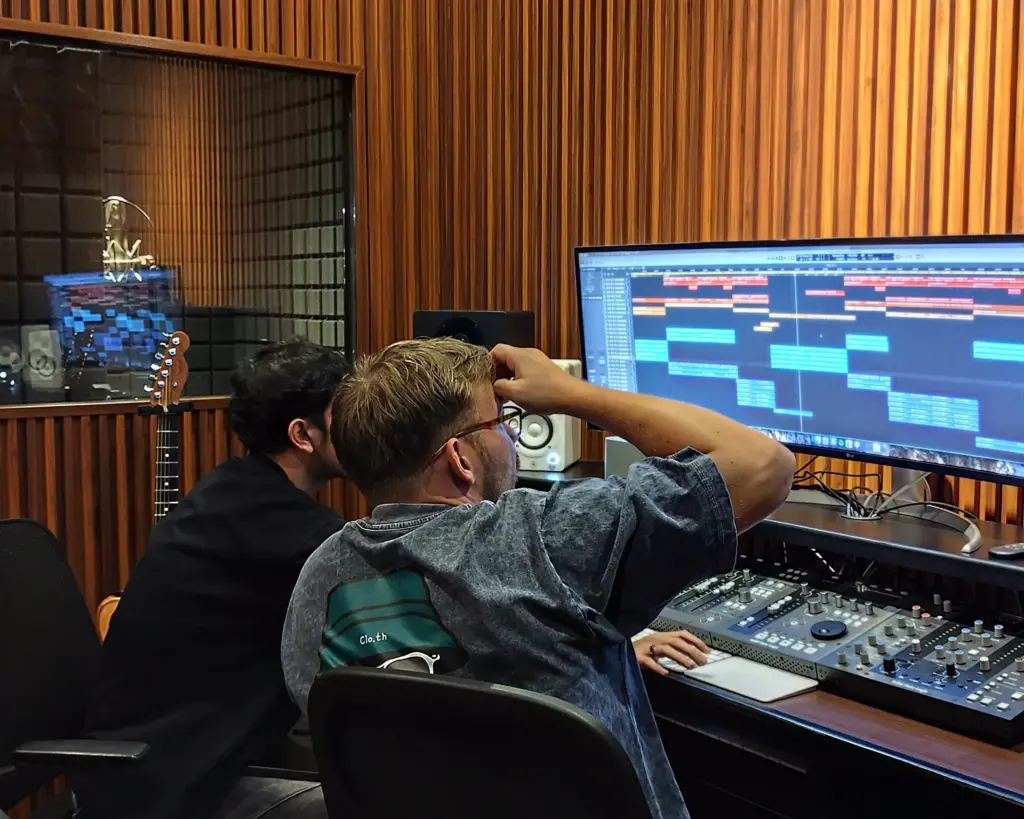
One of overseas artist bring his idea to Dimulti Music studio and work with us. Our producer know how to handle the culture of music also the technical in music.
Short audio samples of our work in music production.
For you who want to have music production services, we are ready to help you to create great music with some service from songwriting services, jingle music making, march music making, music making services for movies, philosophical music for company, music for marketing purposes, music for the brand booster, to audio creator for products and services.
What Long-Term Collaboration Really Offers
Over time, a trusted music production services partner will understand your artistic language. Anticipates your blind spots. Protect your identity under pressure. Helps you finish, not just start
This is especially important as projects grow more complex.
Choosing for the Long Run
The right production partner always respects your intent, challenges your assumptions, and shares responsibility for outcomes.
Not every project requires the same depth of collaboration but every serious project benefits from clarity.
Music Production as a Long-Term Craft
Music production is often framed as a means to an end: a finished song, a release date, a streaming number. Those things matter but they are not the craft itself.
The craft lives in the decisions that are repeated over time.
Production Is Where Identity Becomes Audible
An artist’s identity is not defined by one song.
It is shaped by patterns. How emotion is handled. How restraint is practiced. How clarity is chosen over excess. How consistency is maintained.
Listeners may not articulate these patterns but they feel them.
Production is the mechanism that turns intention into something recognizable.
Why Good Productions Age Well
Trends move quickly. Well-made records move slowly.
Productions that last tend to share certain qualities namely clear emotional focus, intentional arrangement, respect for dynamics, and decisions made for the song, not the moment.
They are not frozen in time. They are grounded in purpose.
Patience Is a Technical Skill
In professional production, patience is not passive.
It means allowing ideas to develop, making fewer, stronger decisions, knowing when not to change something, and recognizing when a song is finished. Dimulti Music work with this skillset. We know when to start and end.
Rushing often feels productive. It rarely sounds that way later.
Trust as a Production Tool
Trust is rarely discussed as a technical element but it shapes every session. Trust allows honest feedback, risk-taking performances, decisive editing, and creative restraint.
Without trust, production becomes defensive. With trust, it becomes focused.
Professionalism Over Virality
Viral moments are unpredictable. Craft is not.
Professional music production does not chase attention. It builds credibility. Over time, credibility compounds.
Songs made with care will travel further than expected, reach listeners you never planned for, and represent you accurately when you are not in the room.
The Quiet Advantage of Doing It Right
The most meaningful benefit of professional production is not external validation.
It is the confidence that the song says what you meant. The work reflects your standards. The result will still make sense years from now.
That confidence changes how you create the next song.
Why You Should Work With Dimulti Music?
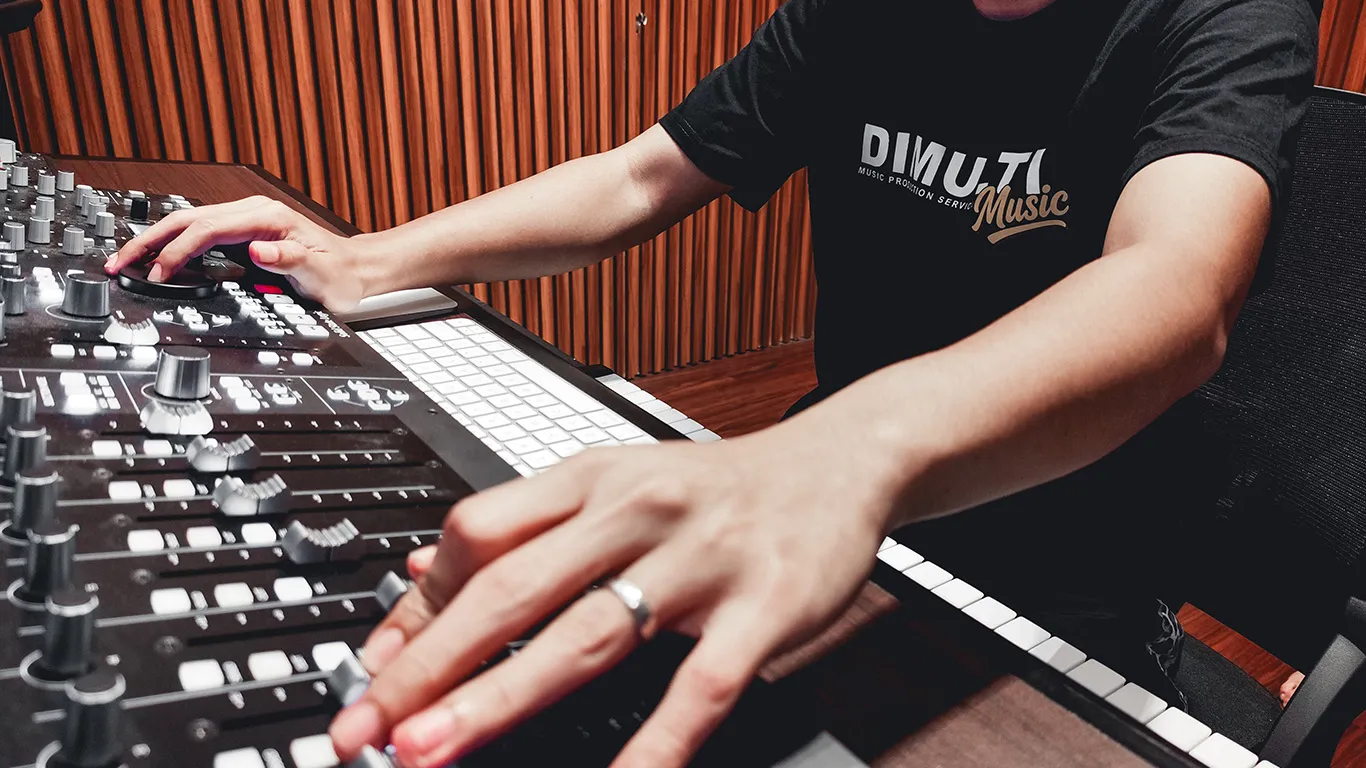
The gear that we use is industry standard. The producer and engineer know what you need. We involved in wide range of projects.
We work with human and deliver to human. AI does not listen to anything. The machine only analyze algorithm. We know which one has soul. And you come to the right place. Dimulti Music.
Music production services are not about making music louder, cleaner, or more impressive.
They exist to protect intent, clarify direction, and help artists finish work they can stand behind.
Everything else is secondary.
Contact Us
Feel free to contact us. We will make sure to connect you to the right person.
Why choose us!
Here are some strong reasons why you should choose us as your business partner.