Understanding the Principles of Drone Operation
There are several principles of drone operation. The first is communication between the vehicle with the control headquarter. The second is loop…
There are several principles of drone operation. The first is communication between the vehicle with the control headquarter. The second is the loop principle.
It’s always interesting to talk about something new, especially in technology. And continuing our previous article (Drone Definition of Unmanned Aerial Vehicle Era), now we are going to talk about Drone operation.
It is already stated before that this technology has so many good and bad things. The good things are that a Drone can be used to get aerial visuals, to carry logistic, and to rescue victim of natural disasters.
Besides, there is still so much functionality that we can get from this innovative vehicle. Some of them are for the military use, rare animal tracking, etc. But, behind all that functionality, this technology also brings controversy.
Some people strongly reject the use of this unmanned aerial vehicle due to certain issues. And before we talk further about that, let’s find out the main principle of a Drone.
How a Drone Gets to Work
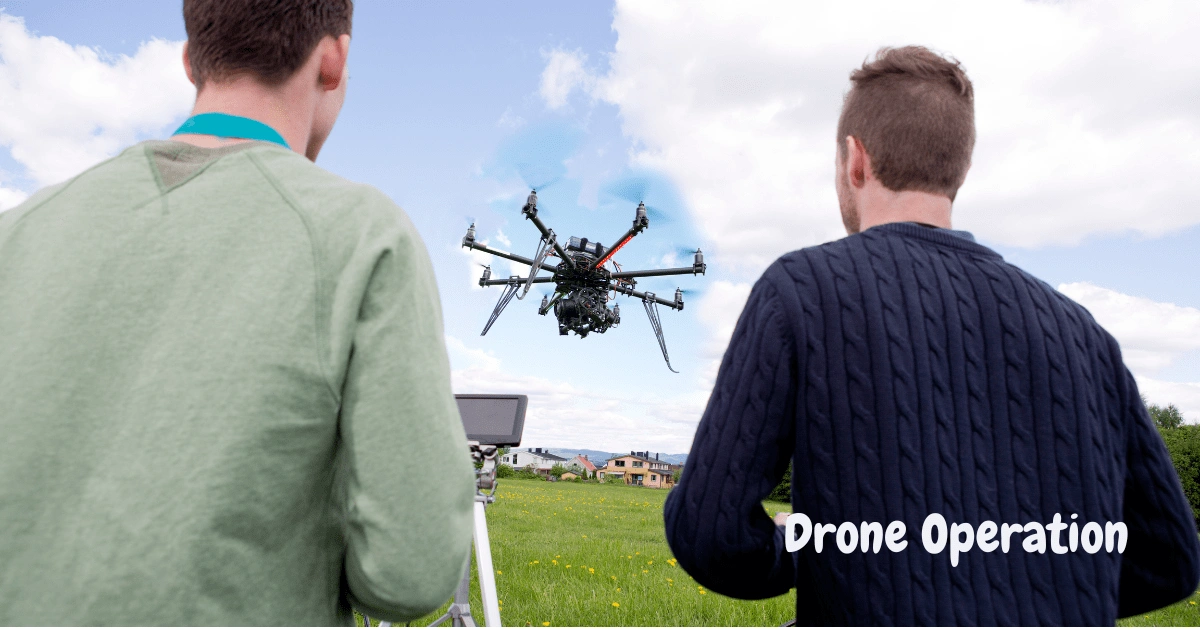
Before knowing the operation system of a drone, it will be better for us to understand the main parts of it. Usually, this unmanned aerial vehicle has six main body parts.
They are Body, Platform and Power Supply, Computing, Actuators, Sensors, and Software. All of these parts are working together to result in the integrated system of unmanned vehicle.
Body Parts
First thing and the most basic one is the body. The body of a drone is different from the body of manned plane. It doesn’t have any cockpit or even windows. Generally it has rotary wings and tailless Quadcopters.
The second is about platform and power supply. As the power supplier, a drone usually employs LiPo batteries. While for the platform, large unmanned aerial vehicle sometimes uses the engine of conventional airplane.
In the computing sector, a drone employs analog controls or even the advanced microcontrollers. Further, we can find a Single-Board-Computer and System-On-Chip in it. And also, don’t forget about the sensors.
Some sensors such as exproprioceptive, exteroceptive, proprioceptive and others will gather the information needed by the headquarters. While to do other functions like speed control, propeller, lights, weapon, speaker, etc., this vehicle employs the Actuators in it.
And the last main part is the Software. Software plays a big role in controlling a drone. This software is generally related to the autopilot system. This is a complex system that needs a fast response to employ the data from sensors. Some software such as Xenomai, Ocoros-Robot OS, DDS-ROS, and Nuttx, are the common software in running a drone.
Principles of Drone Operation
There are several principles that should be followed to make a drone work smoothly. The first principle is communication. This is a principle related to the communication between the vehicle with the control headquarter.
In applying this principle, most devices employ Radio Frequency. Besides controlling the aerial vehicle, this radio frequency can also be used in data transferring from the sensors to headquarter.
The second one is loop principle. Most of the drone devices using close-loop, open-loop, or even hybrid loop. The open loop here provides the positive control (left, right, slow, fast, up, down) of the signal without needing feedback from sensors.
While the close-loop, it employs feedback from the sensors to adjust the action (increasing and decreasing speed, moving altitude, etc.) to the recent condition.
The last principle is Flight control, this is the similar principle in manned aviation. It controls something like flight dynamics, automation and unautomation, multirotor dynamics of the flight, and other parameters. Through this principle, we can set the drone to do certain maneuver, landing, perching, and climbing.
Drone Operation at a Glance
To sum up, here are the main parts and principles that make a drone work:
- Six main parts: Body, platform and power supply, computing, actuators, sensors, and software.
- Communication: Most drones use radio frequency to connect with the control headquarters and send sensor data.
- Loop principle: Open-loop, close-loop, or hybrid-loop control.
- Flight control: Manages flight dynamics so the drone can maneuver, land, perch, and climb.
Frequently Asked Questions
What kind of battery does a drone usually use?
Drones usually employ LiPo batteries.
What is the difference between open-loop and close-loop?
Open-loop controls the drone without feedback from sensors, while close-loop uses sensor feedback to adjust its actions.
Does a drone need certification in Indonesia?
Since it uses radio frequency, DJID Type Approval needs to be considered before bringing it into Indonesia.
In closing, we believe that this unmanned aerial vehicle technology will be very useful especially in Indonesia. And also, this country is considered as the prospective market place for this technology.
So, if you are a manufacturer, distributor, or importer who are about to bring it in, considering applied regulation is a must. In this case, you should consider the DJID Type Approval.
For more information about this Type Approval, you can contact us. Finally, we hope it could be useful, and the application of this tech could bring goods for life.