

On February 2, 2026, Singapore, through the Infocomm Media Development Authority (IMDA), released a draft of the Technical Specifications for CMT (Cellular Mobile Terminals). This draft was released as a forum for industry stakeholders to provide input and feedback.
This latest 2026 revision is the fourth revision of the Technical Specifications for CMT. The third revision was made in September 2024.
The Technical Specifications for CMT have undergone several revisions due to certain adjustment requirements in Singapore. These changes will certainly affect related industries, so the government needs public comments to ensure the perfection of the latest regulations.
Scope CMT
Technical Specifications for CMT cover its use in Public Mobile Communication Systems and several services. It covers three main categories, namely:
- ITU IMT-2000 radio interface technologies
- ITU IMT-Advanced radio interface technologies (LTE-Advanced)
- LTE-Advanced technology series from 3GPP
- ITU IMT-2020 radio interface technologies (5G NR)
CMT includes handheld, portable, and vehicle-mounted equipment, as well as RF interface cards and modems.
Main Revision of Technical Specifications for CMT
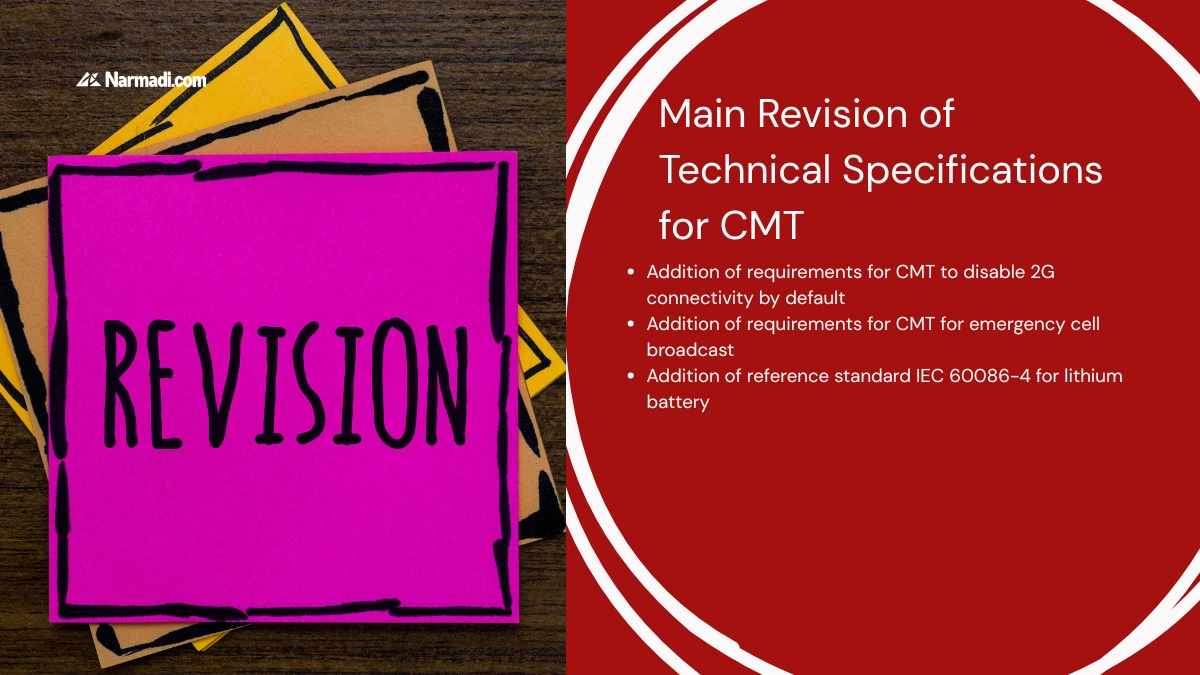
The Draft Technical Specifications for CMT have three major revisions. These revisions include requirements for 2G connectivity, specifications for Cell Broadcast Services, and new standard references for lithium batteries.
Requirements for 2G connectivity
The draft Technical Specifications for Cellular Mobile Terminals (CMTs) includes additional requirements to disable 2G connectivity in the factory default configuration. CMTs must also not connect or attemptto connect to 2G networks by default.
2G connectivity is only allowed if it is explicitly enabled by the user. Additionally, 2G activation must require deliberate user action, such as accessing the settings menu or entering a confirmation prompt.
Specifications for Cell Broadcast Service
The Draft Technical Specifications for CMT also adds requirements for emergency cell broadcast services. The following table shows the CMT configuration used for Cell Broadcast Services, including the type of alert, message ID, and device behavior.
| Configurations | Types of alert | |
| Alert title behaviour | ||
| Alert Title | SG Alert | Test Alert |
| Message ID | 4370 | 4380 |
| Message ID in additional language | 4383 | 4393 |
| Language filtering | On | On |
| Menu setting | ||
| Enabled by default | Yes | No |
| Allow user opt-out | No | Yes |
| Sound and Vibration | ||
| Override “Do not disturb mode” | Yes | Yes |
| Alert volume | Max Volume | Device setting |
| Alert notification duration | 10.5 sec | 10.5 sec |
| Alert vibration | See 5.4.1.12 for vibration pattern | See 5.4.1.12 for vibration pattern |
| Alert tone | See 5.4.1.12 for audio attention signal | See 5.4.1.12 for audio attention signal |
New standard references for lithium batteries
Finally, the draft Technical Specifications for CMT also adds the IEC 60086-4 reference standard for lithium batteries. Previously, for equipment safety testing, devices only needed to comply with the IEC 62368-1 standard (minimum edition No. 2), while lithium batteries were required to comply with UL 1642 and IEC 62133.
Therefore, currently, equipment safety testing for lithium batteries can comply with UL 1642, IEC 62133, or IEC 60086-4. The inclusion of this additional reference standard provides greater flexibility in meeting lithium battery safety requirements.
When are Public Comments Held?
Public comments for draft Technical Specifications for CMT are open from the date the document was released, which is February 2, 2026. IMDA is open to all input from related industries until February 9, 2026, at 12 noon.
You can download the draft of the Technical Specifications for CMT on the IMDA official website to help you better understand the new revision. After that, you can help the government by giving feedback.
All views and comments from relevant parties can be submitted in soft copy (Microsoft Word or PDF format) to Telecoms_Standards@imda.gov.sg. IMDA will then respond to respondents via email and/or request further clarification on the comments, if necessary.