

In order to access the global market, it is important to know the guidelines for applying for telecom type approval. Knowing the differences will make it easier for manufacturers, importers, and distributors to market their products in the destination country.
There are certain requirements for applying for telecom type approval around the world. In Southeast Asia alone, the differences are quite significant. Therefore, it is important for those of you who want to dominate the Southeast Asian market to know what the requirements are.
This article will provide comparative guidelines for telecom type approval in Southeast Asia. That way, manufacturers, importers, and distributors can learn and create schemes for the distribution of their devices.
Telecom Type Approval in Southeast Asia
Telecom type approval in Southeast Asia has various national regulations. The requirements vary considerably, ranging from testing, local representation, and certification schemes.
Below, we will discuss telecom type approval in Indonesia, Malaysia, Singapore, Thailand, Vietnam, the Philippines, and Cambodia in more detail.
Indonesia DJID
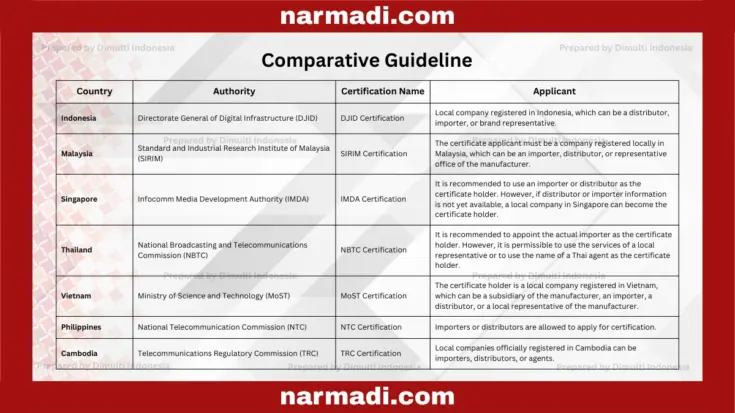
In Indonesia, telecom type approval is under the authority of the Directorate General of Digital Infrastructure (DJID). This compliance instrument is called “DJID certification,” or previously known as “SDPPI certification” or “Postel certification.”
When applying for DJID certification, there are several things to note:
- Document requirements: Product specifications, product photos, self-declaration letter, MOU or distributor agreement, RF test reports, EMC, Laser Safety, and Electrical Safety Test Report.
- Certificate applicant: Must be a local company registered in Indonesia, which can be a distributor, importer, or brand representative.
- Local testing requirements: Mandatory for Laser Safety and SAR. For RF, EMC, and Electrical Safety testing, it is sufficient to provide a Test Report issued by an International Testing Laboratory recognized by DJID.
- Sample requirements: Two types of samples are required, one for conducting EMC and electrical safety testing, and one for conducting RF testing.
- Paperwork process: Document evaluation or file processing can be done if the product has RF, EMC, and Electrical Safety test reports issued by overseas laboratories accredited by DJID.
- Lead time: The processing time for applications through the Local Testing Approach is around 5 weeks. On the other hand, the processing time through the administrative channel is around 1 week.
- Certification validity: The certificate is valid for 3 years from the date of issue.
- Labeling: Must be affixed to the product and its packaging. Alternatively, if the product is too small, it may be affixed to the packaging only.
Malaysia SIRIM
In Malaysia, telecommunications type approval is under the authority of the Standard and Industrial Research Institute of Malaysia (SIRIM). This is an organization under the Malaysian Ministry of Trade and Industry responsible for product standards and technological advancement.
When applying for SIRIM certification, there are several things to note:
- Document requirements: Application form, RF and EMC test reports in accordance with EN or FCC standards, user manual and product data sheet, product photos, brand/trademark authorization letter or registration certificate, authorization letter to the agency, declaration of conformity, and SIRIM IP form.
- Certificate applicant: The certificate applicant must be a company registered locally in Malaysia, which can be an importer, distributor, or representative office of the manufacturer.
- Local testing requirements: Not required because the certification process is done through paperwork.
- Sample requirements: Samples are not required as there is no local testing.
- Paperwork process: This is done by evaluating RF or EMC test reports based on international standards, such as CE and FCC, issued by laboratories abroad.
- Lead time: Processing time is approximately four weeks.
- Certification validity: This certificate is valid for five years from the date of approval.
- Labeling: ICT products certified in Malaysia must have an MCMC label affixed. The label can be affixed to the surface of the device or used with electronic labeling (e-labeling).
Singapore IMDA
In Singapore, telecom type approval is under the authority of the Infocomm Media Development Authority (IMDA). This government organization is part of Singapore’s Ministry for Digital and Information Development.
When applying for IMDA certification, there are several things to note:
- Document requirements: Existing RF and EMC reports must be submitted. Any test reports based on common international standards, such as CE or FCC, will be accepted.
- Certificate applicant: It is recommended to use an importer or distributor as the certificate holder. However, if distributor or importer information is not yet available, a local company in Singapore can become the certificate holder.
- Local testing requirements: Product testing is not mandatory because IMDA accepts international test reports, such as CE or FCC.
- Sample requirements: Samples are not required because there is no local testing.
- Paperwork process: Will be processed through administrative methods by evaluating existing CE, FCC, CB, and other certifications.
- Lead time: Processing time is generally three days. However, for IMDA M2M (Machine to Machine) certification, processing time can take two to three months.
- Certification validity: The certificate is valid for five years.
- Labeling: Must be affixed to the product, manual, or packaging before the product is displayed or offered for sale.
Thailand NBTC
In Thailand, telecom type approval is under the authority of the National Broadcasting and Telecommunications Commission (NBTC). This is a government regulatory body responsible for establishing regulations and policies related to Information and Communication Technology.
When applying for NBTC certification, there are several things to note:
- Document requirements: The general documents required are the application form, specification sheet, product photos, RF test report, EMC test report, and other relevant test reports, such as safety, EMF, and SAR test reports.
- Certificate applicant: It is recommended to appoint the actual importer as the certificate holder. However, it is permissible to use the services of a local representative or to use the name of a Thai agent as the certificate holder.
- Local testing requirements: There is no local testing; product testing is required using reports from ISO/IEC 17025-accredited international laboratories.
- Sample requirements: Samples are not required as there is no local testing.
- Paperwork process: Through an administrative process by evaluating existing CS, FCC, CB, and other certifications.
- Lead time: Waiting time is approximately four to five weeks.
- Certification validity: The certificate has no expiration date. However, if there are changes to the model, recertification is required.
- Labeling: A conformity mark must be affixed. There are three different types of labels: Class A Label, Class B Label, and SDoC.
Vietnam MoST
In Vietnam, telecom type approval is under the authority of the Ministry of Science and Technology (MoST). This is the official government agency responsible for regulating publishing, newspapers, and postal services, such as the internet, telecommunications, broadcasting, information technology, and other related fields.
When applying for MoST certification, there are several things to note:
- Document requirements: Application form, product specifications, sample information, valid ISO 9001:2015 certificate from the manufacturing plant, factory statement, sample delivery statement, and TA certificate holder’s business license.
- Certificate applicant: The certificate holder is a local company registered in Vietnam, which can be a subsidiary of the manufacturer, an importer, a distributor, or a local representative of the manufacturer.
- Local testing requirements: Local testing for RF is mandatory, and the standard used during testing is QCVN Vietnam.
- Sample requirements: One normal sample is required.
- Paperwork process: This method is not permitted, as product testing is mandatory. After testing is complete, there will be an evaluation process to determine whether the product complies with local standards.
- Lead time: It takes approximately six weeks from local testing to certificate issuance.
- Certification validity: The certificate is valid for three years from the date of issuance.
- Labeling: It can be affixed directly to the product surface or packaging. If this is not possible, the mark can be printed on technical documents such as specifications, user manuals, or compliance sheets accompanying the product.
Philippines NTC
In the Philippines, telecommunications type approval is under the authority of the National Telecommunication Commission (NTC). This is an agency under the Philippine Department of Information and Communications Technology (DICT) responsible for setting communication technology standards, testing products, issuing certifications, and monitoring products on the market.
When applying for NTC certification, there are several things to note:
- Document requirements: Technical documents such as product specifications with photos, RF and EMC test reports in accordance with international standards (CE and FCC), a signed Letter of Authorization (LOA), a Declaration of Conformity (DoC), and a product specification statement must be submitted.
- Certificate applicant: Importers or distributors are allowed to apply for certification.
- Local testing requirements: Local product testing is not required because the process is done through paperwork.
- Sample requirements: Product samples are not required as there is no local testing.
- Paperwork process: NTC certification can be processed through administrative methods by evaluating existing CE, FCC, CB, and other certifications.
- Lead time: Processing time is approximately 20 business days from the date of submission to NTC.
- Certification validity: The certificate will not expire unless modified; therefore, there will be an annotation invalidating the previously issued certificate.
- Labeling: Mandatory labeling requirements only apply to Customer Premises Equipment (CPE) and Grant of Equipment Conformity (GEC) certificates.
Cambodia TRC
In Cambodia, telecom type approval is under the authority of the Telecommunications Regulatory Commission (TRC). This organization is a public legal entity that carries out its functions and duties through autonomous administration and regulation, and is independent from telecommunications operators and individuals associated with the telecommunications sector.
When applying for TRC certification, there are several things to note:
- Document requirements: Product Identity, RF Report, EMC Report, Safety Report or CB Certificate & CB Report, Health Test Report or EMF or SAR, Conformity Certificate or EU Type Examination Certificate, Technical Specifications/Product Description, and User Manual.
- Certificate applicant: Local companies officially registered in Cambodia can be importers, distributors, or agents.
- Local testing requirements: Product testing at TRC Cambodia is not mandatory. The certification process is document-based, evaluating existing reports issued by international laboratories.
- Sample requirements: No product samples are required as there is no local testing.
- Paperwork process: The certification process in Cambodia is document-based, evaluating existing reports issued by ISO/IEC 17025-accredited international laboratories.
- Lead time: Processing time is 15 working days after the application is received.
- Certification validity: The TA certificate has no expiration date (valid indefinitely). One certificate is issued for one model and one country of origin.
- Labeling: They are not mandatory. Once the certificate of conformity is obtained, there are no further labeling requirements.
This is a comparative guide to telecom type approval in Southeast Asia. In its development, ASEAN countries are working towards harmonization through the Mutual Recognition Agreement (MRA). By understanding the differences, you can easily monitor the regulatory updates. Additionally, you can also easily enter the markets in these countries without making the common mistakes in telecom certification.