

Recently, the National Broadcasting and Telecommunications Commission (NBTC) issued new regulations regarding the requirement for electrical safety test reports for Bluetooth devices for the certification process. This is stated in the NBTC TS 1035-2562 announcement regarding technical standards for telecommunications equipment and radio communication devices that use 2.4 GHz and 5 GHz frequencies.
The new regulation regarding mandatory electrical safety test reports for Bluetooth devices significantly alters the landscape of NBTC certification applications. Within the scope of Thailand type approval, telecommunications equipment and radio communication devices with Bluetooth features are subject to Supplier Declaration of Conformity (SDoC) registration.
This article provides comprehensive information on regulatory updates regarding the requirement for electrical safety test reports for Bluetooth devices to obtain NBTC certification. It is hoped that suppliers and operators will be aware of this development, which impacts the Thailand type approval process.
New Requirement of Electrical Safety Test Reports for Bluetooth Devices
These new requirements regarding electrical safety test reports for Bluetooth devices refer to the NBTC TS 1035-2562 standard announcement. The announcement discusses technical standards for telecommunications equipment and radio communication devices that use 2.4 GHz and 5 GHz frequencies.
Previously, the technical standards for the 2.4 GHz and 5 GHz frequencies referred to the NTC TS 1012-2551 standard. This technical standard was actually specifically intended only for WLAN/RLAN equipment.
Meanwhile, the new NBTC TS 1035-2562 technical standard is not limited to WLAN/RLAN equipment. It is intended for all telecommunications equipment and radio communication devices that use the 2.4 GHz and 5 GHz frequencies, such as WiFi, Zigbee, and SRD.
Previously, for NBTC certification applications, Bluetooth devices only required a Radio Frequency (RF) report and radiation exposure. However, currently, electrical safety test reports for Bluetooth devices are also required for SDoC applications.
When does it take effect?
The requirement to submit electrical safety test reports for Bluetooth devices for the NBTC certification process takes effect on February 1, 2026. For SDoC applications issued until January 31, 2026, NBTC will still waive the requirement to submit electrical safety test reports for Bluetooth devices.
New Standards NBTC TS 1035-2562
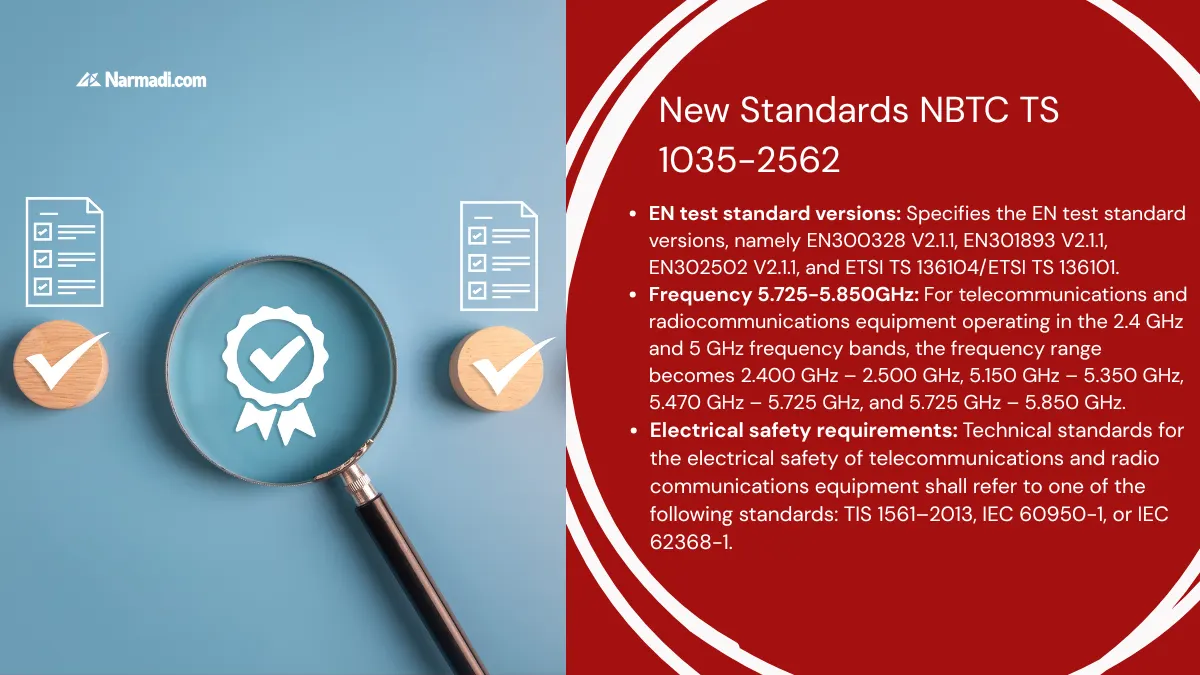
There are three important points related to the new standards NBTC TS 1035-2562. These points serve as the reference for electrical safety test reports for Bluetooth devices in the NBTC certification application process.
- EN test standard versions: Specifies the EN test standard versions, namely EN300328 V2.1.1, EN301893 V2.1.1, EN302502 V2.1.1, and ETSI TS 136104/ETSI TS 136101.
- Frequency 5.725-5.850GHz: For telecommunications and radiocommunications equipment operating in the 2.4 GHz and 5 GHz frequency bands, the frequency range becomes 2.400 GHz – 2.500 GHz, 5.150 GHz – 5.350 GHz, 5.470 GHz – 5.725 GHz, and 5.725 GHz – 5.850 GHz.
- Electrical safety requirements: Technical standards for the electrical safety of telecommunications and radio communications equipment shall refer to one of the following standards: TIS 1561–2013, IEC 60950-1, or IEC 62368-1.
Certification Classification Based on NBTC TS 1035-2562 Standard
Telecommunications equipment using the 2.4 GHz and 5 GHz frequency bands must comply with regulations established by the NBTC. The following are standard certifications for Thailand type approval:
| Frequency Band | NBTC Type Approval |
| 2.400 – 2.500 GHz | SDoC |
| 5.150 – 5.350 GHz | SDoC |
| 5.470 – 5.725 GHz | SDoC |
| 5,725 – 5,850 GHz | SDoC |
| Class A |
What is the Impact on NBTC Certification Applications?
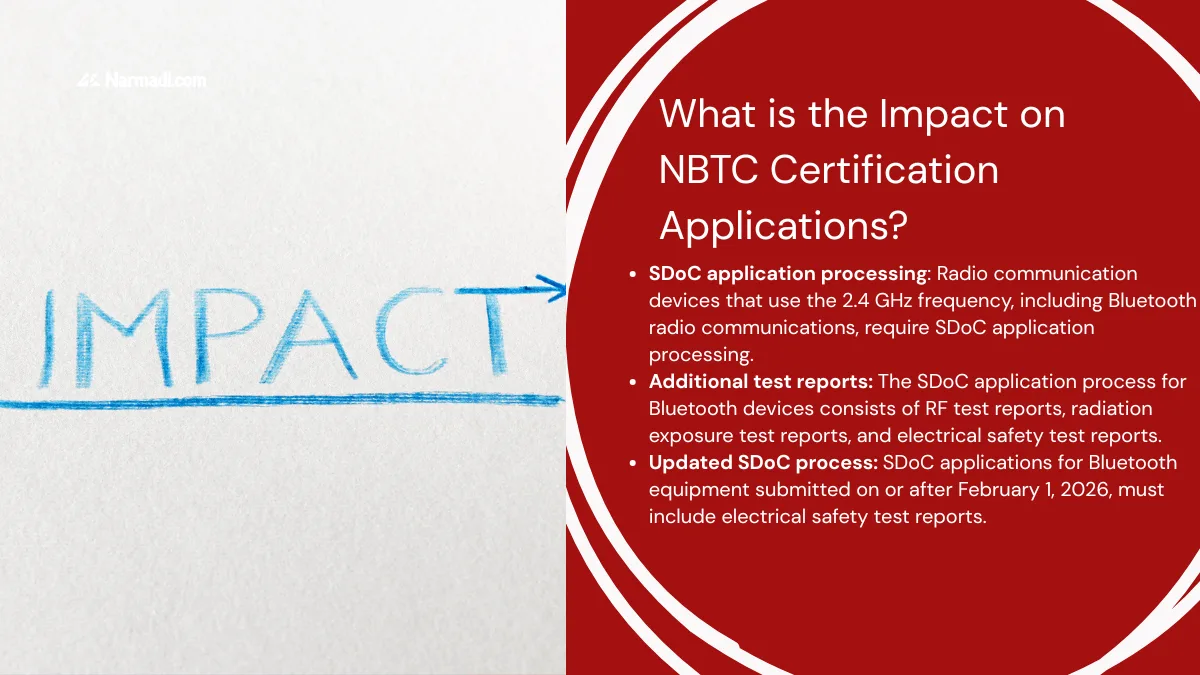
The requirement for electrical safety test reports for Bluetooth devices certainly changes the landscape of NBTC certification applications. Here are the impacts that applicants will experience.
- SDoC application processing: Radio communication devices that use the 2.4 GHz frequency, including Bluetooth radio communications, require SDoC application processing.
- Additional test reports: The SDoC application process for Bluetooth devices consists of RF test reports, radiation exposure test reports, and electrical safety test reports.
- Updated SDoC process: SDoC applications for Bluetooth equipment submitted on or after February 1, 2026, must include electrical safety test reports.
This is the new requirement regarding electrical safety test reports for Bluetooth devices when applying for NBTC certification. This change needs to be taken into consideration for those who wish to market Bluetooth devices in Thailand. This will help you avoid distribution delays and legal issues in the future. [UN]