


Most manufacturers, importers, and distributors may consider telecom certification to be the finish line. This perception is completely wrong because the issuance of a certificate is actually the beginning of ongoing obligations.
Telecom certification is not the end of all processes related to product distribution. It is merely a passport to enter a destination country. After the certificate is issued, there are still post-certification obligations. These are usually related to labeling and market surveillance.
This article will explain what to do after telecom certification obligations that manufacturers often forget. Manufacturers can understand what comes next after the certificate is issued.
What are Post-Certification Obligations in Telecom Compliance?
Post-certification obligations in telecom compliance are ongoing responsibilities for manufacturers, importers, and distributors of products on the market. These responsibilities are inseparable from the certainty that certified equipment meets all technical and regulatory requirements throughout its lifetime on the market.
Post-certification obligations in telecommunications include market surveillance, documentation and record keeping, notification of changes, product labeling, and collective action. There is a fundamental difference between pre-market compliance and post-market compliance.
Pre-market compliance occurs from the development and testing stages to product certification. The aim is to ensure that products do not have safety and performance issues because they meet applicable technical, safety, and regulatory standards.
Meanwhile, post-market compliance occurs after the certification process, specifically at the distribution, consumer use, and after-sales support stages. The goal is to continuously monitor product safety and performance in a real-world environment.
Additionally, post-market compliance is also carried out to respond to consumer complaints and ensure ongoing compliance with regulations that may evolve.
Labeling Requirements for Telecom Certification
Labeling for telecom certification is one of the stages that must be passed. This is usually done after the certificate is issued. The purpose is to provide information to consumers that the product meets the applicable safety and regulatory compliance standards.
Each country has its own policies; some require them, and some do not. Generally, labeling must be physical on the device or packaging. Some also allow online labels or labels attached to the manual book.
Each country also has its own regulations regarding the placement, size, and what needs to be included on the label. However, generally, what is included on the label is the telecom certificate number that has been issued by the authority. This indicates that the product has passed the certification test.
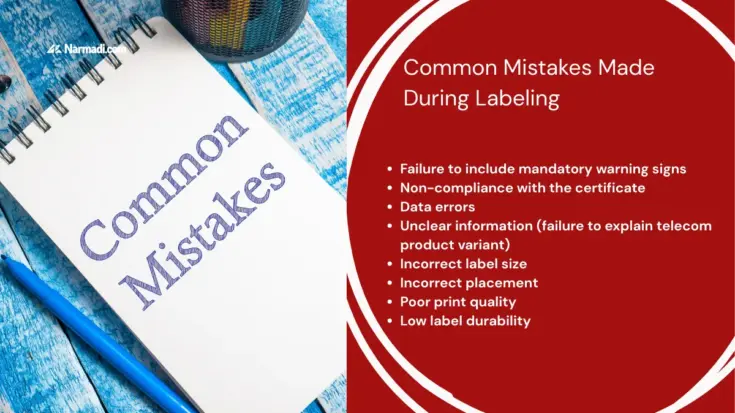
Common mistakes made during labeling:
- Failure to include mandatory warning signs
- Non-compliance with the certificate
- Data errors
- Unclear information (failure to explain telecom product variant)
- Incorrect label size
- Incorrect placement
- Poor print quality
- Low label durability
Certificate Validity, Renewal, and Expiry Tracking
Certificate validity, renewal, and expiry tracking are also important considerations after telecom certification is issued. The validity period of certificates varies from country to country, with some having fixed validity and others having conditional validity.
Fixed validity certificates have no expiration date, meaning they remain valid as long as there are no changes to product specifications. Conditional validity certificates, on the other hand, have an expiration date. The length of the validity period varies from country to country, depending on the policies of the respective authorities.
In the case of conditional validity certificates, manufacturers often forget about the expiration date. However, certificate renewals can be submitted several months before the expiration date. If this is missed, it will result in a certification process similar to the initial process.
The risk of not renewing a certificate is that products on the market will be considered illegal. This is just as risky as uncertified products. It is advisable for manufacturers to create a certificate lifecycle management and reminder system and incorporate it into the telecom compliance lifecycle.
Labeling and Certification Validity in Southeast Asia
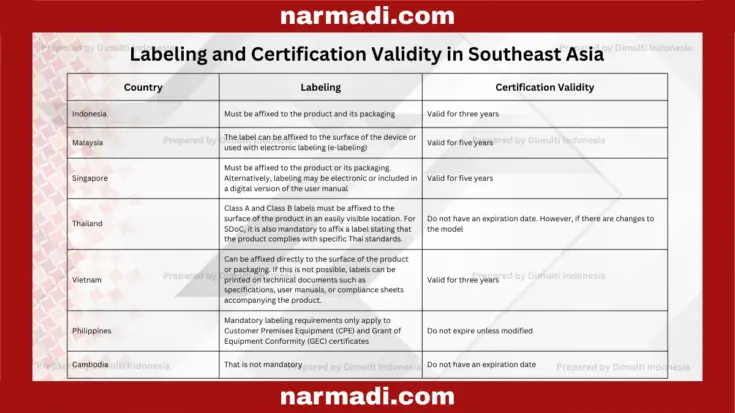
As previously mentioned, labeling and telecom certification validity are different regulations from country to country. This is also true for countries in Southeast Asia, where each country has its own policies.
Below, we will discuss telecom post-certification in Indonesia, Malaysia, Singapore, Thailand, Vietnam, the Philippines, and Cambodia in more detail.
Indonesia DJID
- Labeling: Must be affixed to the product and its packaging. Alternatively, if the product is too small, the label can be affixed to the packaging only.
- Certification validity: The DJID certificate is valid for three years from the date of issue.
- Renewal: If, after three years, the item is still being manufactured, assembled, or imported for use or sale in Indonesia, it must be recertified.
Malaysia SIRIM
- Labeling: Malaysia telecom certification must have an MCMC label affixed. The label can be affixed to the surface of the device or used with electronic labeling (e-labeling).
- Certification validity: The SIRIM certificate is valid for five years from the date of approval.
- Renewal: The same document can be used as long as there are no changes to the product specifications, and the same process as the initial certificate application is followed.
Singapore IMDA
- Labeling: Singapore telecom certification must be affixed to the product, manual, or packaging before the product is displayed or offered for sale. The label must be affixed to the product or its packaging. Alternatively, labeling may be electronic or included in a digital version of the user manual.
- Certification validity: IMDA certificates are valid for five years from the date of issue.
- Renewal: May be applied for using the same documents and fees as a new application.
Thailand NBTC
- Labeling: The labeling requirements for Thailand telecom certification must be applied. Class A and Class B labels must be affixed to the surface of the product in a location that is easily visible, not easily removable, and easily accessible. For SDoC, it is also mandatory to affix a label stating that the product complies with specific Thai standards.
- Certification validity: Thai NBTC certificates do not have an expiration date. However, if there are changes to the model, recertification is required.
- Renewal: There is no renewal. However, when there are changes to the equipment that affect NBTC standards and technical requirements, recertification is required.
Vietnam MoST
- Labeling: Vietnam telecom certification can be affixed directly to the surface of the product or packaging. If this is not possible, labels can be printed on technical documents such as specifications, user manuals, or compliance sheets accompanying the product.
- Certification validity: MoST certificates are valid for three years from the date of issue.
- Renewal: Renewal can be requested using the same documents as long as there are no changes to product specifications and Vietnamese regulations regarding the product, and the same process as for the initial certificate application is followed.
Philippines NTC
- Labeling: Mandatory labeling requirements only apply to Customer Premises Equipment (CPE) and Grant of Equipment Conformity (GEC) certificates.
- Certification validity: NTC certificates do not expire unless modified; therefore, there will be a note stating that previously issued certificates are invalid.
Cambodia TRC
- Labeling: That is not mandatory. Once the certificate of conformity has been obtained, there are no further labeling requirements.
- Certification validity: TRC certificates do not have an expiration date (they are valid indefinitely). One certificate is issued for one model and one country of origin.
- Renewal: There is no renewal. However, if there are changes to the equipment that affect TRC standards and technical requirements, a re-inspection is required.
These are some things that manufacturers, importers, and distributors need to remember regarding what to do after telecom certification obligations. Labeling is required in some countries as a sign that the product complies with applicable safety and regulatory standards.
For certificate validity, it is also important to remember to create a certificate lifecycle management and reminder system. This way, the company will remain secure in terms of the post-certification process.