Kenbak-1 The First Personal Computer in the World
Contents
Let's get going and dive deep into the invention that changed the world of technology forever. The First Personal Computer, The Kenbak-1!
Meet the first personal computer in the world, the Kenbak-1!
Imagine a time before the internet, social media or even before floppy disks existed. Yup! The history of the personal computer isn’t going to be the same without Kenbak-1!
So, let’s get going and dive deep into the most influential invention that changed the world of technology forever!
Kenbak-1 The First Personal Computer in the World
From room-sized giants to something that you can carry around in your pocket, the history of the personal computer is one interesting topic to cover.
Long before that, personal computers were these massive things that were used by the
governments, universities and some giant corporations.
Thus, the idea of having a personal computer at that time seemed like science fiction. But then came the Kenbak-1, the first personal computer in the world that was a giant leap for technology.
Picture the Kenbak-1 as the grandpa of your PC and laptop as this device was invented in 1971 by John Blankenbaker, even before the Intel 4004, the first commercially produced microprocessor was invented.
Yup, it might not even be able to run your favorite game on windows like Solitaire, but for its time, it was a groundbreaking concept!
The production of Kenbak-1 was started in 1971, with a total of less than 50 machines were built, and it was sold for US$750 at that time which is around US$5,640 today.
Specification of Kenbak-1
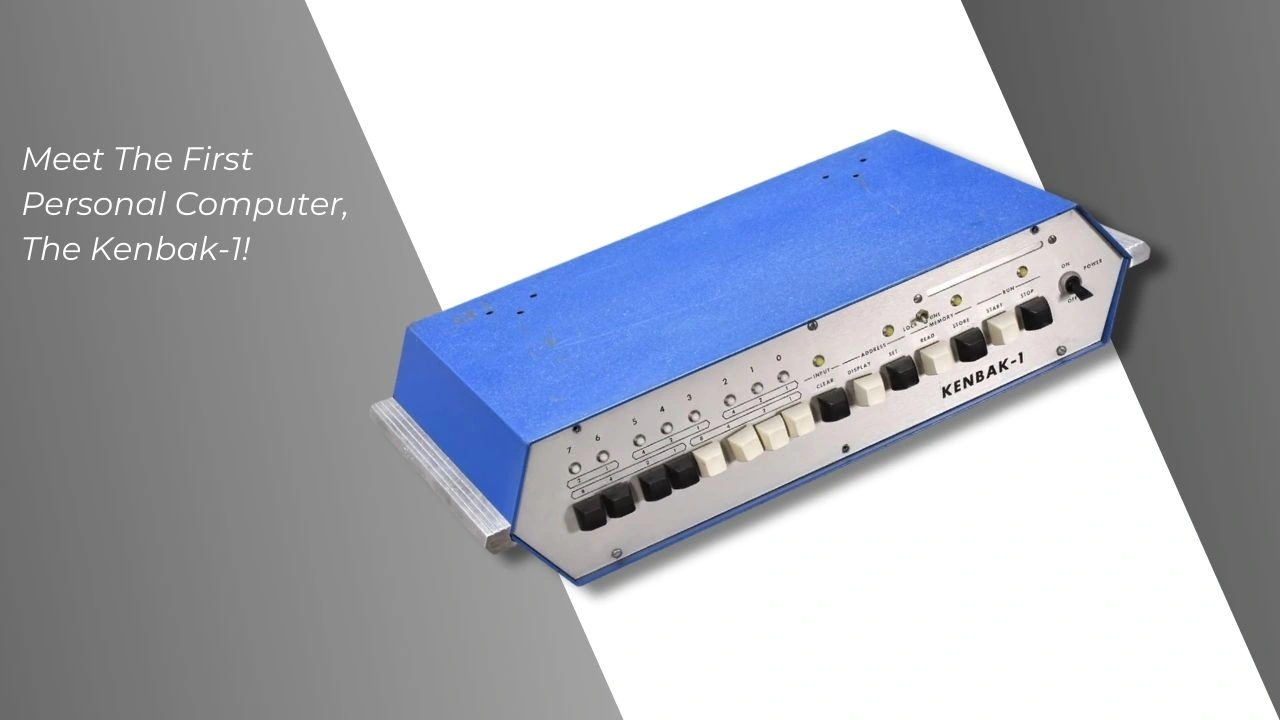
Here’s a breakdown of its key specification:
Processor: The Kenbak-1 pre-dates the microprocessor, but it relied on TTL integrated circuits (imagine this as tiny switches and resistors that working together to create a simple functions) to perform operations.
Clock Speed: Through a use of 1 microsecond clock signal period, the Kenbak -1 achieved a clock speed equivalent to 1MHz
Memory: 256 bytes, through the use of Intel's type 1404A silicon gate MOS shift registers.
Storage: No secondary storage
Input/Output:
- 8 toggle switches for entering data.
- 8 LED lights for displaying output.
- Additional internal registers for program control and data manipulation.
While lacking in a lot of features that are present in modern computers like keyboard, monitor or even operating system, the Kenbak-1 has given us a valuable learning tool for understanding computer programming fundamentals.
How Did People Use the Kenbak-1?
No keyboard. No monitor. No mouse. So how did people use it? Here's the fun part.
To enter data, users flipped the 8 toggle switches, one by one. To see the result, they looked at the 8 LED lights. Each switch and each light stood for a bit, a 1 or a 0. Simply put, you talked to the Kenbak-1 in its own language, binary!
Sounds hard? It was. But that is exactly why the Kenbak-1 became a valuable learning tool. Using it, people had to understand how a computer really thinks, step by step.
Kenbak-1 vs Your Laptop Today
Let's have a little fun and compare the Kenbak-1 with the laptop you might be using right now.
- Memory: the Kenbak-1 had 256 bytes. Yup, bytes. A single photo on your phone is much bigger than that.
- Storage: the Kenbak-1 had no secondary storage. Your laptop can store thousands of files.
- Input: toggle switches versus a keyboard, a touchpad, and maybe even a touchscreen.
- Output: 8 LED lights versus a full color display.
- Processor: TTL integrated circuits versus a modern microprocessor.
Funny, right? But every modern computer still follows the same basic idea: take input, process it, and give output. The Kenbak-1 did that too, just in a much simpler way.
What We Can Learn From the Kenbak-1
Here's the thing. Big changes often start small. Less than 50 machines were built. It was not a big commercial success. But it showed that a computer could be personal, not only for governments, universities, or giant corporations.
That idea changed everything. Today, almost everyone carries a computer in their pocket. And it all started with a box of switches and lights.
Frequently Asked Questions
Who invented the Kenbak-1?
John Blankenbaker, in 1971.
How much did it cost?
It was sold for US$750 at that time.
Did it have a microprocessor?
No. The Kenbak-1 pre-dates the microprocessor. It relied on TTL integrated circuits to perform operations, and it was invented even before the Intel 4004.
So there it is the first personal computer that revolutionized the technology world, Kenbak-1!
Hey, did you know that Enterprise Digital Assistance, PCs including laptops can emit radio frequency signals? These signals are the fundamental things for your PC and laptop to be able to connect to the internet.
In Indonesia, the use of radio frequency signals is strictly regulated. Under the Indonesian regulation on telecommunication device certification (No. 3 of 2024), each communication device produced, assembled, used, or traded in Indonesian territory must hold type approval certification.