What is Z Wave? It is a Variation of Zigbee with Lower Price

Contents
Z wave is the newly born wireless technology that will be beneficial for data transferring. With the simpler protocol, this network offers cheaper cost.
We already talked about Zigbee technology previously. And now, we are going to talk about the similar wireless technology that uses the same concept as Zigbee, the “Z wave”. It may seem not familiar for some people, but it is.
Compared to the other wireless technology such as Bluetooth and WLAN, Z wave seems to be unseen. But for several purposes, it is really needed, especially when it comes to certain specialization. So, what actually is this technology, what is it for, and how does it work? Everything will be explained below.
What is Z Wave?
Some people call it Zwave, some others call it Z wave, and the rest is Z-wave. It all refers to communication protocols that are mostly used for home automation devices.
This protocol, which is called Z wave, was a development product from Danish start-up Company called Zensys in 2004.
It seems like we know where the “Z” mark comes from, right?
Then in 2009, the Zensys Company was acquired by Sigma Designs, a Californian company that focuses on designing and building system-on-a-chip for many kinds of semiconductor technology.
Basically, Z-wave was built under the concept of Zigbee. That’s why both technologies have a lot of things in common, such as frequency, and range of operation. But, what makes it different is that this kind of wireless technology was developed to produce simpler protocols than Zigbee.
That’s why the use of this technology is believed to result in a lower budget. Further, just like other communication protocols, this technology also employs Radio Frequency (RF) in its operation. And the RF here mostly takes part in the control and signaling sectors.
The operation
In its operation, Z-wave employs 868.42 MHz frequency to work. But in fact, it is different in every country to avoid interference with other kinds of wireless technology. Only Europe uses this standard for z-wave operation.
While for US and Canada, their governments allow the use of Z-wave communication in the 908.42 MHz frequency. Further, this network is also able to consist of 232 nodes with several numbers of profiles. But, these profiles do not operate individually since they work interoperably.
Z-wave also works by using routed network topology. It can employ several controllers. But mainly it uses only one as the main controller. A second controller also exists, but it is only used as an option.
Z wave based devices will communicate to each other by employing the routed nodes and radio dead spot or circumvent household obstacle that possibly occur through message called healing.
A message can be delivered from node A to node C successfully even when they both are not within the range. How could it be? It is because node A transfers the data to node B, which will deliver it to node C. That’s how communication is supposed to happen in z-wave.
The Technology Usage
As stated before, it offers much simpler protocols. This network is developed to offer low latency and more reliability of small packet of data. This is the data packets which only rates up to 100 kbps.
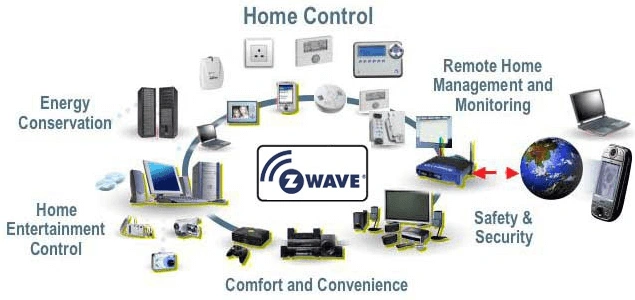
Therefore, it is perfect to be used at home automation. Some home facilities such as lighting control space, home cinemas, home security system, HVAC, automated window treatments, spa control, and others.
With the functionality above, of course, the usage of technology will be very various. And in the future, we believe that there will be many more devices that will employ this kind of wireless connection.
Where Z-Wave Is Commonly Used
Z-Wave is mostly found in home automation. Here are some examples of how it is used in daily life:
- Lighting control: Turning lights on and off or dimming them from a single controller.
- Home security: Connecting door sensors, alarms, and locks.
- HVAC: Managing heating, ventilation, and air conditioning.
- Window treatments: Opening and closing curtains or blinds automatically.
- Home cinema and spa control: Making entertainment and relaxation easier to manage.
Tips Before Choosing Z-Wave Devices
Since Z-Wave frequencies differ between countries, make sure the devices you buy match the frequency used in your area. It is also wise to choose devices that work with your main controller, so the whole system can communicate smoothly.
Frequently Asked Questions
Who developed Z-Wave?
Z-Wave was developed by Zensys, a Danish start-up company.
How many nodes can a Z-Wave network have?
As mentioned above, a network can consist of 232 nodes.
How does Z-Wave send messages over long distances?
Messages can hop from one node to another until they reach their destination.
Why is Z-Wave cheaper?
It was developed with simpler protocols, which helps keep costs lower.
In closing, we hope that this article will be informative. So, it will be able to update your understanding toward the newest issues of technology. If you have any thoughts about this article, the comment section below is provided to welcome your opinion.