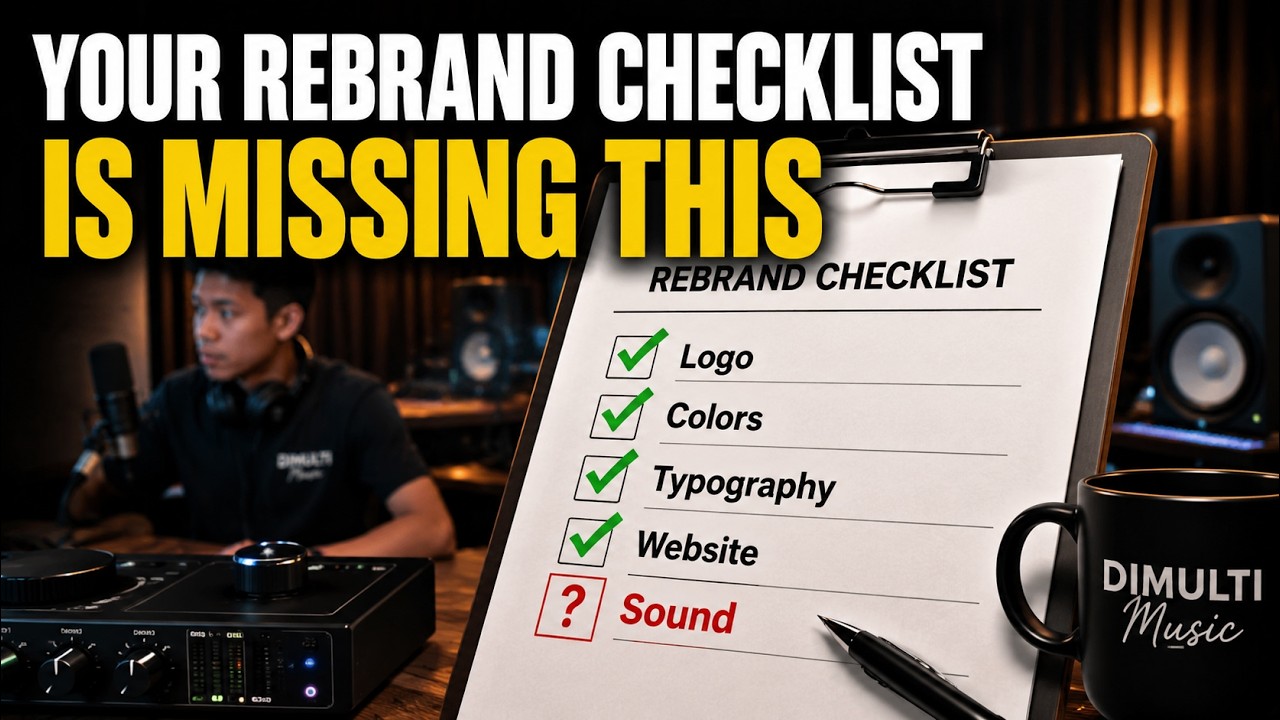
Every growing brand keeps a version of the same list. Redo the packaging. Refresh the website. Maybe, someday, rebrand the office.
Sonic identity usually sits on that same list, filed under "later," right next to the items that can genuinely wait.
That is the mistake. Not because sonic identity matters more than everything else on the list, but because it is the one item on it that gets more expensive to fix the longer it sits there. Packaging can wait five years and cost the same to redo. Sound cannot. Every month it waits, a brand is still publishing, still answering calls, still putting out content, all of it quietly training an audience to associate the brand with nothing in particular.
Nobody schedules a meeting to decide this consciously. It happens by default, one video at a time, one call hold at a time, until a year has passed and the brand realizes it never actually chose a sound. It just accumulated whatever happened to be on hand each time, which is a different thing entirely from having an identity.
Why It Ends Up on the "Someday" Shelf
Ask most growing brands why they have not touched their sound and the answer is rarely "we don't think it matters." It is closer to "we assumed that's for later, once there's real budget."
That assumption is not irrational. Look at who is actually talking about sonic branding in public. Global banks. Telecom giants. Companies running Super Bowl ad budgets. Every agency in that space is positioned toward enterprise clients, enterprise timelines, enterprise case studies. Nobody in that conversation is explicitly speaking to a business still watching every dollar.
So the quiet conclusion a small brand draws is reasonable on the surface: this is a big-company problem, and we are not a big company yet.
It shows up almost word for word in budget conversations. Someone raises sonic identity, and the answer is not "no." It is "not this quarter, once we've got a few more things settled." The same sentence, quarter after quarter, until enough time has passed that nobody remembers it was ever raised as a priority at all.
Reasonable, and backwards. Waiting does not pause the cost. It just means every video published, every ad run, every product demo recorded in the meantime keeps building recognition on a sound that was never designed to be remembered. None of that effort compounds into anything. It just accumulates on top of a foundation that will eventually need to be replaced anyway.
Picture two coffee roasters launching the same year. Both post weekly. Both run the same modest ad spend. One of them opens every video with three notes that never change. The other uses whatever royalty-free track felt right that week. A year in, someone can hum the first roaster's intro without ever having been told to remember it. Nobody can hum the second one's, because there was never one thing to remember. That gap did not cost the first roaster a bigger budget. It cost them a decision, made early, instead of later.
The Math Runs the Opposite Direction
Here is the part that gets missed. Large brands build recognition mostly through repetition at massive scale. Television buys, billboard campaigns, the same visual pushed in front of millions of people until it sticks by sheer volume.
A growing brand cannot compete on that axis. Outspending a company running a hundred times your advertising budget is not a strategy, it is a fantasy.
So the lever has to be different, and sonic identity happens to be exactly that lever. A short, distinct audio motif costs a fraction of a single major ad campaign to produce. Once it exists, it gets reused for free every time a video goes out, every time a call gets answered, every time a notification fires. The cost is almost entirely upfront and one time. The recognition it builds keeps compounding for free after that, indefinitely, without another dollar of media spend.
Put plainly: the brands with the smallest marketing budgets are the ones who benefit most from a form of branding that does not depend on marketing budget to work. That is not a coincidence. It is the entire point.
Think about what a small, growing brand already has in hand without spending anything new. A YouTube channel. A product demo. A handful of social videos going out every week regardless. Every single one of those is a free, already-scheduled opportunity to repeat the same three-second motif, at zero incremental cost, in a way no billboard campaign could ever match dollar for dollar.
Why Repetition Is Doing the Actual Work
It helps to be honest about why this works at all. Nobody remembers a sound because it is beautiful. They remember it because they heard it enough times, in enough consistent contexts, that their brain stopped treating it as background noise and started treating it as a signal.
That is the entire mechanism behind a jingle stuck in someone's head for twenty years, or a two-note chime that instantly reads as a particular phone company before a single word is spoken. Nothing about those sounds is special in isolation. What makes them work is that they never changed, and they showed up often enough for recognition to build without anyone consciously trying to memorize them.
A large brand buys that repetition with media spend. A small brand gets it for free, simply by not changing the sound every time a new video goes out. The mechanism is identical. Only the price tag is different, and the small brand's version happens to be nearly nothing.
Cheaper to Maintain Than It Looks
There is another comparison worth making, and it has nothing to do with advertising spend. It is the comparison between keeping a visual identity consistent and keeping a sonic one consistent.
A visual identity has to be reshot constantly. New product, new photo. New location, new footage. New season, a slightly different color grade because the light changed. Every one of those updates costs money, requires a shoot or a designer, and has to be approved all over again.
A sonic motif does not have that problem. Once it is produced correctly, it does not age, does not need reshooting, and does not require a new session every time the brand launches something. The same three seconds that opened a video eighteen months ago still work today, exactly as they were, at zero additional production cost. Of everything a brand maintains, sound is quietly the cheapest one to keep consistent for years at a time, which makes it an odd item to leave for "later" while everything more expensive gets budget approved first.
That also means the decision to start is close to risk free. A visual rebrand, done badly, is expensive to notice and expensive to undo, because every asset built on the old look has to be replaced. A sonic motif that misses the mark the first time costs almost nothing to revisit and swap out, since there was never a warehouse of printed material or a year of photography riding on it. The downside of trying is small. The downside of never trying is the one that compounds.
What This Looks Like Without a Big Budget
None of this requires the elaborate system a multinational builds out. Nobody starting today needs twelve variations, a full orchestral theme, and a hundred-page sonic guideline document before they are allowed to begin.
What it requires is one motif. Short, deliberate, consistent. Used the same way across every video, every product demo, every piece of content already going out the door, starting with whatever gets published next instead of waiting for a budget conversation that keeps getting postponed.
In practice that single motif shows up in a handful of places that already exist for most growing brands. The three seconds before a YouTube video's hook. The tone a phone system plays before a call connects. The short sting that opens a product demo sent to a prospect. None of these are new touchpoints that need to be invented. They are moments a growing brand is already producing content for, week after week, without a consistent sound attached to any of them yet.
At Dimulti Music, this is exactly the way we approach sonic branding for growing brands, not by shrinking down an enterprise process into something smaller, but by starting with the one asset that actually carries the weight and letting everything else expand around it later. If you are still unclear on what a sonic identity even is before deciding to build one, What is Sonic Branding lays out the fundamentals first.
That single asset is not a temporary placeholder either. The same motif opening a brand's videos today can extend into a fuller system later, a notification sound, an event intro, without ever needing to be thrown out and rebuilt from scratch. Nothing built at the small scale gets wasted once the bigger budget conversation finally happens. It just grows into it.
"We Don't Have the Production Budget for That"
This is usually where the hesitation shows up, and it is worth addressing directly instead of skipping past it. A distinct sonic motif does not require an orchestra, a recording studio booked for a week, or a composer on retainer.
It requires something short enough to notice and simple enough to repeat exactly the same way every time. Three notes. A single tone with a specific texture. A two-second whoosh that always resolves the same way. The production cost of getting that right once is genuinely a fraction of what a single video ad shoot or a print campaign costs, and unlike that campaign, it never needs to be reshot for the next quarter.
The barrier was never really budget. It was the assumption that sonic identity has to look like what a bank or an airline does before it counts as real. It does not. It has to be consistent. That is the entire bar.
The Real Price of Waiting
Every competitor in a given category who starts building sonic recognition now gets a multi-year head start, for a cost that only grows more expensive to close later.
"We'll deal with sound once we're bigger" usually just means dealing with it after three competitors already sound more consistent, more deliberate, and more remembered than a brand that spent those same years staying quiet.
What Catching Up Actually Involves
Catching up later does not just mean picking a sound at that point. It means overriding an impression that already got built by accident, years of videos and calls and demos that trained an audience to associate the brand with whatever random track happened to be loaded at the time.
Undoing that is a slower job than building the right impression from the start. An audience has to unlearn the inconsistency before a new, deliberate sound has any chance of sticking, and unlearning takes far more repetition than learning something for the first time would have. The brand that starts today with one simple motif never has to pay that unlearning cost at all. The brand that waits almost always does, on top of whatever the sonic identity itself would have cost to begin with.
This is the part that rarely gets said out loud in those quarterly budget conversations. The delay is not free just because nothing gets spent on it yet. It is being paid for anyway, in the form of a slightly weaker impression compounding across every touchpoint, quarter after quarter, until the bill eventually comes due as a much bigger fix than the one that was postponed.
None of this requires a big budget to start. It requires one motif, used consistently, beginning with whatever gets published next, not the polished version a brand is still waiting to afford.