7 Evolution of Data Storage Device

Contents
Data storage devices have evolved through centuries, from the nineteenth century punched cards to modern cloud storage systems, here are the evolution of data storage over the centuries!
The volume of data collected, processed, and saved has skyrocketed in the digital age.
Because of this, storage devices are now an essential part of everything we use every day, from computers and cellphones to cloud servers that run the internet.
With the development of technology, storage devices have undergone a tremendous transformation that has allowed us to store more data in more compact and effective formats.
So let’s dive into the evolution of data storage device!
7 Evolution of Data Storage Device
1. Punched Cards (1725)
Punched card, founded in 1725, has been dubbed as the earliest type of data storage.
They were initially used to directly control the automated textile looms at the start of the industrial revolution in the early eighteenth century.
And after more than two centuries, this basic machine had become the most common form of data storage for financial records and basic computer programs.
2. Magnetic Tapes (1928)
Magnetic tapes finds its popularity in the 50s and also 60s, this thin strip of plastic coated with magnetic material was used to store data sequentially.
Invented in 1928 in Germany by Fritz Pfleumer, the magnetic tapes was first used for recording sound.
And by the late 70s, magnetic tape was one of the most widespread standards for home computers.
3. Hard Drives (1954)
If magnetic tapes can evolve into something, there is nothing but a hard drive to be its evolution.
Hard drives still use a magnetic tape as its medium of data storing, and being one of the staples standards in the industry.
The earliest and well known hard drive was the IBM 350 which was invented in 1954 with a size of a large fridge and a mere 3,75 megabytes of storage capability.
4. Floppy Disks (1971)
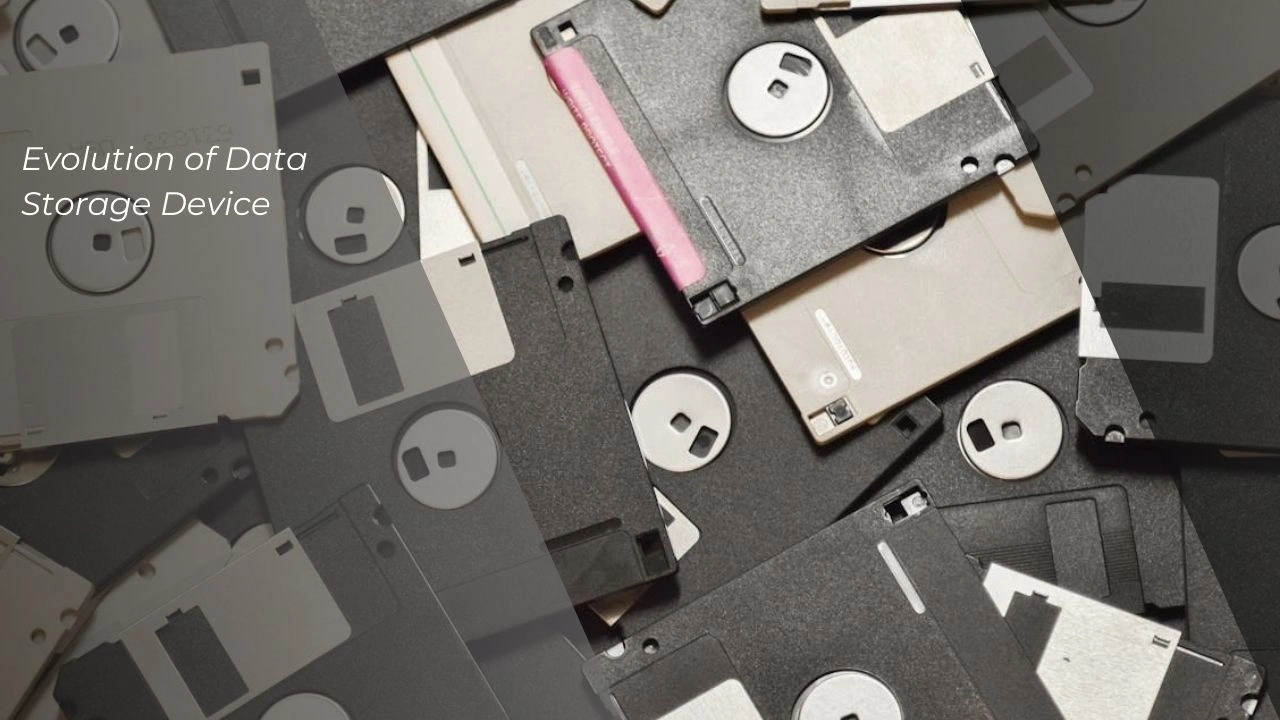
One of the most well-known data storage devices that made such an impact was the floppy disks
The floppy disks were invented in the early 70s by the tech giant company IBM.
Hailed as the first removable storage medium, floppy disks have their glory days through the 70s, 80s, and also 90s in home and business settings.
5. Compact Disks (1982)
In 1982, the compact disc (CD) arrived, and started revolutionizing digital music storage, but as the time went by CDs became much more than just music players.
They later morphed into CD-ROMs, capable of holding massive amounts of computer data, a whopping 700 megabytes, which was like carrying around hundreds of floppy disks in your pocket.
But not only that, modern CDs, the ultra HD Blu-ray has the ability to hold up to 100 gigabytes of data!
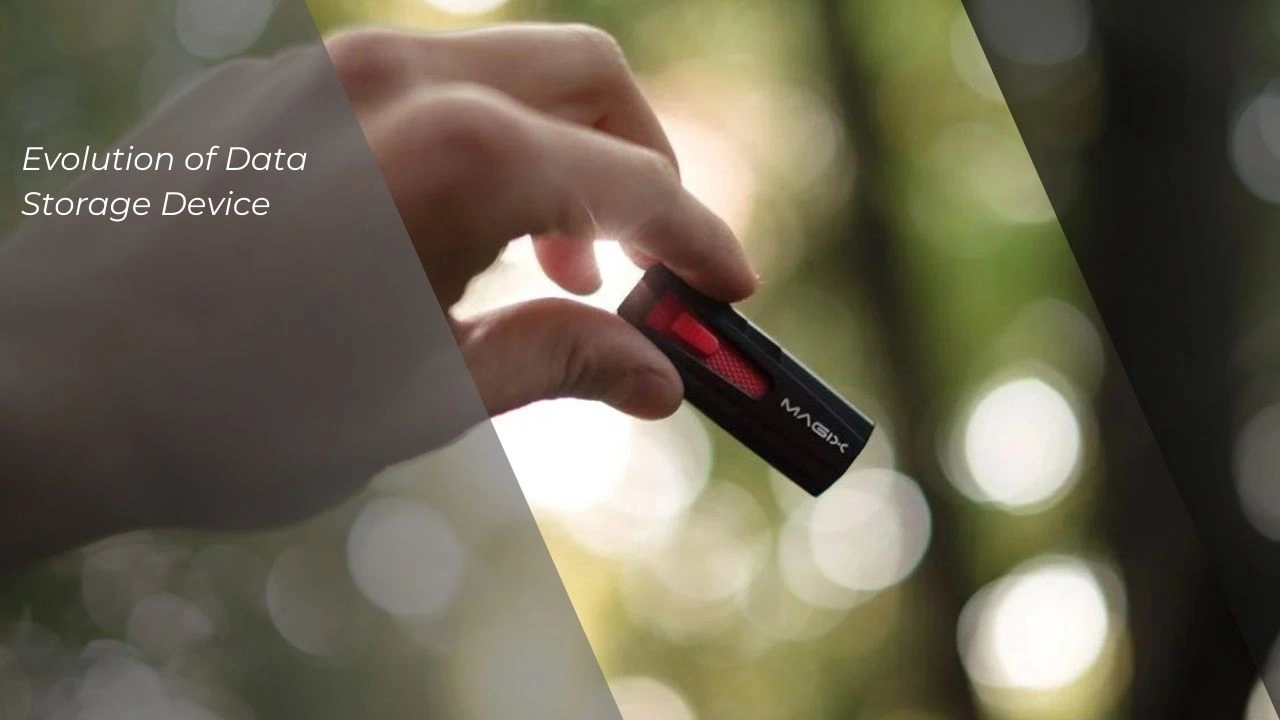
6. USB Flash Drives (2000)
The 2000s marks the invention of USB Flash Drives, that within its first releases was able to hold about 8 megabytes of data.
7. Cloud Storage (Now)
Now, everything is stored within a cloud storage, which makes it possible to store unlimited amounts of data online in the internet data centers.
The Evolution at a Glance
That's a long journey! Here's a quick recap to help you remember it.
- Punched cards (1725): the earliest type of data storage, first used for textile looms.
- Magnetic tapes (1928): first used for recording sound, popular in the 50s and 60s.
- Hard drives (1954): the IBM 350, as big as a large fridge.
- Floppy disks (1971): the first removable storage medium.
- Compact discs (1982): from music to CD-ROMs holding 700 megabytes.
- USB flash drives (2000): small and easy to carry.
- Cloud storage (now): data stored online in internet data centers.
What Can We Learn From This Evolution?
Here's the thing. Every step made storage smaller, faster, and easier to use. A hard drive the size of a fridge. Then disks you could carry in your bag. Then a tiny flash drive in your pocket. And now? Your files live online, and you can open them from almost anywhere.
Funny, right? The things that once filled a room now fit in your hand, or don't even need a physical place in your house at all.
Tips for Storing Your Data Today
With so many options, how should you store your important files? Here are a few simple habits:
- Keep more than one copy of your important files.
- Combine physical storage, like a flash drive or external drive, with cloud storage.
- Label your files and folders clearly, so you can find them later.
- Check your old storage devices from time to time, before they become hard to read.
- Protect your cloud account with a strong password.
Frequently Asked Questions
What was the first removable storage medium?
The floppy disk, invented by IBM in the early 70s.
Who invented magnetic tape?
Fritz Pfleumer, in Germany, in 1928.
How much could the first USB flash drives hold?
About 8 megabytes of data.
So here they are the evolution of data storage device over centuries!