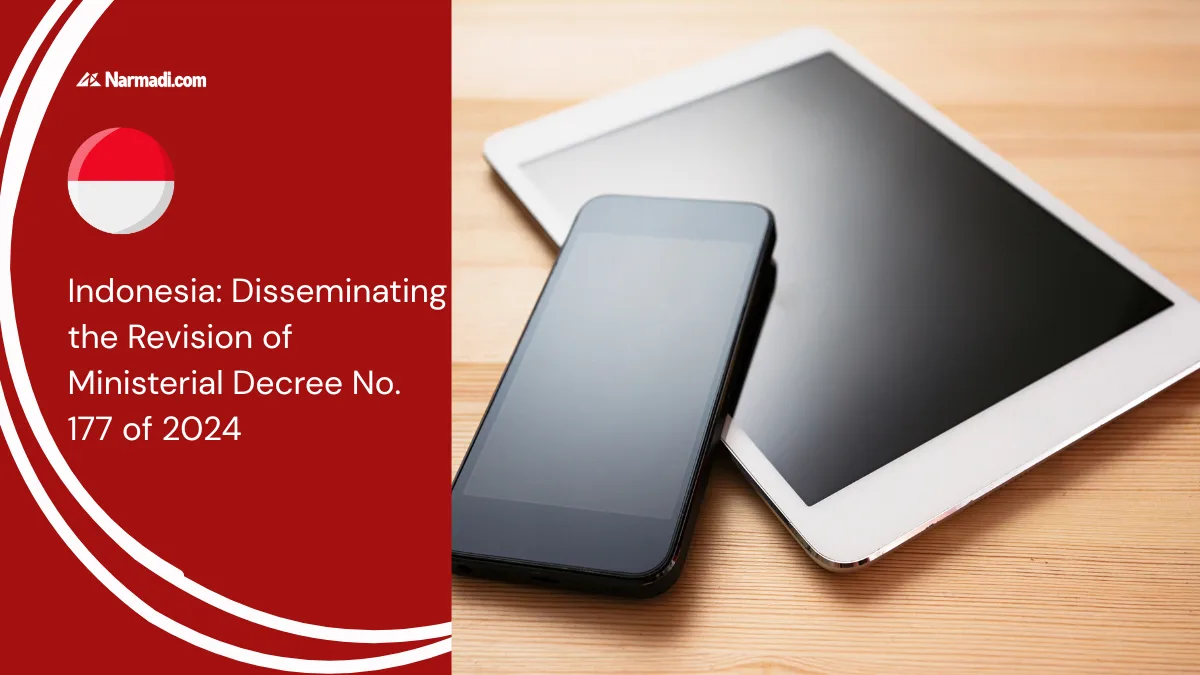

On Thursday, January 22, 2026, the Indonesian Ministry of Communication and Digital Affairs (KOMDIGI) held a socialization event regarding the revision of Ministerial Decree No. 177 of 2024. The discussion focused on Specific Absorption Rate (SAR) limits for mobile phones and tablet computers.
The socialization event for Ministerial Decree No. 177 of 2024 took place at Menara Danareksa. It was attended by the Directorate of Radio Frequency Spectrum Management (SFR), Satellite Orbit, and Digital Infrastructure Standardization, the Directorate of Digital Infrastructure Services, the Telecommunications Equipment Testing Center (BBPPT), the Indonesian Mobile Phone Association, and other relevant stakeholders.
The meeting was opened and chaired by Mr. Adis Alifiawan, Director of Radio Frequency Spectrum Management, Satellite Orbit, and Digital Infrastructure Standardization. He conveyed several points from the draft and changes made to Ministerial Decree No. 177 of 2024.
Background of Changes
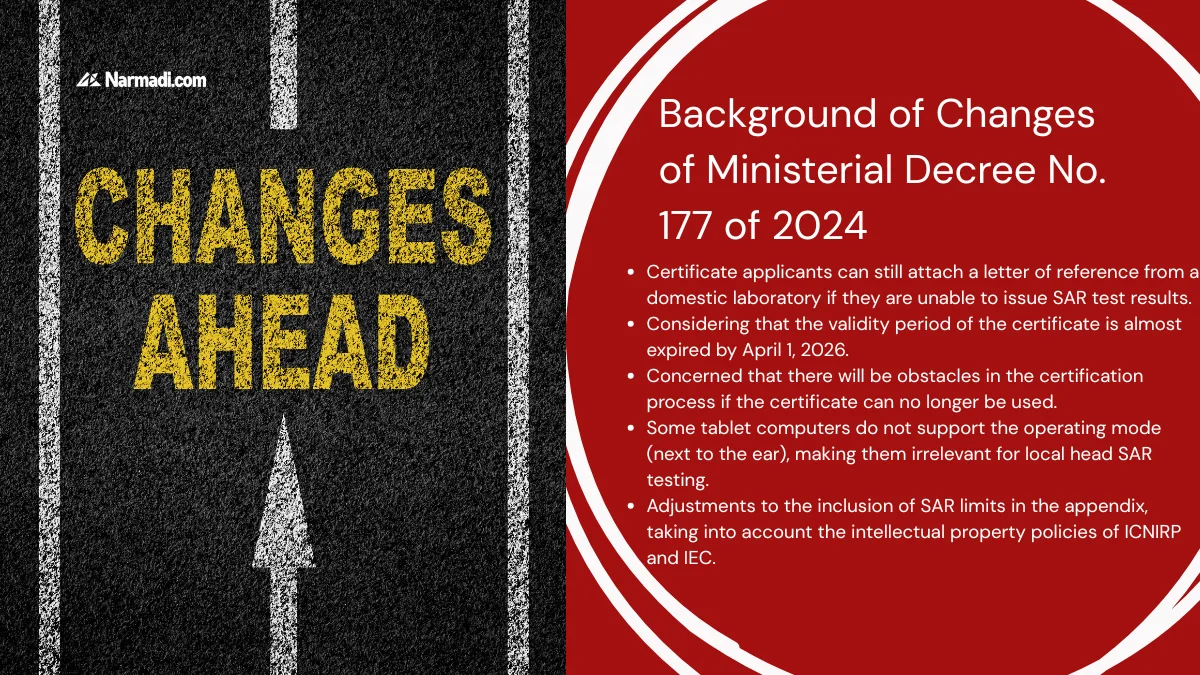
The dissemination of information regarding changes to Ministerial Decree No. 177 of 2024 did not occur without reason. Several factors led to these changes. The background is as follows:
- Certificate applicants can still attach a letter of reference from a domestic laboratory if they are unable to issue SAR test results.
- Considering that the validity period of the certificate is almost expired by April 1, 2026.
- Concerned that there will be obstacles in the certification process if the certificate can no longer be used.
- Some tablet computers do not support the operating mode (next to the ear), making them irrelevant for local head SAR testing.
- Adjustments to the inclusion of SAR limits in the appendix, taking into account the intellectual property policies of ICNIRP and IEC.
Extension of the Letter of Reference Related to Ministerial Decree No. 177 of 2024
During the socialization, the chair of the meeting announced plans to extend the letter of reference related to Ministerial Decree No. 177 of 2024. Initially, the letter of reference was only valid for two years from 2024, which would expire on April 1, 2026.
The certificate is planned to be extended until April 1, 2027. This is in line with the periodic evaluation to be conducted by KOMDIGI. Additionally, there will be efforts to add testing equipment at BBPT this year and next year in order to improve SAR testing services and reduce testing queues.
Exemption from SAR Limits on Tablet Devices
The draft revision of Ministerial Decree No. 177 of 2024 relates to exemptions from SAR limits on tablet devices. This applies to tablet devices that are not equipped with speakers for voice communication next to the ear.
The following is the draft revision:
- The application of the obligation to comply with SAR limits on the head as referred to in the FOURTH dictum, is exempted for tablet computers that do not have speaker facilities for voice communication next to the ear.
- Applicants for certificates for tablet computers that do not have speaker facilities for voice communication next to the ear must submit a statement and specifications of the tablet computer device in question.
Changes and Additions to the Appendix
Changes and additions to Ministerial Decree No. 177 of 2024 are also included in the appendix. The following is the revised draft:
- Limits for exposure to electric and magnetic fields for radio frequency bands up to 10 GHz are in accordance with Table 4. Basic limits for time-varying electric and magnetic fields for frequencies up to 10 GHz are in accordance with the ICNIRP guidelines (1998).
- Exposure limits for electric and magnetic fields for the frequency band from 100 kHz to 300 GHz, for an average interval of ≥ 6 minutes, as per Table 2. Basic restrictions for electromagnetic field exposure from 100 kHz to 300 GHz, for an average interval of ≥ 6 minutes, as per the ICNIRP guidelines (2020).
- Exposure limits for electric and magnetic fields for the frequency range from 100 kHz to 300 GHz, for an average interval of ≥ 6 minutes, as per the following table. Basic exposure limits for electromagnetic fields from 100 kHz to 300 GHz, for integration intervals >0 to <6 minutes in the ICNIRP (2020) guideline document.
| Exposure characteristics | Radio Frequency Range | Localized SAR (Head) (W kg-1) | Localized SAR (Trunk) (W kg-1) | Localized SAR (Limbs) (W kg-1) |
| Occupational Exposure | 100 k Hz-10 MHz | 10 | 10 | 20 |
| 10 MHz-10GHz | 10 | 10 | 20 | |
| General Public Exposure | 100 kHz-10 MHz | 2 | 2 | 4 |
| 10MHz-10GHz | 2 | 2 | 4 | |
| SAR Usage Method Standards | – IEC / IEEE 62209-1528 or EN 50360:2017; – KDB 941225 D01; – KDB 941225 D05; – KDB 941225 D05A; and/or – 447498 D01 or equivalent (IEC 62209-1) | – IEC/ IEEE 62209-1528 or EN 50566:2017; – KDB 9401225 D01; – KDB 941225 D05; – KDB 941225 D05A; and/or – 447948 D01 or equivalent (IEC 62209-2) | ||
- The standard testing method for specific absorption rate (SAR) is as follows:
- Head Testing
- Torso and Limb Testing
- SAR testing must be conducted at least at the frequency bands specified in the technical standards regulations.
- In the LHU, SAR testing for tablet computers must include a note regarding the speaker facility for voice communication next to the ear.
These are the changes and additions to Ministerial Decision No. 177 of 2024. This means that after this Ministerial Decision is signed, which is expected to be before April 1, 2026, the regulations will refer to the updates that have been made.