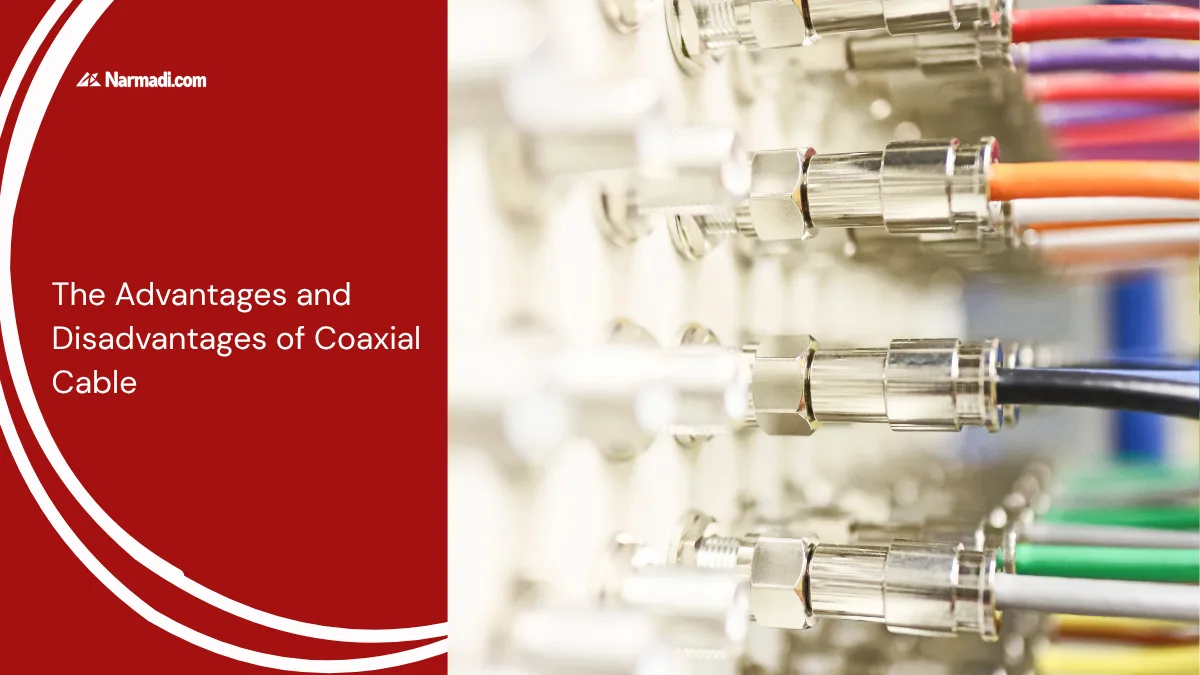
Coaxial cable provides many benefits, especially a unique set of characteristics that make it suitable for certain applications while presenting challenges in others. However, the advantages and disadvantages of coaxial cable cannot be separated, even though we can feel the benefits.
The advantages and disadvantages of coaxial cable include wide bandwidth, resistance to interference, no need for additional power, limited range, thick and stiff cable contours, to vulnerability to physical damage.
This article will inform you about some of the advantages and disadvantages of coaxial cable that you can consider.
The Advantages
Here are some of the advantages of using coaxial cable:
1. Superior shielding against interference and EMI
Coaxial cable is capable of maintaining high signal integrity in environments with a lot of interference. This is because its outer metal shield effectively blocks external electromagnetic interference (EMI) and radio frequency interference (RFI).
2. Wide bandwidth
Wide bandwidth is another advantage of coaxial cables. This cable allows data transmission at a higher speed because it has a wider bandwidth than twisted-pair cables.
3. Flexible in installation
Coaxial cables are ideal for use in telecommunications, broadcast, and industrial applications that require low-cost networking and easy installation. Its advantages of being easy to install and optimize make it used in small- to large-scale networks.
4. No need for additional power
Another advantage of coaxial cable is its ability to transmit signals without the need for additional power. This cable is ideal for use in networks that require low or no power, such as CCTV networks and audio networks.
5. Physical durability and outer protection
Coaxial cables are resistant to physical abrasion, moisture ingress, and wear caused by environmental conditions. This is because the cables are equipped with a sturdy outer sheath and strong dielectric insulation.
The Disadvantages
Here are some of the disadvantages of using coaxial cable:
1. High attenuation over long distances compared to fiber
Coaxial cables experience greater signal loss (attenuation) at high frequencies and over long distances compared to optical fiber. To prevent a decline in signal quality, an inline active amplifier or an optical splice is required.
2. Thick and stiff cable contours
Thick and stiff cable contours are another drawback of coaxial cables. The contour of the cable will make the installation process very difficult, especially in tight locations. Therefore, this cable is still less popular than other types of cables such as fiber optics and UTP.
3. Only one type of copper wire
Another thing that must be considered among the shortcomings of coaxial cables is the possibility of collisions during the data transmission process. This is because this cable only has one type of copper wire inside.
4. High investment cost
High-quality coaxial cables can have a higher price, especially for applications that require special specifications. Their underground installation also comes at a considerable cost. Careful planning before the installation of these cables is essential.
5. Vulnerability to physical damage
Although quite durable, coaxial cables are susceptible to physical damage. The cable can be damaged if it is bent too sharply or pinched. Therefore, a technician who is aware of this is needed.
Matching Cable Types to Needs
Understanding the advantages and disadvantages of coaxial cable helps you see both sides of the issue. From there, we can determine the specifications that best suit your network needs.
For High-Frequency RF and Radio Systems: 50-ohm RG-58 coaxial cable is suitable for optimizing power handling and antenna connections. It has the impedance required to support wireless transceivers and two-way radio systems.
For Broadband Internet and TV Distribution: 75-ohm RG-6 or RG-11 coaxial cable is suitable for minimizing signal attenuation at GHz-level frequencies. It features a thicker conductor and double shielding.
Matching the right type of cable to specific distance and frequency requirements is essential. By doing so, network operators can maximize overall performance.