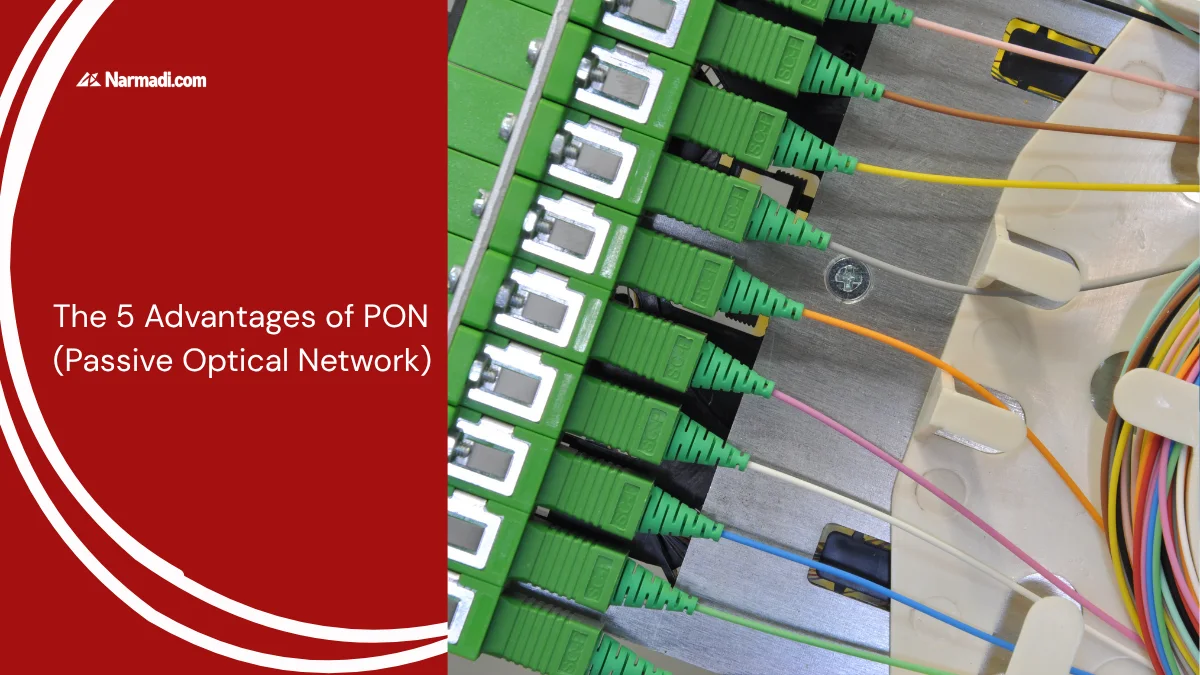
Passive Optical Network (PON) technology is emerging as a pioneer in today’s interconnected world, with reliable and efficient network infrastructure. One of the advantages of PON is that it supports seamless connectivity.
Other advantages of PON presenting a robust solution for modern communication needs include its cost-effective deployment, outstanding scalability, and easy installation.
This article will discuss five key advantages of PON and its importance in shaping our connected future.
What Makes Passive Optical Network (PON) Advantageous?
Before discussing its benefits, it’s worth understanding why Passive Optical Network (PON) architecture is so popular today. PON does not require powered switching equipment between the service provider’s central office and the end customer.
That is what sets it apart from traditional active optical networks. PON simplifies the fiber-optic infrastructure, reduces hardware complexity, and optimizes data transmission paths by utilizing unpowered (passive) optical splitters.
The Advantages of PON
Passive Optical Network (PON) has several advantages such as low cost, energy saving, reliability, and good scalability. Here are the details of some main advantages of PON:
1. Low cost
One of the advantages of PON is its low cost. Using fewer passive components, such as unpowered splitters and less fiber optic cable, makes PON installation and maintenance costs inexpensive.
2. Energy efficiency
Energy efficiency is another advantage of PON. Because it does not require power to run and cool active components, such as switches or repeaters, it is more energy efficient.
3. High reliability
PONs support high-speed triple-play (Voice, Video, and Data) access on a Gigabit bandwidth scale. PON also transmits data over distances of tens of kilometers using fewer passive components, resulting in a lower risk of failure.
4. Good flexibility and scalability
PON provides flexibility in adjusting to demand growth and new customer needs. PON is also easily scalable by adding more Optical Network Terminals (ONTs) without the need to upgrade the infrastructure.
5. Easy installation
Another advantage of PON is its easy installation. PONs are easy to install as they require no additional hardware other than cables and splitters.
Best Practices for Implementing
The benefits of PON in corporate or residential networks must be maximized. Therefore, it is important for engineers and project managers to implement it properly.
The following are best practices for a PON solution:
- Accurate Optical Power Budget Calculation: Carefully calculate optical losses in fiber-optic paths, connectors, and splitters to ensure that the signal reaching each ONT remains within the optimal power range.
- Choose the Right Splitting Ratio: Select the appropriate optical splitting ratio based on customer density and individual bandwidth requirements.
- Plan for Future Speed Upgrades: Deploy a high-quality passive optical distribution network (ODN) capable of supporting the transition without the need to replace outdoor cables.
Understanding the advantages of PON makes it clear why this technology remains the cornerstone of modern fiber-optic broadband infrastructure. It has been proven to drastically reduce operating costs, lower energy consumption, and provide scalable bandwidth for future growth.