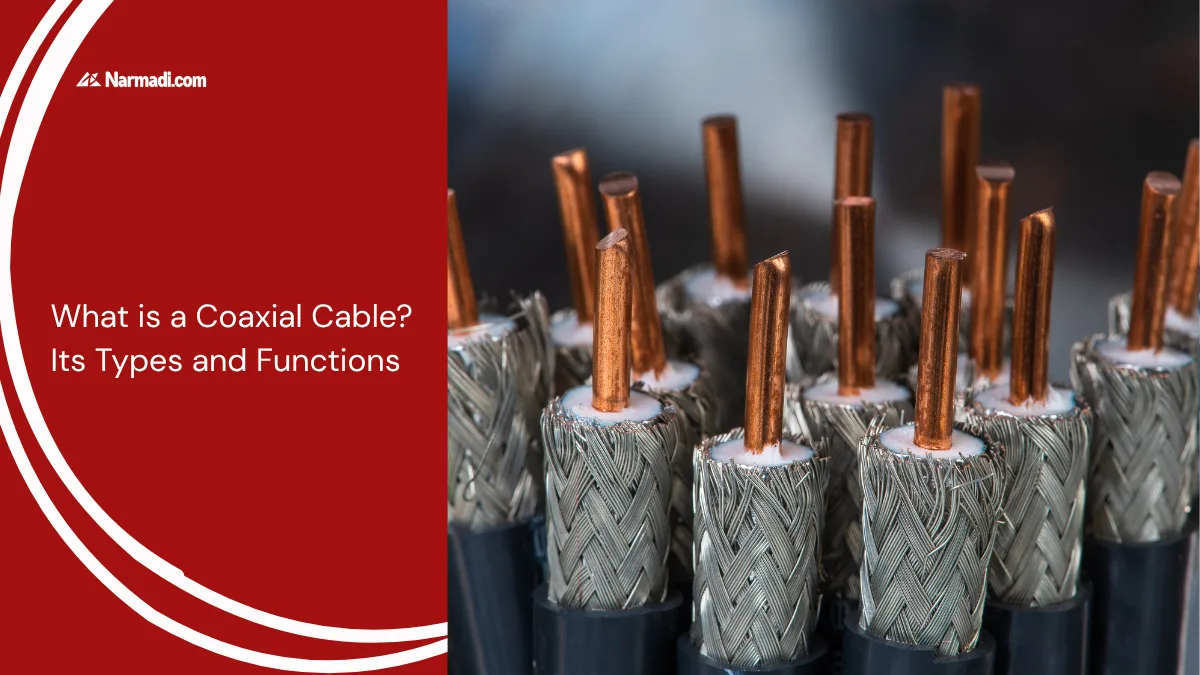
A coaxial cable is one of the indispensable components in various systems in supporting daily communication by transmitting high-frequency electrical signals.
With its various types and functions, coaxial cables are widely used in various applications, including cable TV, telecommunications, and computer networks.
This article will discuss the core aspects of coaxial cable, from its definition and its various types to its crucial function in transmitting high-frequency electrical signals.
What is a Coaxial Cable?
A coaxial cable is a type of cable used to transmit electrical signals at high frequency. This cable consists of two parallel conductors: a centre core that functions as a signal conductor and an outer shield that functions as a ground, which is separated by an insulator layer.
These cables are often used in cable television systems, telecommunications, modems, and CCTV camera systems with their signal sources. These cables also play an important role in computer networks, connecting various devices in a local network (LAN), especially for Coaxial Cable Home Network (CCHN) modems.
This cable has a simple structure but is effective in transmitting data at high speeds with minimal electromagnetic interference. Because of the cable’s structure that allows it to transmit stable signals with minimal interference, it is widely used in various applications that require reliable signal transmission.
The Types
Coaxial cables have several common types, such as RG-6, RG-59, RG-11, and RG-58, and here’s a detailed explanation:
- RG-6: Featuring a thicker center conductor and enhanced shielding, RG-6 is the standard cable used for cable TV, satellite television installations, and high-speed cable internet modems.
- RG-59: Built with a thinner center conductor, RG-59 is designed for low-frequency video signals and short-distance baseband applications, such as analog CCTV security systems.
- RG-11: A thick, heavy-duty cable engineered for long cable runs. Due to its minimal signal attenuation over extended distances, RG-11 is typically used for outdoor drop lines and telecommunication backbones.
- RG-58: Unlike 75-ohm video cables, RG-58 has a 50-ohm impedance optimized for radio frequency (RF) transceivers, wireless antennas, and legacy Ethernet networks.
The Function
Coaxial cables have several crucial roles in transmitting high-frequency electrical signals, including:
1. Shielding interference
Thanks to a protective layer of insulation, this cable effectively prevents electromagnetic interference (EMI). This is vital for maintaining signal quality, especially in high-frequency applications such as telecommunications and cable television.
2. Efficient transmission of electrical signals
Its main function is to transmit high-frequency electrical signals from the source to the destination device. These cables are specially designed so that signals can be transmitted with good quality and minimize electromagnetic interference from the surrounding environment.
3. Connecting the antenna to a receiving device
This cable also connects the antenna to a receiving device such as a TV or radio. The signal captured by the antenna can be forwarded to the device with good quality and minimal interference.
4. Transmission media in computer networks
In computer networks, this cable can be used as a data transmission medium, especially in LAN (Local Area Network) networks that use Ethernet technology. Ethernet coaxial cable offers high data transfer rates, suitable for small to medium-sized computer networks.
5. Audio and video system connection
Coaxial cables are also useful for connecting audio and video devices such as home theatres, DVD players, and game consoles. These cables are capable of transmitting audio and video signals with good quality and reducing interference during transmission.
CCHN Connection as Modern Broadband
Long-distance backbone networks are dominated by fiber-optic cables. However, high-quality coaxial cables such as RG-6 remain essential for broadband distribution in the “last-mile” segment and within buildings.
To deliver multigigabit broadband speeds over existing coaxial lines inside buildings, protocols such as DOCSIS and MoCA must be implemented. Connecting home networks to these coaxial lines relies on specialized gateway devices, such as CCHN modems.
To understand how this device balances high transmission capacity with physical attenuation limitations, check out our detailed guide on the Advantages and Disadvantages of CCHN Modems.
Understanding what coaxial cable is helps you appreciate its importance in telecommunications. Coaxial cable uses a physical metal shield to block interference. This makes it a robust and cost-effective foundation for modern high-frequency data transmission.