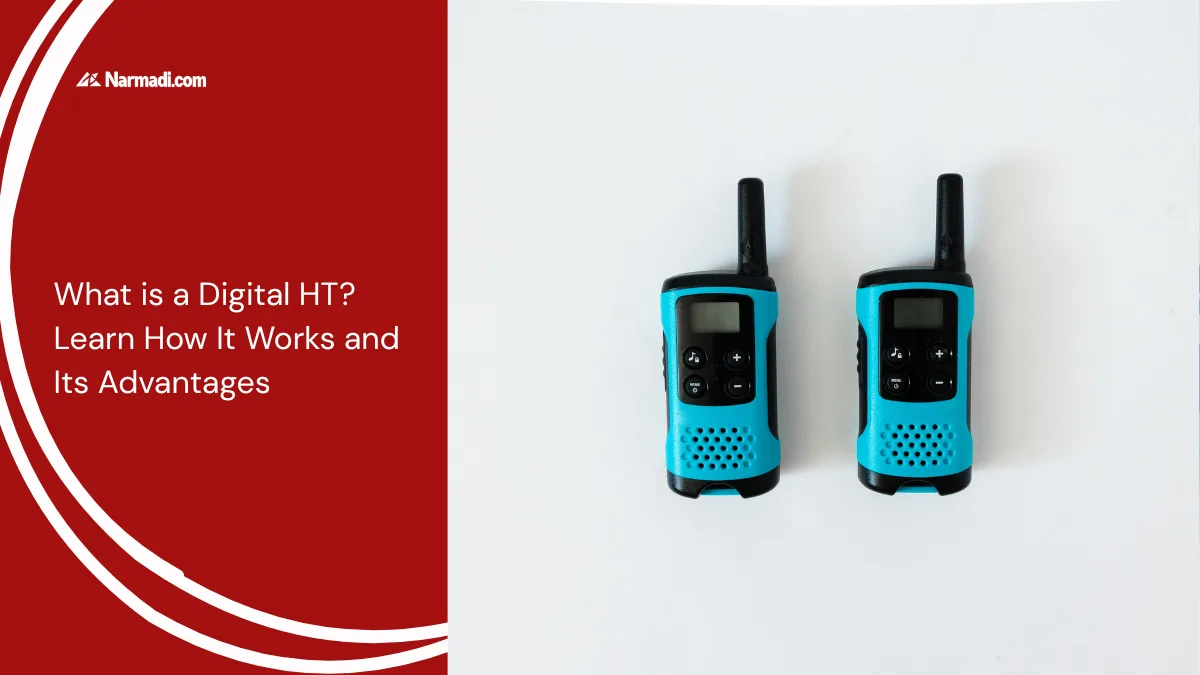
Digital Handy Talky, or Digital HT, is an innovation from analog HT as an answer to the growing digital era.
Digital HT has several differences in how it works and its advantages from its predecessor, analog HT.
This article will review digital HT from the definition, how it works, and its advantages that can be your consideration before using it.
What is a Digital HT
Digital Handy Talky is a portable two-way communication device that uses digital technology to transmit sound.
This device is generally used in digital radio communication and is suitable for various purposes, such as outdoor activities, security surveillance, and military operations.
Compared to the analog version, digital HTs have more advanced features, such as voice encryption, digital frequency programming, and the ability to send text or data messages.
The main advantage of digital Handy Talky lies in their clearer audio quality and wider range compared to analog signal-based devices.
Thanks to their resistance to signal interference and challenging terrain conditions, digital HTs are a more reliable option.
As technology evolves, these devices continue to be updated with advanced features, moving beyond traditional analog radio modulation.
How it Works?
A digital HT works by utilizing digital signal processing (DSP) to transmit audio over radio frequencies. Here’s how it works in more detail:
- Voice Encoding (Vocoder): Analog audio fed into the HT’s microphone is converted by an internal vocoder (such as AMBE+2) into digital data.
- Digital Transmission: Next, the digital data is modulated and transmitted over a radio channel using multiplexing technologies such as Time Division Multiple Access (TDMA) or Frequency Division Multiple Access (FDMA).
- Signal Reconstruction: Next, the HT receiver decodes the digital packets back into audio, which is then output through the speaker.
The HT receiver will only decode clean digital data and naturally filter out static and background noise. This results in clearer audio.
The Advantages
1. Superior Audio Clarity and Noise Suppression
The ability of digital HTs to filter out background noise is a distinct advantage. The sound produced is not only clear, but also maintains consistent sound quality as long as you remain within range.
This is what sets it apart from analogue signals. As you move further away from the sound source, the sound quality deteriorates until it becomes static.
2. Battery Efficiency and Spectrum Capacity
In terms of battery efficiency, digital HT offers up to 40% longer battery life. This is because the transmitter is not continuously active during the voice frame.
In terms of spectrum capacity, these devices are capable of doubling it. Digital technologies such as 2-slot TDMA allow two conversations to take place simultaneously and independently within a single 12.5 kHz channel.
3. Enhanced Security and Integrated Safety Features
In terms of security, digital HT are equipped with built-in digital encryption. This enables them to prevent unauthorised eavesdropping on private channels.
In high-risk industrial environments, these devices can be integrated with built-in worker safety features, such as GPS location tracking, lone worker alarms and man-down sensors. This automatically triggers an emergency alert if an operator fails to respond.
Seamless Migration with Dual-Mode (Analog/Digital) HTs
Given the benefits offered by digital HT, it is no surprise that users are beginning to switch from analogue models. This, of course, means that analogue HT are becoming less popular.
This transition can actually be carried out whilst continuing to utilise existing analogue equipment. After all, within a single industry or organisation, the switch from an analogue to a digital radio system does not have to happen overnight.
Most modern digital HT radios are equipped with a Dual-Mode feature (Analog & Digital). This feature allows the devices to operate on legacy analog channels as well.
As a result, an industry or organization can upgrade its equipment gradually. It is still possible to use legacy analog radios for communication while gradually transitioning to digital channels as new funding becomes available.
In today’s digital age, switching to a digital HT is something we simply have to do. Given what they offer in terms of privacy, superior audio clarity and safety management through the integration of industry-standard features, these devices are indeed reliable.
One thing to bear in mind when using them is to ensure that the digital radio equipment has met the Type Approval Certification requirements. This will guarantee safe, smooth and interference-free operation.