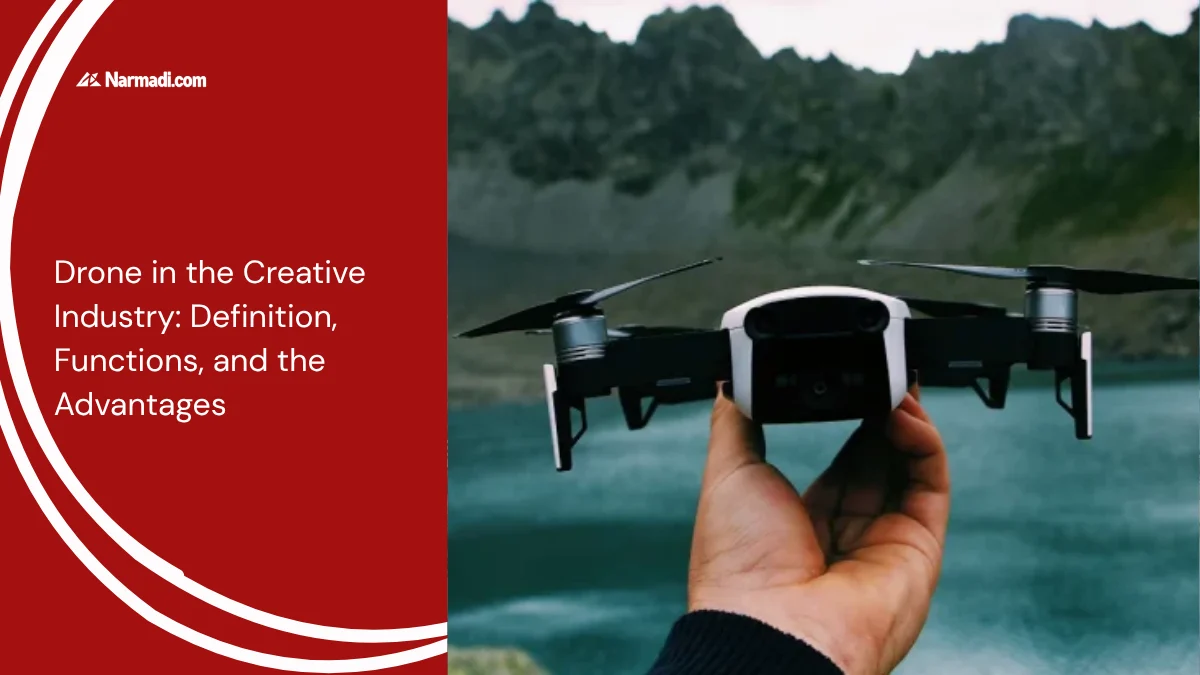
The presence of drones as a recording tool for more efficient aerial imaging needs has benefited various sectors, one of which is the creative industry. Drones in the creative industry have some functions and advantages.
The functions of drones in the creative industry include unique aerial shooting and cost and time efficiency. The advantages include efficient aerial photography to reduce production costs.
This article will give you information on drones in the creative industry from definition, functions, and advantages that they have.
What is a Drone in the Creative Industry?
Commonly known, drones are used in the creative industry for professional photo and video shooting needs. Drones are currently being utilised in the world of film which is used for aerial shots.
Not only in movies, but in the world of photography, drones are also used to capture images from the air. The use of drones in the creative industry cannot be separated from their ability to create high-quality videos and photos from different points of view.
The Functions
Drones in the creative industry have several functions, from unique aerial shooting to cost and time efficiency. Here are some of their functions:
- Unique aerial shooting: Allows shooting from high altitudes and difficult viewpoints, thus providing new perspectives and interesting visuals.
- Improving production safety: Ensuring the safety of production staff is maintained when aerial shots can be taken with drones.
- Cost and time efficiency: With drones, the need for heavy crews and equipment is naturally reduced, and the shooting process can be faster.
The Advantages
Drones in the creative industry have several advantages, from efficient aerial photography to reduced production costs. Here are some of their main advantages:
1. Efficient aerial photography
One of the advantages of drones for the creative industry is the efficiency of aerial photography. With drones, images and videos from various heights, including aerial images, panoramas, and different angles, can be quickly and easily captured.
2. More innovative content creation
More innovative content creation is another advantage of drones for the creative industry. With drones, artists and filmmakers can open up opportunities to create more innovative and unique content for short films, promotional videos, or light shows.
3. Reduced production costs
Reduced production costs are one of the advantages of drones in the creative industry. Using drones for aerial shots can reduce production costs compared to traditional methods that require larger crews and equipment.
4. Better safety
Before drones, aerial shots could be shot using conventional airplanes or pulleys. This poses a risk to the safety of the user. With drones, aerial photography can be easily done with lower safety risks.
Cinematic Stabilization and Spatial Control in Production
Unlike industrial drones, creative industry drones are designed to produce smooth, shake-free cinematic shots. This capability is made possible by advanced payload engineering, particularly a three-axis mechanical gimbal and high-resolution camera sensors.
The gimbal actively neutralizes wind turbulence and sudden maneuvers. As a result, camera movement remains smooth even when recording at high speeds.
Additionally, for filmmaking purposes, drones are often operated in challenging environments. Examples include narrow urban alleys, enclosed spaces, or dense crowds. Therefore, the devices require a precise electronic speed control system as well as an obstacle detection system.
Creative production is one of the main areas where these UAVs are used. However, the applications of drones in many sectors continue to expand into various industries, including agriculture, construction, and emergency logistics.