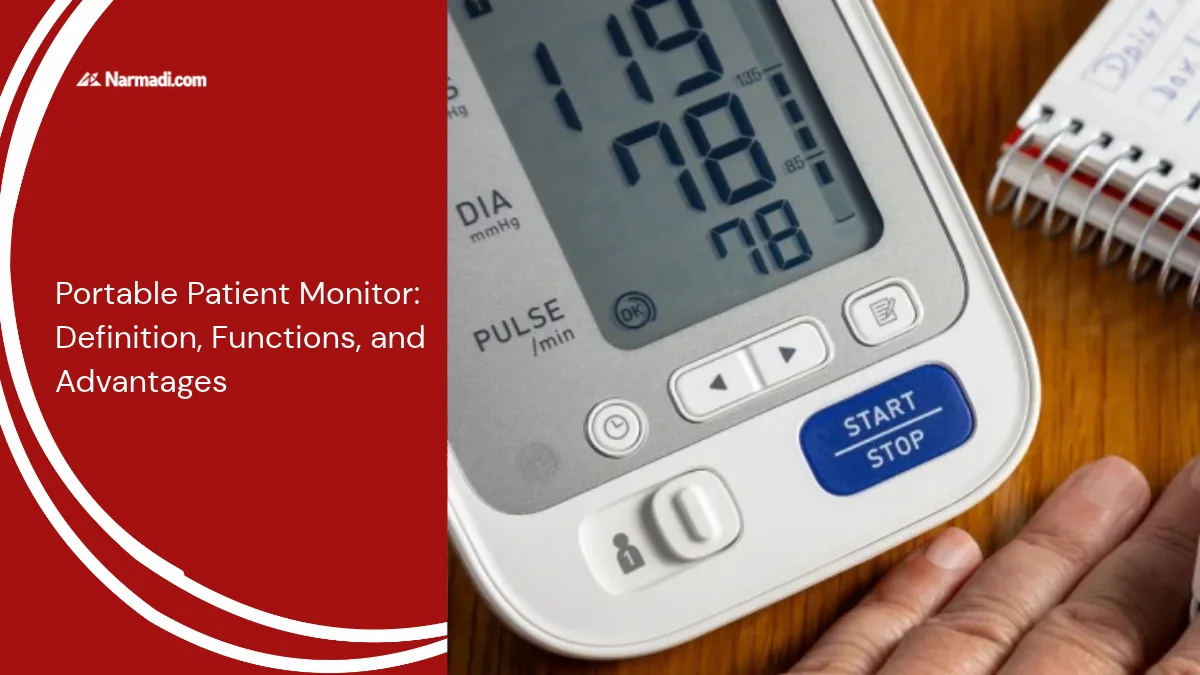
The presence of a patient monitor facilitates medical operations by continuously monitoring vital signs, including heart rate, blood pressure, oxygen saturation, and respiratory rate, in real time. One type of patient monitor is a portable patient monitor, which has some functions and advantages.
The functions of a portable patient monitor include improving efficiency for continuous monitoring. Moreover, the advantages include ease of use, high mobility, and affordable prices.
This article will give you information on portable patient monitors, including their definitions, functions, and advantages they have.
What is a Portable Patient Monitor?
Portable patient monitors are monitors designed for high mobility. It is used in medical monitoring in ambulances during medical transportation or medical activities in the field during disasters.
Portable patient monitors are lightweight and power-efficient, but their capabilities are limited, usually only able to monitor basic parameters such as ECG, SpO2, and blood pressure.
The Functions
The portable patient monitor has several functions, from improved efficiency to continuous monitoring. Here are some of its functions:
- Improves efficiency: Helps reduce the need for intensive manual monitoring by medical personnel.
- Flexibility of use: Compact and lightweight, making it easy to transport the device for use in a variety of settings.
- Continuous monitoring: Enables continuous monitoring of vital signs by providing real-time information.
The Advantages
The portable patient monitor has several advantages, from efficiency of use and high mobility to affordable prices. Here are some of its main advantages in detail:
1. Provides high mobility
One of the advantages of portable patient monitors is that they provide high mobility for monitoring patient conditions. With its compact size and lightweight design, it allows the monitor to be easily moved to several locations, including those that are difficult to reach.
2. Efficiency of use
The efficiency of use is another advantage of these patient monitors. This device allows medical personnel to speed up the process of diagnosing and treating patients, especially during emergency conditions.
3. Supported by telemedicine
Another advantage of this type of portable patient monitor is telemedicine support in some models. By connecting to the telemedicine system, it allows patient monitoring and consultation to be carried out remotely.
4. Ease of use
These patient monitors have the advantage of ease of use. The device has a simple design, allowing it to be used by medical staff or patients personally while at home.
5. Affordable price
Another very important advantage of portable patient monitors is their affordable price. Of course, this device, when compared to other patient monitors, has a more economical and affordable cost. It is possible if the patient wants to buy this device for personal monitoring at home.
Enhancing Mobility in Patient Monitoring
The implementation of portable patient monitoring systems marks a significant shift in emergency medicine. These devices facilitate continuous monitoring during prehospital care, disaster response, and field assessments in remote areas.
Comprehensive stationary devices, such as standard multi-parameter monitors, serve as the gold standard for intensive care settings. However, portable devices excel in providing direct clinical monitoring in decentralized locations.
Portable devices are also equipped with telemetry and wireless connectivity, allowing health data to be transmitted in real time to medical command centers. This helps medical teams facilitate early triage and prepare for patient arrival.