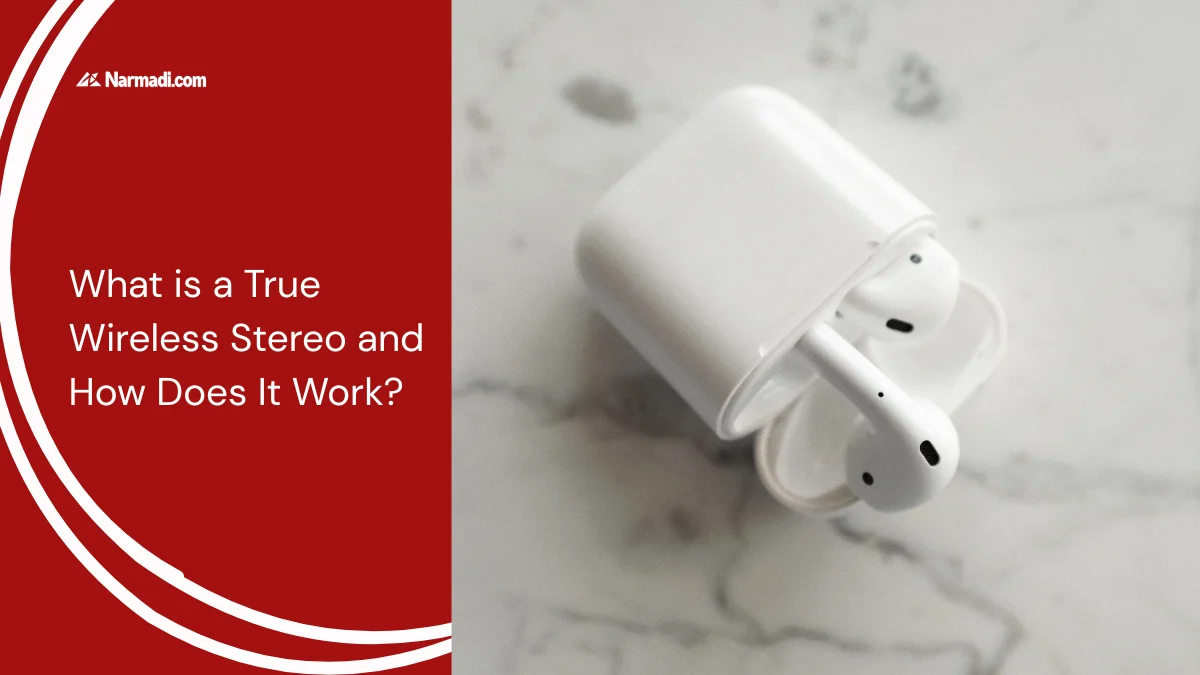
Nowadays, it is rare to find devices with cables, but their role has been replaced by True Wireless Stereo (TWS).
The versatility of use and the features of True Wireless Stereo make this tool popular among many people for listening to audio, watching movies, playing games, and making phone calls.
This article will provide you with more information about True Wireless Stereo, including its definition, how it works, its components, functions, features, and usage regulations.
What is a True Wireless Stereo?
True wireless stereo (TWS) is a wireless audio device that allows wireless use between the two earbuds and a primary device, such as a laptop or mobile phone. The TWS connects to the main device using Bluetooth technology that transmits sound directly to the earbuds.
The TWS was first released in 2015; its emergence was supported by the periodic removal of 3.5mm audio ports from devices. It has been loved ever since for its ability to freely listen to audio, take calls, or play games without annoying wires.
1. How does it work?
In general, True Wireless Stereo (TWS) works with Bluetooth technology that connects to a primary device, such as a smartphone or laptop. Here is how it works in detail:
- Bluetooth connection: Activate the Bluetooth connection of the primary source (phone or laptop) and connect to the TWS earbud device.
- Inter-earbud synchronization: The TWS uses a master-slave working system, with the master connecting to the audio source device and acting as the main receiver, while the slave then connects to the master earbud.
- Audio transmission: Audio from the main device, as the audio source, is sent to the master earbud and then forwarded to the slave earbud.
- Digital signal processing: To ensure good audio, the TWS uses digital signal processing (DSP) technology.
2. The main components
Here are some of the main components of True Wireless Stereo (TWS):
- Bluetooth chipset: Manages wireless connectivity.
- Speaker driver: Converts digital signals into sound.
- Internal battery: Generally sufficient for 3-6 hours of use per charge.
- Charging case: A case that also serves as a portable charger.
- Sensor & microphone: For touch operations and features such as noise cancellation.
3. The characteristics
The device can be called True Wireless Stereo (TWS) if it has some characteristics. TWS does not have a cable connection between the right buds and the left buds, or to the phone. They use Bluetooth to connect with the device.
TWS has a charging case that has functions for storage and charging. You can use the TWS just for the right buds or the left buds independently. Furthermore, they have some sophisticated features, such as active noise cancellation (ANC), a microphone for calls, and a touchscreen.
The Functions
The main function of True Wireless Stereo (TWS) is to provide a wireless audio listening experience. Here are some of the functions of TWS:
- Provides wireless stereo audio: Allows listening to audio in stereo from the main device wirelessly.
- Provides convenience and mobility: Offers the convenience of use and seamless mobility in the absence of wires.
- Versatility of use: Suitable for a variety of activities such as listening to music or making phone calls, even when doing sports, working, or traveling.
The Features
Here are some features of True Wireless Stereo (TWS):
- Touch control: Allows control of music playback, volume, calls, and other functions through touch only on the earbuds.
- Voice assistant integration: Allows integration with Siri, Google Assistant, or Alexa voice assistants.
- Find my earbuds: Helps locate lost earbuds with the tracking feature.
- Wireless charging: Enables wireless charging of the charging box.
- Water and sweat resistance (IPX): Equipped with an IPX4 standard or higher to protect the earbuds from damage due to water or sweat.
- Ergonomic design: Designed to be comfortable for long-term listening.
- Long battery life: Lasts from several hours to tens of hours in use.
The Advantages and Disadvantages
Every device has its positives and negatives, including True Wireless Stereo (TWS). Here are some of them:
1. Advantages
- No cable limits your movement.
- Simple design, light, and easy to carry.
- Some models support smart features, such as active noise cancellation (ANC).
- Ideal to use for many activities, from sports to work.
2. Disadvantages
- Have a shorter battery life than wired earphones.
- Small size makes the TWS easy to lose.
- Some entry-level models might have a delay or signal issues.
- More features, higher price.
Ensuring Global Compliance for TWS Products
True Wireless Stereo (TWS) devices rely on short-range radio frequencies, primarily Bluetooth technology. In practice, devices that use this technology must comply with strict regulatory frameworks worldwide.
Before wireless audio products can be legally marketed in a specific market, manufacturers, importers, or distributors must obtain a Type Approval Certificate. As part of this process, regulatory authorities must ensure that all radio-frequency-based devices undergo rigorous technical evaluation.
These compliance testing procedures typically include Radio Frequency (RF), Electromagnetic Compatibility (EMC), and Specific Absorption Rate (SAR) testing. The result is a test report that confirms the device operates within the specified frequency band without causing harmful interference to communication devices.
The test report is then submitted to the relevant authorities in a country for evaluation and certification. Obtaining a Type Approval Certificate ensures a smooth launch of your product into the target market.