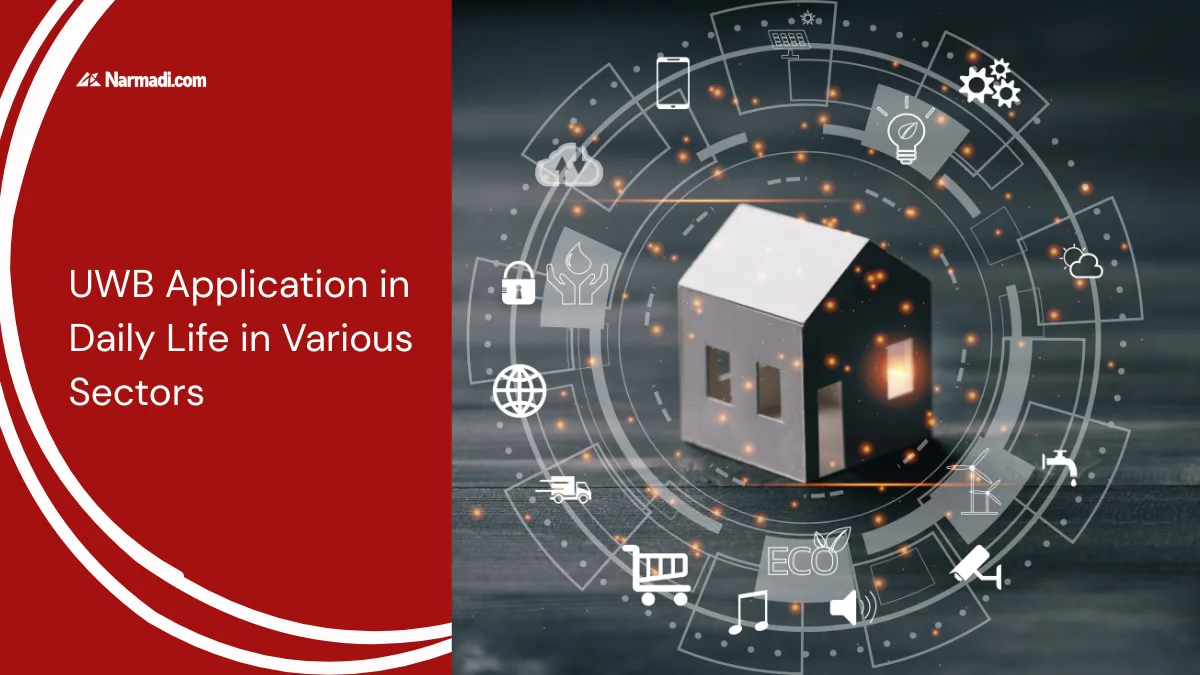
Ultra-wideband (UWB) has become one of the most talked-about technologies with continuous development and innovation. Currently, there are many UWB applications in daily life.
Modern technologies such as device tracking, smart homes, or even super-fast short-distance communication are some examples of UWB applications in daily life.
You will often come across UWB applications in everyday life, ranging from security systems to the healthcare sector. This article will discuss more about the application of UWB in daily life.
What is UWB and How Does It Work?
Before discussing the use of UWB in everyday life, you need to know what sets it apart from other wireless technologies.
Ultra-wideband (UWB) is a short-range wireless communication technology that transmits data using low-power radio waves. It utilizes radio waves in the frequency range between 3.1 GHz and 10.6 GHz.
This is what sets UWB apart from Bluetooth or Wi-Fi, which operate on a single narrow frequency band.
UWB works by transmitting signals with precise time synchronization. This technology calculates distance and location with centimeter-level accuracy. As a result, it is much more difficult to spoof or intercept.
More than just a wireless connection, UWB excels at determining a device’s exact location with high precision. That’s why it’s used in so many everyday applications.
UWB Applications in Daily Life
You may not realize that UWB technology is already widely used. It can be found in many aspects of daily life. Here are some examples of its applications:
1. Security and access control systems
In addition to RFID, which is used in security and access control systems, many companies are adopting UWB for these systems. With UWB, users can gain automatic access using an access card or their smartphone.
2. Device tracking in smart homes
These days, smart home appliances are ubiquitous. This is where UWB comes into play. It’s used in smart home devices such as speakers, cameras, and sensors.
This technology allows these devices to track the user’s location within the home. Not only that, but you can customize the services provided, such as turning on lights or adjusting the temperature based on the user’s presence.
3. Indoor navigation
At airports or shopping centres, UWB is used for indoor navigation. This technology enables users to navigate their way around indoor spaces, making the user experience more interactive and informative.
4. Digital car keys
UWB technology allows users to unlock and start their vehicles using just their smartphone. The distance between the phone and the car can be measured with high accuracy, making access more secure.
5. Contactless Payment Systems
UWB technology can be used to create contactless payment systems that are more secure and reliable than current solutions.
This technology is capable of transmitting payment information between mobile devices and payment terminals, making the process more secure and minimizing the risk of fraud.
6. Industrial automation
UWB technology can be used in industrial automation applications to enable more precise and reliable communication between devices.
For example, it can be used to transmit information between robots and other industrial equipment, allowing them to work together more efficiently.
7. Applications in the healthcare sector
UWB has great potential for applications in the healthcare sector. One such application is tracking the movements of patients or medical equipment in hospitals.
This technology is capable of determining precise positions, making it an ideal choice for monitoring the location and condition of assets.
Those are some examples of UWB applications in everyday life. In the future, the adoption of UWB is expected to continue expanding as the number of smartphones, vehicles, and smart home devices grows.
This will lead to UWB becoming a standard feature. As a result, you’ll enjoy a more accurate, secure, and seamless experience across various sectors, such as retail, logistics, and public infrastructure.