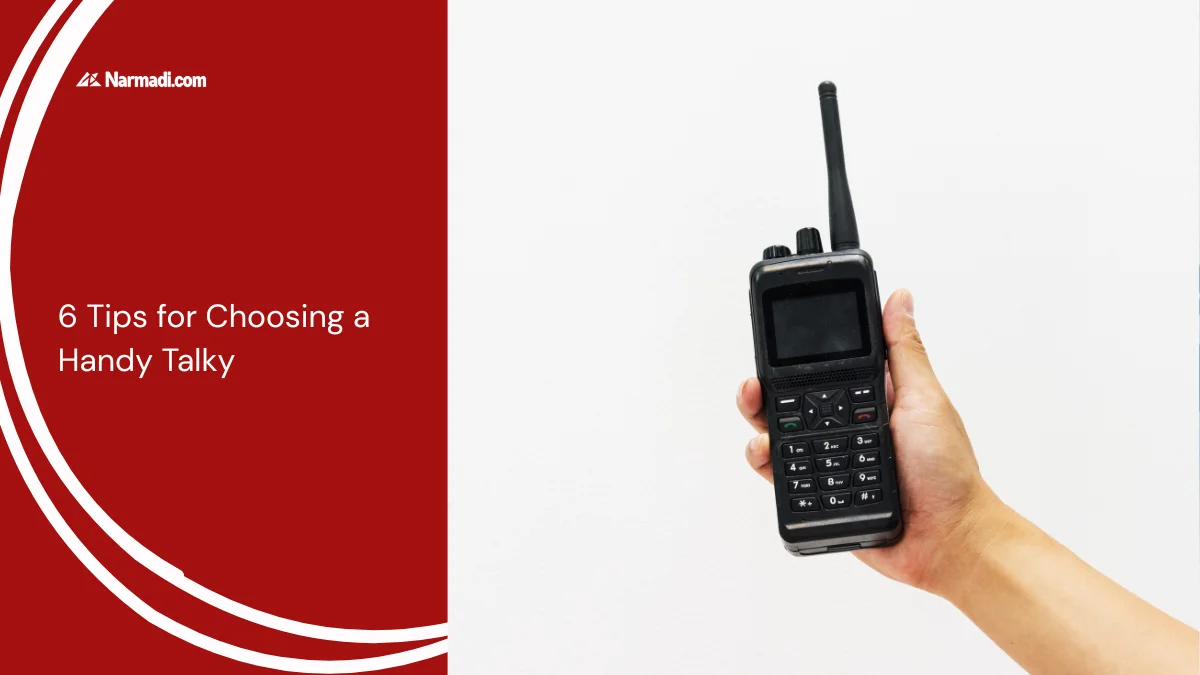

Handy Talkie (HT) is a two-way communication device still widely used in various sectors, from industry and security to outdoor activities. Therefore, tips for choosing a Handy Talky are important so as not to choose the wrong one.
Tips for choosing a Handy Talky may sound simple, but choosing the right Handy Talky requires special attention to suit your needs and provide the best performance.
In this article, we will share six tips for choosing a Handy Talky that will help you choose the best HT according to your needs.
Tips for Choosing a Handy Talky
1. Identify usage needs
The first step in choosing a Handy Talky is to understand its intended use. Will it be used for outdoor activities such as hiking and camping, or for industrial, hospitality, and security purposes?
For outdoor activities, choose an HT with a wide range, high battery life, and water- and dust-resistant features. For industrial or public service needs, choose HTs with strong signals and group communication features for work effectiveness.
2. Choose the right type of handy talky
Handy Talkies are available in two main types:
- Analog HTs: Simpler and more affordable, suitable for everyday communication.
- Digital HTs: Provides clearer sound, wider range, and is more power efficient than analog HTs.
3. Look at the frequency and transmission range
Transmission range is an important factor in Handy Talky selection. Generally, the range varies from a few hundred meters to tens of kilometers.
- Short range (100–500 meters): Ideal for indoor events, warehouses, or small building operations.
- Medium range (1–5 km): Suitable for outdoor industrial sites, events, or security patrols.
- Long range (5–10+ km): Recommended for large areas such as forests, mountains or emergency response operations.
4. Choose the Right Frequency Band: VHF vs UHF
Walkie-talkies operate on two main radio frequency bands. Their use determines where these devices are best suited:
- VHF (Very High Frequency / 136–174 MHz): Can cover longer distances in open areas. Ideal for open environments, such as forests, farms, the ocean, and hiking.
- UHF (Ultra High Frequency / 400–512 MHz): Can easily penetrate solid structures such as concrete walls, steel, and multi-story floors. Ideal for indoor environments, such as offices, malls, and hotels.
Some devices come equipped with dual-band VHF/UHF frequencies or a repeater. These are suitable for long-range communication needs exceeding 10 km.
5. Check battery life
Battery life affects the duration of Handy Talky usage. Generally, there are two types of batteries:
- Dry battery: Practical for emergencies or outdoor activities as they can be replaced at any time.
- Rechargeable battery: More cost-effective in the long run and environmentally friendly.
Battery life will determine how long your device can operate. Devices that use AA dry-cell batteries are limited to a few emergency backup models. Most modern professional two-way radios now use rechargeable lithium-ion (Li-ion) battery packs.
For activities such as patrols or outdoor expeditions, choose a two-way radio with a capacity of at least 1,500 mAh to 2,200 mAh. This will ensure the device can be used all day without needing to be recharged.
6. Choose useful additional features
Modern Handy Talkies are equipped with various advanced features to improve the convenience and effectiveness of communication, such as:
VOX (Voice-Activated Transmission): Allows communication without pressing a button, ideal for hands-free use.
- Emergency Alert: Sends an emergency signal in case of a dangerous situation.
- Noise Cancellation: Reduces noise interference from the surrounding environment.
- IP Rating (Water & Dust Resistant): Essential for use in extreme environments such as outdoor areas or heavy industry.
Choosing a Handy Talky with the appropriate features will improve communication efficiency and the overall user experience.
In addition to these six criteria, there is one criterion that must not be overlooked, namely the Type Approval certificate. This certificate guarantees that the device is safe and does not cause interference when in use.
The device will be tested and certified to ensure that the radio transmitter complies with the applicable frequency allocations in a given country. This certification is, of course, an essential requirement for users in security organisations, corporate users, and public services.