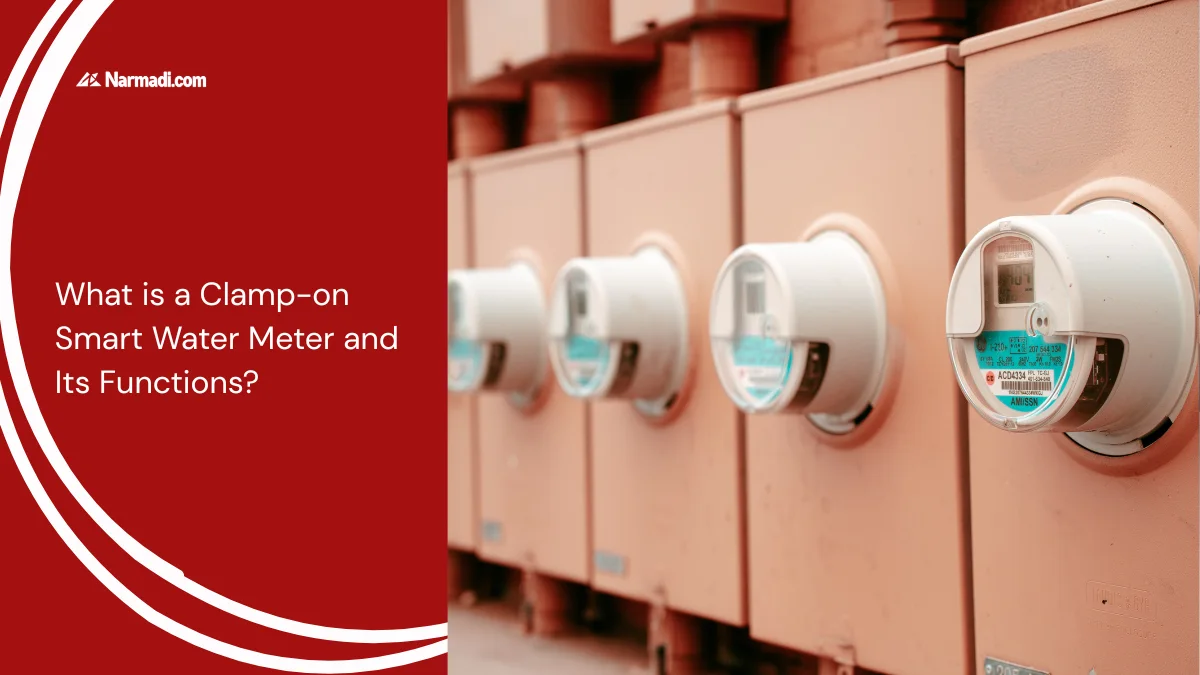

Clamp-on smart water meters are one type of smart water meter. This device is one of the innovations of the growing Internet of Things (IoT) and has penetrated many household needs.
Clamp-on smart water meters have some functions that provide benefits to our daily activity to use water more efficiently.
Are you familiar with the features and benefits of clamp-on smart water meters? This article will discuss the definition, features, and benefits of clamp-on smart water meters.
What is a Clamp-on Smart Water Meter?
Clamp-on smart water meters are smart water meters that use ultrasonic technology to measure the flow of water through a pipe without having to cut or modify the pipe. This meter is not installed inside the pipe, but outside the pipe by clamping or attaching.
It is equipped with IoT (Internet of Things) technology that allows measurement data to be transmitted wirelessly to a central system for monitoring and management.
The Key Functions
Clamp-on smart water meters perform several essential functions that extend beyond basic volume accumulation:
1. Automated Real-Time Usage Tracking
The main function of a clamp-on meter is to automatically measure and record water consumption. The measurement and recording data are stored in the device’s local memory.
Then, the data is automatically sent to your smartphone or central dashboard. This allows you to monitor your daily water consumption patterns in real time.
2. Non-Contact Ultrasonic Flow Measurement
Mechanical wear, pressure drop and the risk of contamination can occur with conventional measurement methods. These issues are eliminated with the clamp-on smart water meter.
This measuring device utilises a high-frequency ultrasonic transducer to measure the velocity of water flow through the pipe wall. This is done without coming into direct contact with the fluid.
3. Early Leak Detection and Flow Anomalies
Early detection and awareness of unusual flow patterns are vital. This is essential to prevent long-term damage.
The clap-on smart water meter continuously analyses the flow rate. The device will issue an instant alert when there is unusual water activity, such as a persistently low flow rate indicating a pipe leak. In this way, property damage and water loss can be prevented.
4. Efficient Water Cost Management
Based on this device’s ability to collect data, usage analysis can be conducted. From there, consumption trends over time can be closely monitored.
This data can serve as a foundation for promoting more sustainable water usage habits. As a result, monthly water bills can be reduced.
The Advantages
Here are some of the advantages of using a Clamp-On on a smart water meter:
- No need to cut or modify pipes: This makes installation and maintenance easier and faster.
- Can be applied to multiple pipes: Suitable for various types of pipes, including large pipes, pipes with corrosive materials, and pipes containing particles.
- Accurate measurements: Ultrasonic technology provides accurate measurement of water flow discharge.
- Efficient management: Wirelessly transmitted data enables more effective monitoring and management of water usage.
Key Installation and Maintenance Factors
Clamp-on smart water meters do not require any pipe cutting. However, correct physical installation and regular maintenance are required. This is to ensure long-term measurement accuracy and signal stability.
The first thing to do is to clean and sand away any rust, paint or dirt from the outer surface of the pipe where the transducer is to be fitted. This is done to ensure optimal acoustic signal coupling through the pipe wall.
Secondly, apply high-quality acoustic coupling gel between the pipe wall and the ultrasonic sensor. This will eliminate any air gaps that could block or distort the high-frequency acoustic signal.
Thirdly, ensure that the transducer is installed at the correct distance, as recommended, along a straight section of pipe. This is necessary to avoid measuring turbulent fluid flow.
Finally, check the mounting clamps and wireless transceivers regularly to ensure they are not affected by environmental vibrations or humidity. If this is not taken into account, it may cause the sensor to shift position or the physical casing to become loose.