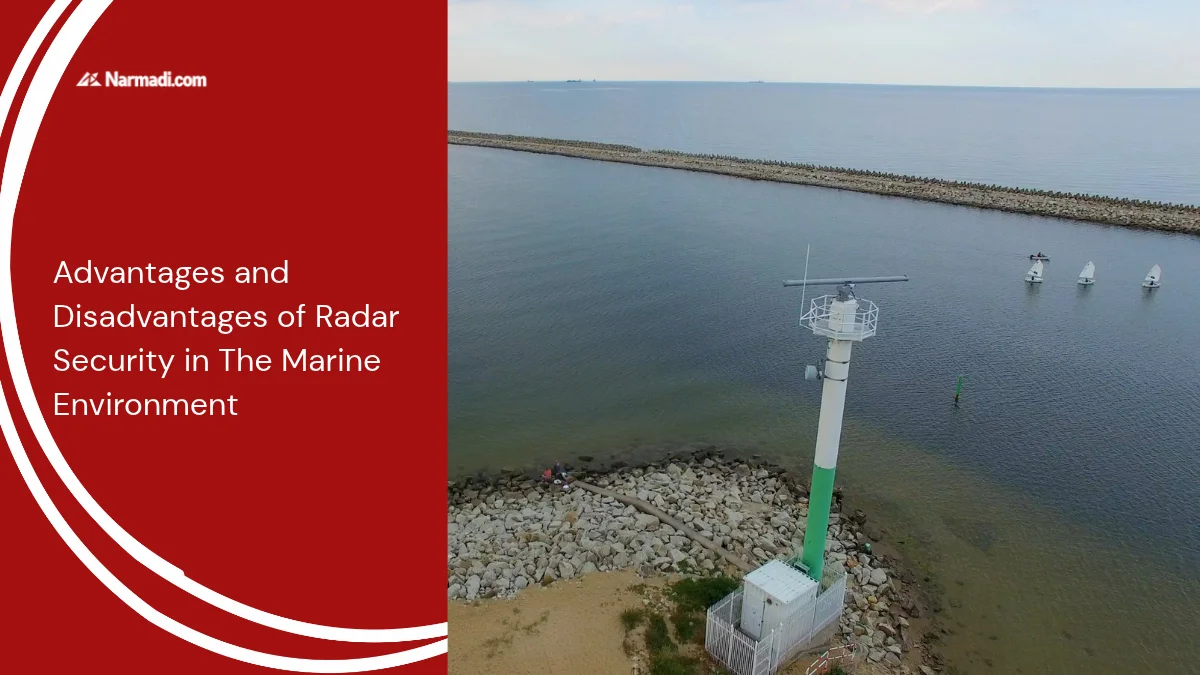

Radar security in the marine environment provides many benefits, especially in military security systems. However, the advantages and disadvantages of radar security in the marine environment cannot be separated, even though we can feel the benefits.
The advantages and disadvantages of radar security in the marine environment include early detection, long-range detection, range limitations, and target lock time.
This article will inform you about some of the advantages and disadvantages of radar security in the marine as your consideration.
Advantages
Here are some of the advantages of using radar security in the marine environment:
1. Early detection
One of the advantages of radar security in the marine environment is its ability to detect incoming threats early. This early detection of threats enables security precautions and anticipation.
2. Wide-Area Maritime Surveillance
Radar systems can scan vast expanses of open water across dozens of nautical miles. This long-range coverage enables maritime authorities to monitor large Exclusive Economic Zones (EEZs) and strategic shipping channels efficiently.
3. Facilitate navigation
Radar facilitates navigation on the water. It assists ships in positioning, avoiding collisions, and operating in limited visibility conditions.
4. All-Weather Operation
Detection on the water knows no weather; radar must still be able to function properly in any condition, including adverse weather. Hence, in weather such as fog or rain, radar can still provide important information in difficult situations.
5. Monitoring ship movements
Another advantage of radar in marine security is that it can provide up-to-date information on ship movements. Monitoring ship movements is important to prevent collisions and secure the waters.
Disadvantages
Here are some of the disadvantages of using radar security in the marine environment:
1. Radar Horizon and Range Limitations
The main limitation of radar in the marine environment is its inability to detect low-profile targets located far beyond the horizon. This is because surface-mounted radar systems are physically limited by the curvature of the Earth (the radar horizon).
2. Sensitivity to Environmental Signal Interference
Natural factors can cause signal attenuation or interference, which temporarily reduces the accuracy of target detection. Examples include heavy sea spray, high waves (ocean interference), heavy rain, and atmospheric interference.
3. High Initial Investment and Maintenance Costs
Marine radar hardware is an unavoidable capital investment. This includes the purchase, installation and maintenance required to protect it from severe seawater corrosion. This applies in particular to long-range military radar systems and solid-state sensors.
4. Target Acquisition and Lock-On Delays
Radar processors require a brief timeframe to acquire, filter, and lock onto target tracks to calculate velocity and course. Rapidly maneuvering, low-signature threats at close range can pose challenges during sudden emergencies.
Those are the advantages and disadvantages of radar security in the marine environment that you need to know. When you choose radar security in the marine industry, you can feel all the advantages from early detection and wide-area surveillance, as well as monitoring ship movements.
However, don’t forget to make a consideration of the disadvantages, which are range limitations, sensitivity to environmental signal interference, and high initial investment.