
Free Space Optics (FSO) is a communication system that uses light propagation in free space through air or free space as a transmission medium to transmit data.
With the increasing use of free space optics, the Indonesian government, through Decree of the Minister (KEPMEN) No. 43 Tahun 2025 from the Ministry of Communication and Digital (KOMDIGI), has established Free Space Optics testing standards to ensure that these devices are safe, efficient, and do not interfere with each other.
This regulation is intended to ensure that all free space optics devices circulating in Indonesia meet quality, safety, and compliance with applicable regulations through testing standards.
Free Space Optics Testing Standard

Before being used or marketed in Indonesia, free space optics devices must meet several established technical requirements. Here are some of the standards that must be met:
Power Supply
Free Space Optics Telecommunication Equipment can be supplied with either AC or DC power. For devices with an AC power supply, the device must operate normally with 220 V ±10 % and 50 Hz of approximately 2% frequency. In the case that the device uses an external power source, such as an AC adapter, that supply must not affect the device’s operability.
Electromagnetic Compatibility (EMC)
EMC measurements on FSO are divided into two, namely, emission and immunity measurements. The following is an explanation of the measurements.
- EMC Emission: Measurements for OLT devices and ONT/ONU devices refer to SNI ISO/IEC CISPR 32.
- EMC Immunity: For now, there is no specific regulation governing this; in the future, there will be a Ministerial Decree that will regulate this.
Electrical Safety
The electrical safety assessment of FSO telecommunication equipment must meet the requirements specified in SNI IEC 62368-1:2014 or the newest, SNI 60950-1:2016 or the newest, IEC 62368-1, or IEC 60950-1.
Laser Safety
- Lasers used for uplink (point-to-point) purposes: Must meet Class 1, 1M, 2, 2M, 3R, and/or 3B standards in accordance with IEC 60825-1 and/or IEC 60825-12.
- Lasers used in optical interfaces for data purposes lines interface: Must meet Class 1 or Class 1M standards according to IEC 60825.
Interoperability Interface Requirements
The FSO telecommunication equipment system consists of Ethernet and SDH with the following conditions:
- Ethernet: The Ethernet interface must comply with the relevant IEEE 802.3 standard.
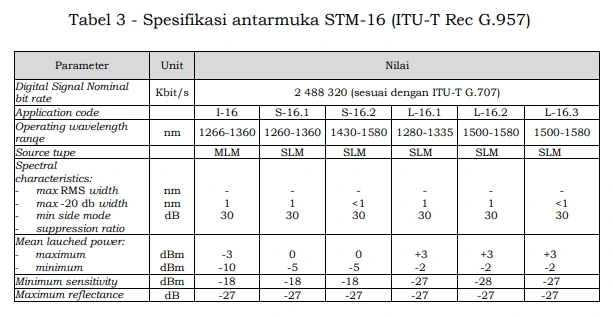
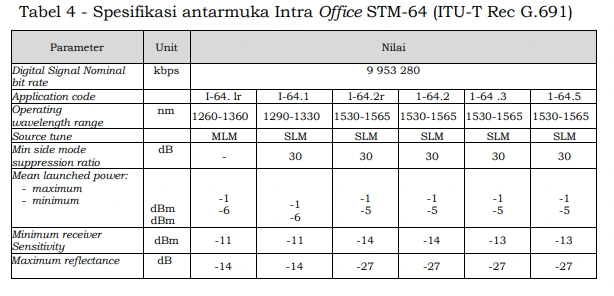
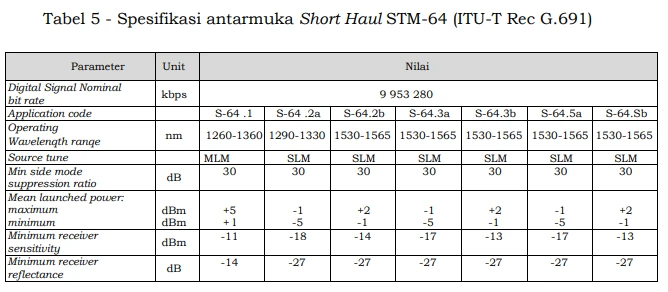
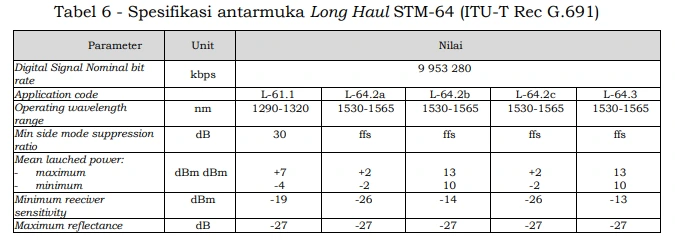
- SDH: If the device has an interface with SDH technology, the interface characteristics must comply with one or more protocol types: STM-16 (ITU-T Rec G.957) and/or STM-64 (ITU-T Rec G.691), with the specifications in Table 3, Table 4, Table 5, and/or Table 6.
Technical Testing and Market Access Clearance
To legally market and operate Free Space Optics (FSO) equipment in Indonesia, manufacturers and importers must obtain type approval certification from the Directorate General of Digital Infrastructure (DJID). KOMDIGI Ministerial Decree No. 43 of 2025 strictly regulates the technical requirements for this certification process.
This regulation serves as the official technical reference for all FSO hardware testing in Indonesia. We have discussed the details of this regulation above.
To market FSO devices in Indonesia, you need to have a basic understanding of the broader marketing authorization framework. This includes a structured evaluation process, as follows:
- Pre-Compliance Verification: The process of ensuring that your device meets the established limits before it is sent for official testing at a laboratory. This will prevent test failures.
- Domestic Laboratory Testing: Once it has been confirmed that the product meets the applicable requirements, physical samples will be submitted to an authorized laboratory to undergo testing for electromagnetic compatibility (EMC), electrical safety, and laser safety parameters.
- DJID Certificate Issuance: Devices that meet all technical requirements will receive an official test report. This report is submitted to the DJID for the certificate issuance process, which serves as proof of full compliance with regulations and grants legal authorization for commercial distribution.
Partnering with Dimulti will ensure that your Indonesia DJID certification process runs smoothly. We understand all the technical standards in effect in Indonesia to ensure your products meet the applicable standards.