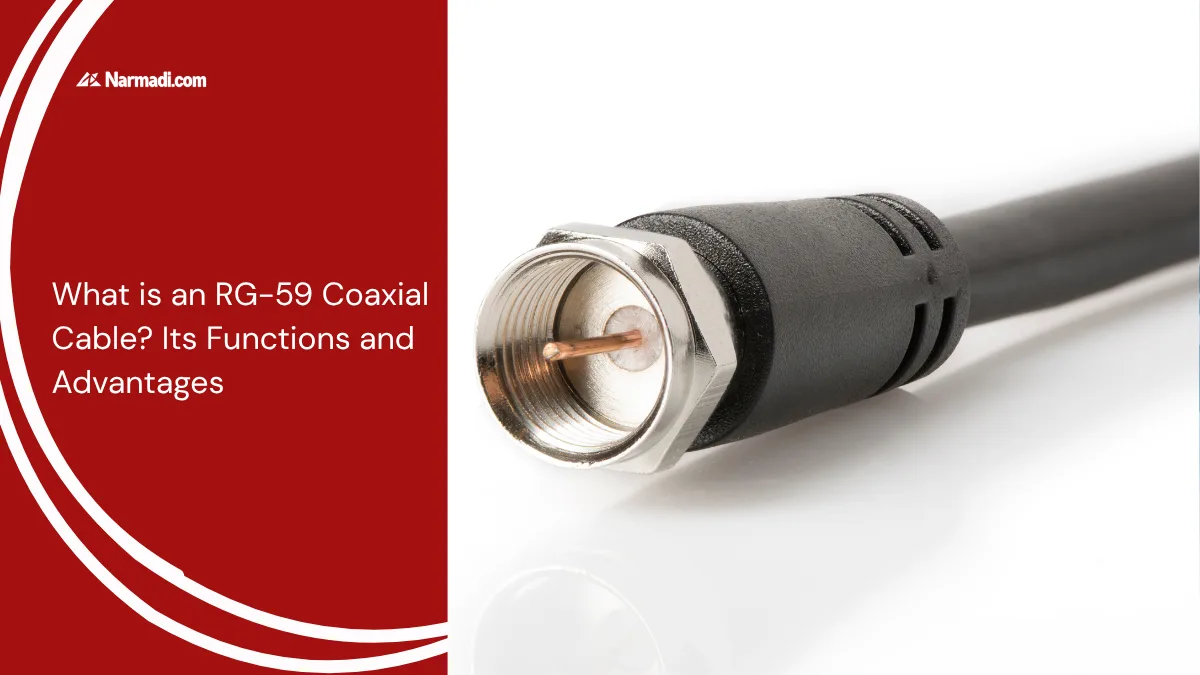

Are you familiar with RG-59 coaxial cable? These cables are commonly found in various video and security setups, especially for CCTV systems.
RG-59 coaxial cable has many functions and advantages that you may have unwittingly experienced so far in TV antennas, home theaters, or especially in CCTV systems.
This article will try to answer your questions by making you aware of RG-59 coaxial cable, from its fundamental structure and primary functions to its practical advantages and when to consider higher-grade alternatives like RG-6.
What is RG-59 Coaxial Cable?
RG-59 is a frequently used coaxial cable, primarily for video and CCTV. With an impedance of 75 ohms, it is commonly used to transmit low-frequency analog video signals, such as in traditional CCTV and composite video systems.
The construction of RG-59 is simpler than RG-6, making it more flexible and easy to install in tight areas. While ideal for home use and small video systems, RG-59 signal quality can degrade over long distances, making RG-6 better for long-distance transmissions.
The Functions
RG-59 coaxial cable serves to transmit analog video signals over short to medium distances, such as in CCTV systems and other audio-video applications. Here are some of the functions of RG-59:
- As a TV antenna cable: This can be used to connect a TV antenna to a signal receiver.
- Used in CCTV systems: Widely used to connect CCTV cameras with video recording devices (DVRs).
- Applied to home theater: Can be used to connect home theater devices such as DVD players and TVs.
- Transmits analog video signals: Suitable for transmitting video signals from devices such as cameras, TV antennas, and other audio-video devices.
The Advantages
RG-59 coaxial cable has several advantages, especially in terms of flexibility, ease of installation, and cost efficiency. Here are some of the advantages of RG-59 cable:
1. Flexibility and ease of installation
One of the advantages of RG59 is its flexibility and ease of installation. With its relatively small size and flexibility, RG-59 is easy to install in various places, including in the corners of a room or tight areas.
2. Good video signal transmission
Good video signal transmission is another advantage of RG59. Although with a lower frequency than RG6, RG-59 is capable of transmitting video signals with good quality.
3. Protection from signal interference
RG59 protects from signal interference from outside because it is equipped with aluminium foil; signal interference from noise caused by electrical equipment or other cables can be reduced with this cable.
4. Suitable for short and medium distances
RG59 is ideal for short and medium-distance use. For example, applications for CCTV at home or office where the distance between the camera and DVR is not too far.
5. Affordable price
Another advantage of RG-59 is its affordable price. If you want a more economical price than RG6 cable with good quality, then RG-59 is the right choice.
When Do You Upgrade to RG-6?
RG-59 is arguably the best choice for budget-friendly, short-distance analog video projects. However, its higher attenuation at high frequencies limits its effectiveness in modern broadband networks.
High-definition digital video signals, cable internet (DOCSIS), and satellite TV require wider bandwidth and stronger shielding to prevent signal loss. This is where you need to upgrade to RG-6 coaxial cable.
RG-6 features a thicker center conductor and enhanced shielding at the GHz level. This cable is suitable for high-frequency applications, satellite TV distribution, or long-distance broadband installations.
RG-59 coaxial cable can be a practical and economical choice for low-frequency video applications, short distances, and analog security systems. This cable is ideal for use in tight spaces and locations that do not require high-frequency capabilities.