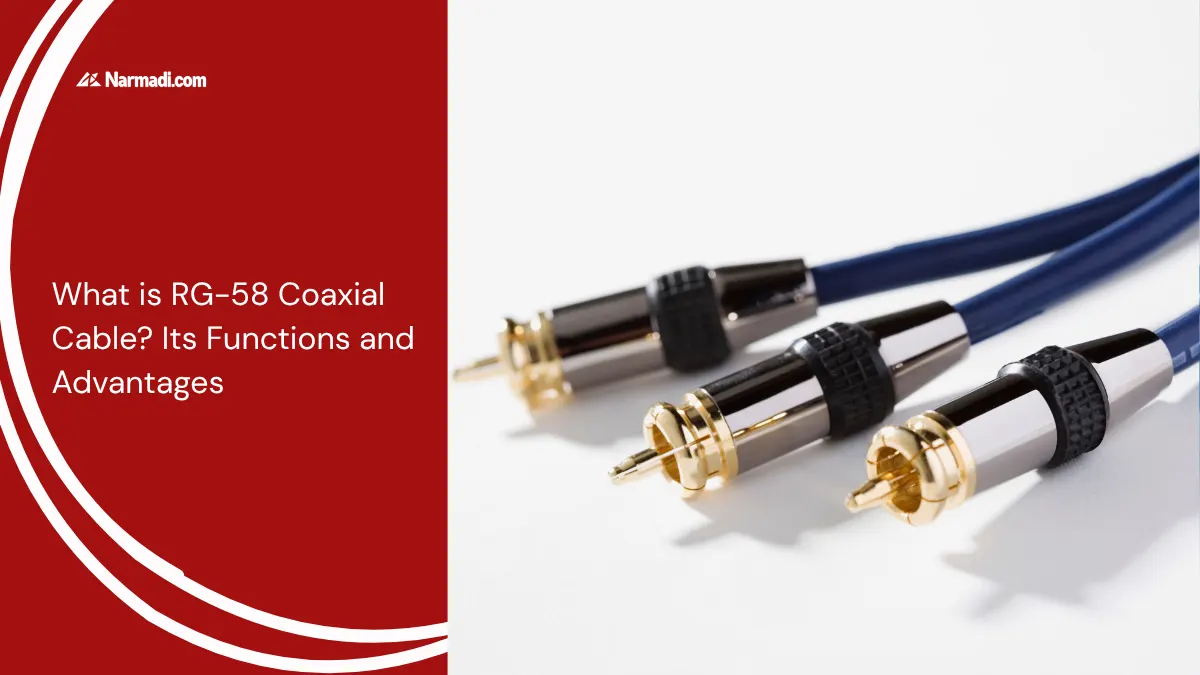

RG-58 coaxial cable is commonly used in computer networks and radio communications due to its flexibility and ability to transmit radio frequency (RF) signals efficiently.
With various functions, RG-58 coaxial cable has many advantages, from high-frequency signal transmission and resistance to interference to an affordable price.
This article will provide a comprehensive overview of RG-58 coaxial cable, from its structural properties and core functions to its practical advantages and how its 50-ohm design compares to 75-ohm alternatives like RG-59 and RG-11.
What is RG-58 Coaxial Cable?
RG-58 is a type of 50-ohm coaxial cable commonly used in computer networks and radio communication systems. Its construction consists of a center conductor protected by an insulating layer, a shielding conductor, and an outer sheath.
Known for its flexibility and lightweight design, RG-58 is suitable for transmitting radio frequency (RF) signals with little signal loss. It is ideal for local area networks (LANs) and RF systems, where signal quality and ease of installation are crucial for good communication performance.
The Functions
RG-58 coaxial cable is used to transmit radio frequency (RF) signals on computer networks and radio communications. Here are some of the functions of RG-58:
RF signal transmission: RG-58, like other coaxial cables, is designed to transmit high-frequency electrical signals, in this case RF signals.
Computer networking: This cable is often used in LAN (Local Area Network) networks due to its ability to transmit data stably over short to medium distances.
Radio Communication: In radio systems, RG-58 is used to connect antennas to radio transmitters or receivers, such as in two-way radio systems.
The Advantages
The main advantage of RG-58 coaxial cable is its ability to transmit radio frequency (RF) signals up to a frequency of 1 GHz. Here are some of the advantages of RG-58:
1. High-frequency signal transmission
One of the advantages of RG-58 is its high-frequency signal transmission. This cable can also transmit signals with frequencies up to 1 GHz, making it suitable for a variety of RF applications, such as WLAN, police, fire department, amateur radio, and CB radio.
2. Flexible and lightweight construction
Flexible and lightweight construction is another advantage of RG-58. The construction that makes up this cable makes it easy to install and organize, especially in areas with limited space.
3. Resistant to interference
RG-58 is resistant to interference because it has shielding that is effective in reducing electromagnetic interference, which is important in environments with many electronic devices.
4. Wide applications
RG-58 is used in a variety of applications, from small-scale computer networks to radio transmission antennas and wireless communications.
5. Affordable price
One of the other advantages of RG-58 is that it is affordable. When compared to other types of coaxial cables, RG-58 has a relatively more affordable price, making it an economical choice for many projects.
RG-58 in RF Networks: Understanding 50-Ohm vs 75-Ohm Applications
Each type of coaxial cable has two different standards: 50 ohms and 75 ohms. RG-58 is the type that uses the 50-ohm standard, while RG-59 and RG-11 coaxial cables use the 75-ohm standard.
The 50-ohm RG-58 cable is more suitable for RF transceivers, wireless antennas, and radio systems. This type maximizes power transfer and impedance matching.
75-ohm cables are required for transmitting video signals or broadband data. RG-59 coaxial cable can be used for short-range analog video setups and CCTV. Meanwhile, RG-11 coaxial cable is used for long-distance outdoor connections and heavy-duty backbone connections where attenuation must be minimized.
RG-58 coaxial cable is a fundamental component in radio frequency engineering and wireless communications. With high flexibility and effective shielding, this cable provides a reliable and cost-effective solution for RF signal transmission and antenna systems.