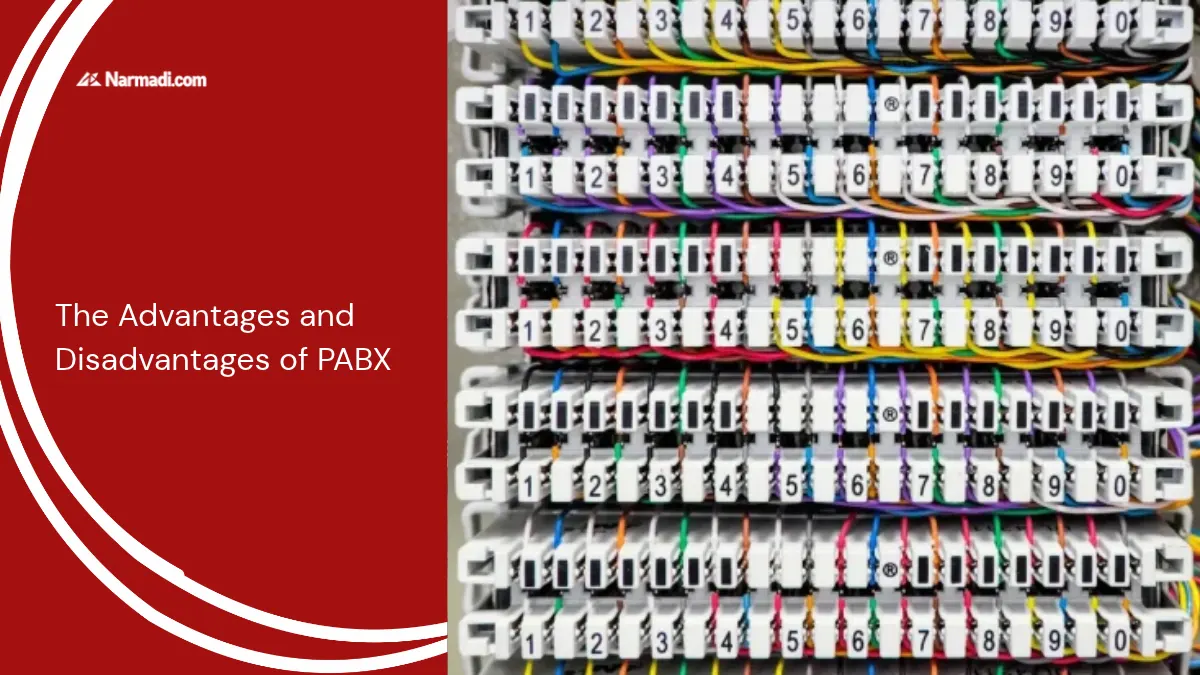

The Private Automatic Branch Exchange (PABX) provides many benefits, especially the ability to support business communication. Understanding the core functions of PABX can help you see how these systems operate.
However, the advantages and disadvantages of PABX cannot be separated, even though we can feel the benefits. These include internal communication efficiency, control of the telephone system, flexibility, and easy scalability, while the disadvantages include dependence on PSTN, lack of integration, and high initial cost.
This article will inform you about some of the advantages and disadvantages of PABX that you can consider.
The Advantages of PABX
Here are some of the advantages of a PABX:
1. Internal communication efficiency
One of the advantages of PABX is its efficiency in internal communication. PABX allows internal communication between employees only by using an extension number. With PABX, internal communication is also not subject to additional fees, so it is more efficient and saves costs.
2. Equipped with advanced features
Advanced features provided by PABX are another advantage of this system. PABX is equipped with several features such as voicemail, conference calls, call forwarding, caller ID, to call logging.
3. Control of the telephone system
By using PABX, all controls on telephone activities in the office can be controlled properly. All incoming and outgoing calls can be monitored and evaluated for irregularities and cost overruns.
4. Cost savings
PABX which uses one channel for outgoing calls makes telephone call costs more efficient. In addition, internal calls with a PABX system are also not subject to additional fees.
5. Flexibility and easy scalability
Another advantage of PABX is its flexibility and easy scalability. PABX allows companies to customize the telephone system according to the needs and scale of the growing business.
The Disadvantages of PABX
Here are some of the disadvantages of a PABX:
1. Dependence on PSTN
One of the drawbacks of the traditional PABX is its dependence on the Public Switched Telephone Network (PSTN). While PSTN in some countries has been abandoned and not used.
2. Lack of integration
The disadvantage of traditional PABX is also the lack of ease of integration with other systems such as CRM or business software. As a solution, you can use a modern PABX such as Digital PABX or IP PABX.
3. Complicated and requires maintenance
PABX has a complicated system and requires maintenance; this is another disadvantage it has. PABX requires experts for installation, configuration, and maintenance.
4. High initial cost
Another disadvantage of PABX is its high initial cost. PABX requires a larger initial investment compared to traditional telephones. However, in the long run, PABX may be more needed in the telephone network system.
Addressing Limitations with Modern PABX Alternatives
Understanding the advantages and disadvantages of a PABX helps us realize that these systems rely on the PSTN and involve high installation costs. However, with technological advancements and digital progress, modern technology is able to address these issues.
Today, companies can transition from legacy hardware to IP PABX, cloud-based PABX, or hybrid communication systems. These modern versions utilize internet protocols (VoIP), which drastically reduce infrastructure costs, integrate seamlessly with digital business software, and enable remote extensions.
Evaluating your current PABX capabilities and your organization’s specific communication needs will help determine whether an upgrade to your legacy system is necessary. If so, a cloud-based PABX can be a modern solution that delivers the best long-term value.