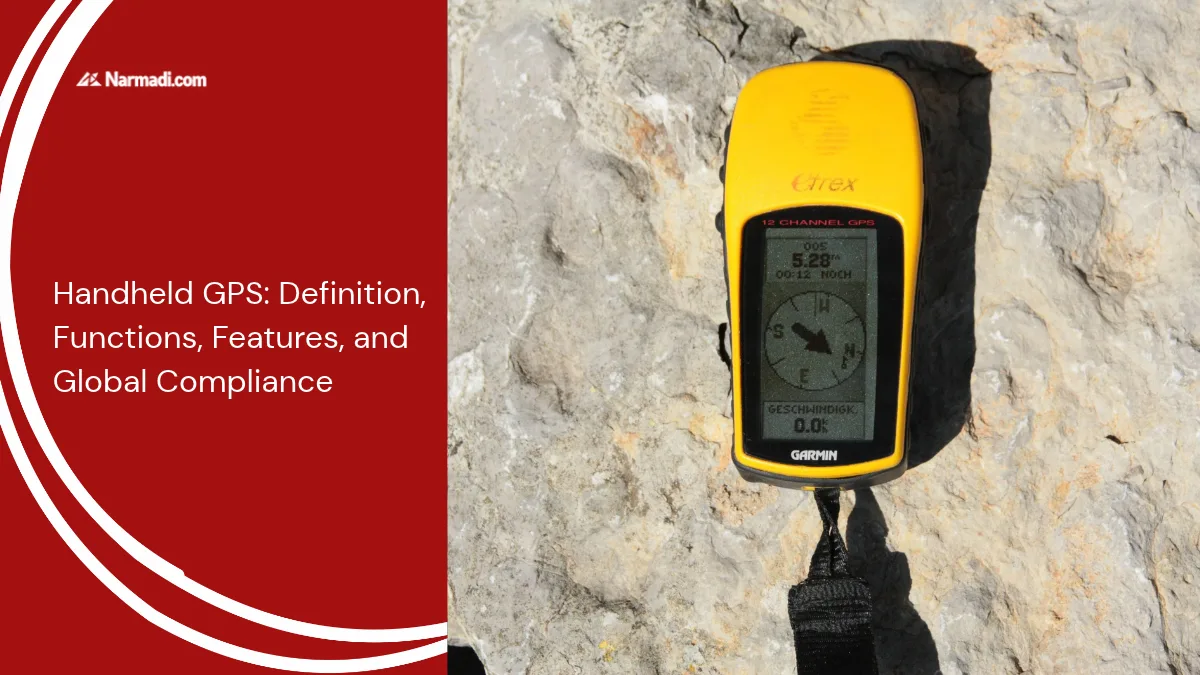

Handheld GPS (Global Positioning System) is an important device for people who do a lot of outdoor activities, such as mountain climbers, forest explorers, and surveyors.
Its ability to provide navigation without having to be connected to the internet or cellular network is an advantage of handheld GPS.
If you are not familiar with this tool, you should read this article until the end, because you will get information about handheld GPS from the definition, function, features, to its regulatory compliance requirements.
What is a Handheld GPS?
Handheld GPS (Global Positioning System) is a handheld navigation device designed for portable use. It does not require an internet or cellular signal to operate. A handheld GPS works by receiving signals from satellites to determine the user’s position in real-time.
With its ability to function independently even in areas with no network, this device is useful for mountain climbers, forest explorers, sailors, and even SAR (Search and Rescue) teams.
The Functions
Handheld GPS (Global Positioning System) has many functions, especially in providing accurate navigation in areas without internet or cellular networks. Here are some of the functions of handheld GPS:
- Navigation without cellular signal: This does not require an internet or cellular signal, as it works by capturing satellite signals.
- Real-time location determination with high accuracy: By capturing signals from satellites to calculate the location. It has an accuracy that is generally in the range of 3-10 meters.
- Save and mark locations (waypoints): With this tool, you can mark specific locations, such as the starting point of a hike, intersections, rest stops, or other important locations.
- Recording track logs: This device can record the path traveled for evaluation or to share the route with others.
- Building and following a path (routing): You can create a point-to-point path so that the device will automatically guide you to the planned route.
- Increased security: This tool will certainly increase your safety when doing outdoor activities.
- Supports professional activities in the field: Of course, this tool is very useful for workers who need to observe difficult spots.
The Features
A handheld GPS (Global Positioning System) has many features in supporting navigation in areas without cellular networks. Here are some of the main features of a handheld GPS:
- Digital compass: To accurately determine cardinal directions
- Barometric altimeter: To measure altitude from sea level
- Topographic map: To display the elevation contours of the terrain
- Track log: To record the path taken
- Waypoints: To mark important points that can be saved
- Interactive SOS: For sending emergency signals
Navigating Global Compliance and Type Approval
Handheld GPS devices use integrated wireless communication technologies such as Bluetooth, ANT+, and Wi-Fi. This means they must comply with strict regulatory frameworks before they can be legally marketed and sold.
These requirements are known as type approval certification. This procedure ensures that the devices operate safely within a specified frequency spectrum without causing harmful interference to other communication systems.
Each country has its own regulations regarding this matter, making it complex to navigate international regulatory standards.
Essentially, this procedure involves rigorous technical testing, safety verification, and comprehensive documentation. However, these steps are mandatory to validate the quality and safety of products in the target market.
Currently, obtaining type approval certification has been made easier with the availability of professional Type Approval Certification Services. We are ready to assist companies in managing compliance requirements, from handling technical testing and legal documentation to verifying standards.
By obtaining this certification, your handheld GPS device is deemed to meet global market access standards smoothly and efficiently. Additionally, user confidence increases because they are using a certified device.