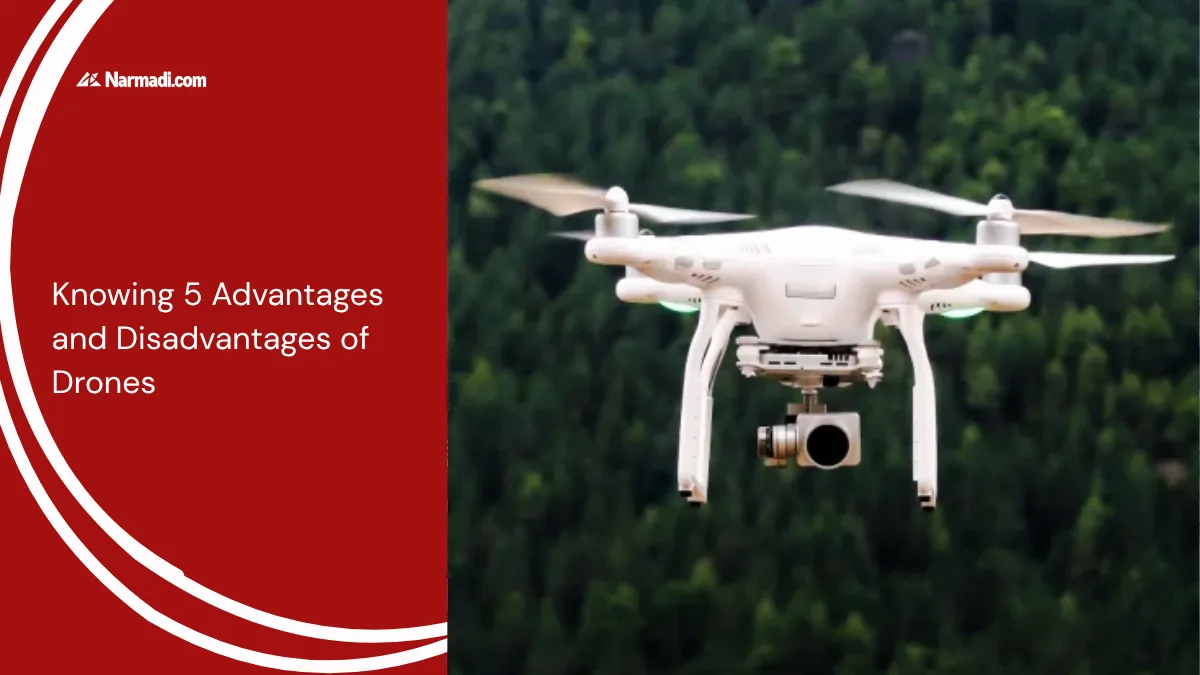
Drones offer numerous benefits, particularly the ability to record and monitor from a height. However, the advantages and disadvantages of drones cannot be separated, even though we can feel the benefits.
The advantages and disadvantages of drones include range flexibility, easy operation, high resolution, potential to damage the surroundings, high operational cost, and being prone to extreme temperatures.
This article will inform you about some of the advantages and disadvantages of drones that you can consider.
Advantages
Here are some of the advantages of drones:
1. Range flexibility
One of the main advantages of drones is their flexible ability to cover a lot of terrain. Some areas are difficult and may not be accessible to humans; with drones, areas such as remote areas or dangerous terrain can be accessed easily for aerial monitoring.
2. Work efficiency
Before drones, aerial monitoring had to use human labor directly from helicopters or planes. With drones, this difficult work can be done without human labor, thereby reducing risks.
3. Easy operation
Easy operation is another advantage of drones. With remotes and software, drones can be easily controlled by learning how to use them. However, for some purposes, drone operators or drone pilots already need certification.
4. Environmentally friendly
As we know, before the existence of drones, aerial monitoring was needed using airplanes or helicopters, which of course required fuel. With the existence of drones, the use of aircraft fuel is no longer needed, because drones use battery power.
5. High resolution
Another advantage of drones is their high resolution. Although this tool is fairly small, it is equipped with a high-quality camera with a resolution of up to 4K for photography and videography.
Disadvantages
Here are some of the disadvantages of drones:
1. Potential to damage the surroundings
One of the drawbacks of drones is their potential to damage the surroundings if not operated carefully. Using drones carefully is necessary so that property or the environment is not damaged.
2. Risk of hacking
Drones use special frequencies in their operation. This increases the risk of hacking. The risk of hacking can lead to disruption and misuse.
3. High operational costs
Using drones requires a high investment in operational costs. These costs include purchase, maintenance, and software licenses. If maintenance and licenses are neglected, it will affect the profitability of using drones.
4. Fragile landing
Using a drone, especially when landing, requires close attention. Some lightweight drones will be fragile when landing, especially when landing on uneven surfaces.
5. Prone to extreme temperatures
Another drawback of drones is that they are prone to extreme temperatures. If exposed to excessively hot or cold temperatures, the drone will potentially experience performance problems or even damage.
Comparative Trade-Off Analysis for Drone Deployment
An assessment of the advantages and disadvantages of drone technology reveals a trade-off between high operational efficiency and technical risk management. In terms of operational efficiency, these devices drastically reduce the time and costs required for large-scale monitoring.
Factors to consider regarding their use include ongoing battery maintenance, signal security vulnerabilities, and landing risks. By implementing strict operational protocols, their advantages can be maximized and their weaknesses minimized.
Challenges related to flight stability and sensitivity to extreme temperatures can be minimized by using a sturdy, weather-resistant UAV frame. An intelligent battery management system can be used to prevent sudden voltage drops during missions.
In terms of signal security, drone devices must comply with radio frequency (RF) and electromagnetic compatibility (EMC) standards. Laboratory testing will ensure that the devices operate within legally permitted frequencies. This will prevent the use of unsafe devices and electromagnetic interference with nearby devices.