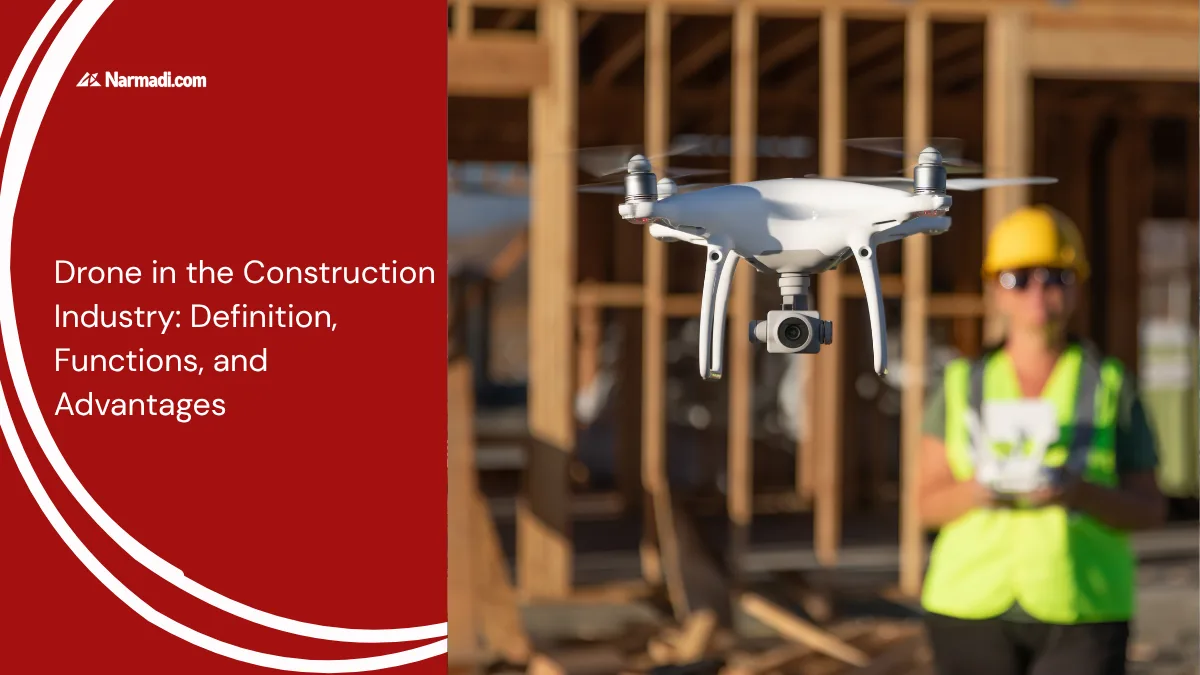
The presence of drones as a recording tool for more efficient aerial imaging needs has benefited various sectors, one of which is the construction industry. Drones in the construction industry have some functions and advantages.
The functions of drones in the construction industry include land surveying and mapping, as well as documentation and reporting. The advantages include increased efficiency and increased safety.
This article will give you information on drones in the construction industry from definition, functions, and advantages that they have.
What is a Drone in the Construction Industry?
Drones in the construction world are used in land mapping, surveying, project progress monitoring, and structure inspection. So that the planning, design, and maintenance of construction projects by referring to the data collected by drones.
The Functions
Drones in the construction industry have several functions, from land survey and mapping to documentation and reporting. Here are some of their functions:
- Land survey and mapping: Able to conduct land surveys and mapping quickly and efficiently with accurate visual data results.
- Real-time project monitoring: Allows for real-time monitoring, allowing for informed decision-making.
- Material volume calculation: This can help calculate the material volume of soil, sand, and stone used.
- Documentation reporting: The progress of the project can be well documented in the form of photos or videos.
The Advantages
Drone in the construction industry have several advantages, from increased efficiency to increased safety. Here are some of its main advantages:
1. Increased efficiency
One of the advantages of drones is their ability to increase efficiency. Remote surveying and mapping work can be done with drones more quickly, reducing the time spent in the field.
2. More efficient structural inspections
Another advantage of drones is their ability to perform more efficient structural inspections. Drones can perform structural inspections on bridges, buildings, and other infrastructure quickly and efficiently, helping to identify damage and ensure construction quality.
3. Better project monitoring
With drones, project monitoring can be done more effectively. Project progress can be monitored in real-time, helping to identify potential issues and ensure that work is carried out as planned.
4. Better data accuracy
Another advantage of drones is their better data accuracy capabilities. With drones, data can be collected with a high degree of precision, making it possible to create highly accurate topographic maps. This is very important for the planning and design of construction projects.
5. Increased safety
Increased safety is another one of the advantages of drones. Hard-to-reach or dangerous areas such as steep slopes or unstable construction sites can be easily inspected by drones without risking the safety of workers.
Photogrammetry Modeling and Volumetric Data Accuracy
Construction drones are not limited to ordinary aerial photography. These devices rely heavily on advanced photogrammetry software and accurate Ground Control Points (GCPs).
Hundreds of overlapping aerial images are combined to produce high-precision 3D topographic models, digital elevation models (DEMs), and accurate orthomosaics. Additionally, 3D point clouds enable project managers to calculate material requirements, such as sand, gravel, and earthwork volumes.
The device is capable of measuring with extraordinary mathematical precision. As a result, errors from manual surveys and costly material discrepancies can be drastically reduced.
The use of photogrammetry in construction projects is similar to the use of drone for agriculture. However, drones are used to monitor crop health, vegetation indices, and irrigation systems across vast agricultural lands.