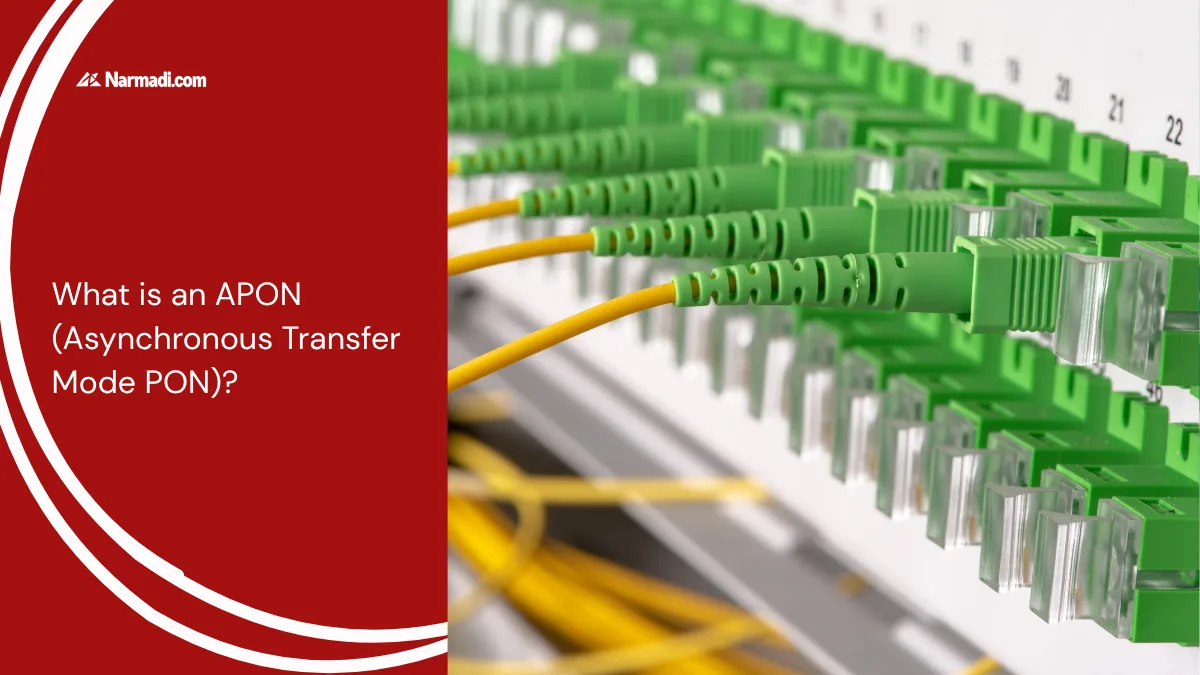

APON (Asynchronous Transfer Mode Passive Optical Network) is a very important early innovation in broadband technology. This technology functions to transmit data, voice, video, and share signals.
The advantages of APON include efficient data transmission, easy scalability, and being able to support various types of services, including voice, video, and data.
This article will explore APON from its definition, functions, highlight the key advantages, and discuss its historical evolution into modern optical network standards.
What is an APON?
Asynchronous Transfer Mode Passive Optical Network marks the first milestone in the development of a commercially successful Passive Optical Network (PON) system. This network uses Asynchronous Transfer Mode (ATM) technology to transmit data over optical fiber. ATM, with its fixed-sized packet (cell) approach, offers advantages in terms of quality of service and minimal jitter.
APON’s electrical layer is specifically designed based on the ATM protocol, which uses a cell format with a 48-byte payload and a 5-byte header to carry information. As such, the technology pioneered the use of ATM as the electrical layer in PON architectures.
The Functions
Asynchronous Transfer Mode Passive Optical Network has the main functions of data transmission, voice transmission, video transmission, and signal sharing. The following is an explanation of the functions of APON:
- Data Transmission: APON provides high-speed connections for various data services, such as internet browsing, video streaming, and large file transfers.
- Voice Transmission: This technology supports telephony services through voice over IP (VoIP) and conventional telephone services (POTS).
- Video Transmission: APON enables video transmission, including high-definition video, over optical fiber.
- Signal Sharing: Passive optical splitters allow a single optical fiber to serve multiple users, reducing infrastructure costs and improving the efficiency of optical fiber use.
The Advantages
Asynchronous Transfer Mode Passive Optical Networks (ATM-PON) offer several key advantages that have contributed to the development of passive fibre-optic distribution models. Just like the core advantages of PON technology in general, APON has laid the foundations for cost-effective multi-user fibre-optic connectivity:
1. Efficient data transmission
One of APON’s strengths is its efficient data transmission. It uses fixed-sized cells (48 bytes payload + 5 bytes header) to transmit data, which makes data transmission more efficient and can support various types of services (voice, video, data).
2. Easy scalability
Easy scalability is another advantage of this technology. It is easily scalable by adding more optical network terminals (ONTs), thus allowing service providers to increase network capacity easily without requiring major infrastructure changes.
3. High reliability
Since APON uses fewer active components (such as optical splitters), the reliability of the network is higher, especially when compared to active optical networks that have more components that are prone to failure.
4. Energy efficient
With a simpler design and the use of passive components, this technology is more energy efficient compared to active optical networks that require power to run the active components.
5. Supports various types of services
Another advantage of APON is that it supports various types of services, including data, video, and voice. This makes this technology a suitable choice to meet the needs of diverse users.
The Evolution from APON to Modern PON Standards
In the late 1990s, APON had revolutionized early optical access networks. However, the rapid surge in demand for Internet bandwidth eventually revealed the limitations of the ATM cell structure.
To address this, APON was developed into a broader standard:
- BPON (Broadband PON): BPON (ITU-T G.983) is an evolution of APON that adds support for WDM, higher downstream speeds (up to 622 Mbps and 1.25 Gbps), and dynamic bandwidth allocation.
- GPON & EPON: As native IP traffic dominates global networks, GPON (Gigabit PON) and EPON (Ethernet PON) leverage the IP/Ethernet framework to replace ATM-based APON/BPON.
Understanding what APON is, its functions, its key advantages, and its historical evolution provides important insights into the foundations of the global fiber-optic broadband network. APON is an indispensable pioneer in passive optical distribution that has paved the way for GPON and XGS-PON networks, which now serve as the backbone of digital infrastructure.