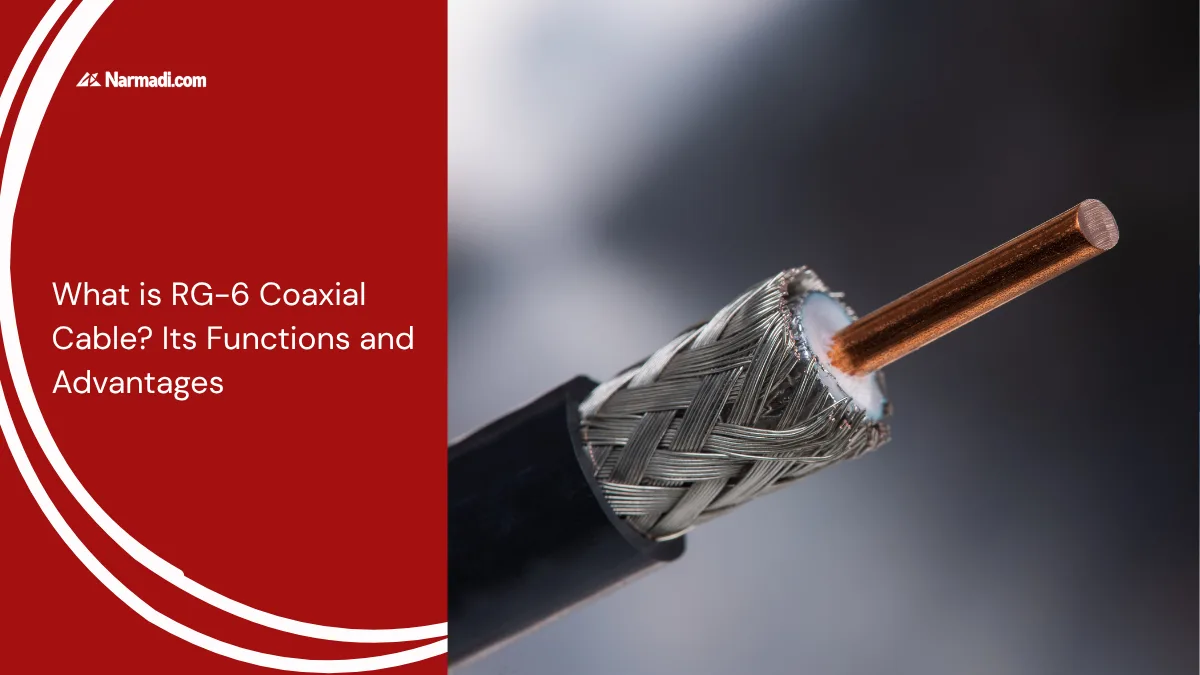

Of the various types of coaxial cables, the most prominent as a solution for transmitting high-quality video and audio signals is the RG-6 coaxial cable.
With its multiple functions in transmitting data, audio, and video, RG-6 coaxial cable has the advantages of good signal quality, its ability to handle high frequencies, and its flexibility and ease of installation.
This article explores the specifics of RG-6 coaxial cable, from its fundamental structure and core functions to its advantages and role within the broader coaxial family.
What is RG-6 Coaxial Cable?
RG-6 (Radio Guide 6) coaxial cable is the most commonly used cable type for video and audio signal transmission, especially in cable and satellite TV systems. This cable is known to have an impedance of 75 ohms and is capable of transmitting signals up to a frequency of 1 GHz.
With its double shielding of aluminium foil and metal mesh, RG-6 effectively protects signals from electromagnetic interference and external interference.
The Functions
RG-6 coaxial cable has a key function in transmitting video and audio signals, particularly in cable TV, satellite, and security system (CCTV) installations. Important functions of RG-6 include:
- Transmitting Video and Audio Signals: This cable streams video and audio signals from the transmitter to the destination device (e.g., TV).
- Connecting Cable and Satellite TV: RG-6 is commonly used to connect the antenna to the TV for stable and quality signal transmission.
- As a CCTV security system: In security systems, RG-6 transmits video signals from cameras to display or recording devices.
- Transmitting Data: Besides being dominant in video and audio, coaxial cables like RG-6 can also serve for data transmission, especially in LAN networks.
The Advantages
RG-6 coaxial cable has several advantages over other types of coaxial cable, particularly in terms of signal quality and ability to handle high frequencies. Here are some of the advantages of RG-6 coaxial cable:
1. Good signal quality
One of the advantages of RG-6 cable is its good signal quality. RG-6 has larger conductors and thicker dielectric insulation, thus helping to improve signal quality and performance, especially for higher frequencies.
2. Ability to handle high frequencies
Its ability to handle high frequencies is another advantage of RG-6. Thanks to its design that prioritizes signal quality, RG-6 can handle GHz-level signals more effectively.
3. Better protection from signal interference
RG-6 cable has better shielding, so it is able to provide better protection against signal interference. The risk of interference and static noise can be easily reduced with RG-6.
4. Improved image quality
Another advantage of RG-6 is the image quality it produces. With the ability to handle higher frequencies and reduce signal interference, RG-6 can improve image quality, especially in CCTV applications.
5. Flexibility and ease of installation
One thing that should not be underestimated about RG-6 is its flexibility and ease of installation. Although thicker than RG-59, RG-6 remains quite flexible and easy to install, especially in tight areas.
RG-6 in Modern Infrastructure: How It Fits the Coaxial Family
The advantages of RG-6, as explained above, highlight why this cable is essential for modern broadband installations. RG-6 is required when high frequencies, low signal loss, and robust protection are needed.
This contrasts with RG-59, which is only suitable for low-frequency baseband video transmission over short distances. The same applies to other types of coaxial cable, such as RG-11 or RG-58.
In today’s modern telecommunications infrastructure, RG-6 coaxial cable is a critical component. It provides a reliable and cost-effective solution for high-speed internet and high-definition signal distribution.