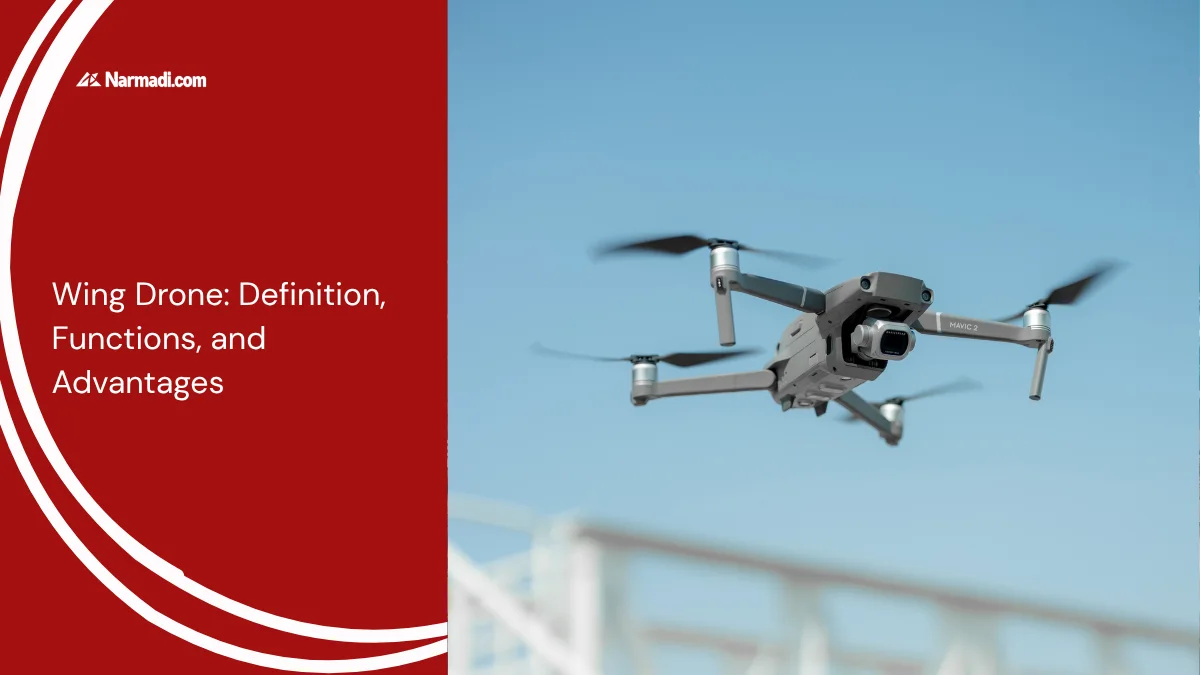

Rotary-wing drones are a type of drone that works like a helicopter. Rotary-wing drones are easy to move and stable to operate.
This article explores rotary-wing drones, covering their definition, the diverse functions they perform across industries, and their advantages.
What is a Rotary-Wing Drone?
Rotary-wing drones use rotors (propellers), just like a helicopter that uses propellers to fly. This type of drone is also known as a multicopter or multi-rotor, depending on the number of rotors used.
Examples of this type of drone are quadcopter, hexacopter, and octocopter. Rotary-wing drones have the advantage of being easy to move and stable when operated.
Unlike fixed-wing drones that require a runway to fly. This type of drone has the ability for Vertical Take-Off and Landing (VTOL), so it can operate in limited areas.
The Functions
Rotary-wing drones have several functions, from photography and videography to space exploration. Here are some of their functions:
- Photography and videography: Suitable for taking photos or videos from hard-to-reach viewpoints.
- Mapping: Commonly used in agriculture for various purposes such as monitoring and surveying land, spraying pesticides, and irrigation.
- Search and rescue: With its range flexibility, this drone can search for victims in areas affected by natural disasters.
- Security and law enforcement: These drones can be used for field monitoring, investigating accidents, and tracking emergency events.
The Advantages
Rotary-wing drones have several advantages, from VTOL capability and hovering ability to ease of use. Here are some of its main advantages:
1. Vertical Take-Off and Landing (VTOL) Capability
One of the advantages of this drone is the vertical take-off and landing capability. This advantage allows the drone to be able to take off and land vertically, so it does not require a runway like a fixed-wing drone.
2. Maneuvering flexibility
Maneuvering flexibility is another advantage of this drone. It allows the drone to fly with precision in tight spaces, making it ideal for tasks that require precision and accuracy.
3. Hovering ability
This drone can hover in one place, allowing the drone to perform photo or video returns with high stability.
4. Integrated with various applications
Being able to integrate with various applications is another advantage of this drone. Applications that can be integrated include aerial photography, land surveying, infrastructure inspection, search and rescue, and shipping.
5. Ease of use
Another advantage of this drone is its ease of use. These drones are generally easier to operate and maintain than fixed-wing drones.
Power Consumption and Flight Stability Challenges
The ability of flexible rotorcraft drones to hover comes at the cost of high power consumption. Because these drones rely entirely on pure motor thrust to maintain their altitude, their lithium batteries drain quickly.
As a result, most standard rotary-wing drones have a relatively short flight time of between 20 and 40 minutes per charge. This duration also depends on the payload and battery size.
To make matters worse, their sensitivity to weather conditions forces the drone’s internal sensors to work extra hard to prevent the device from being tossed about. This causes the battery to drain faster and reduces the overall flight time.