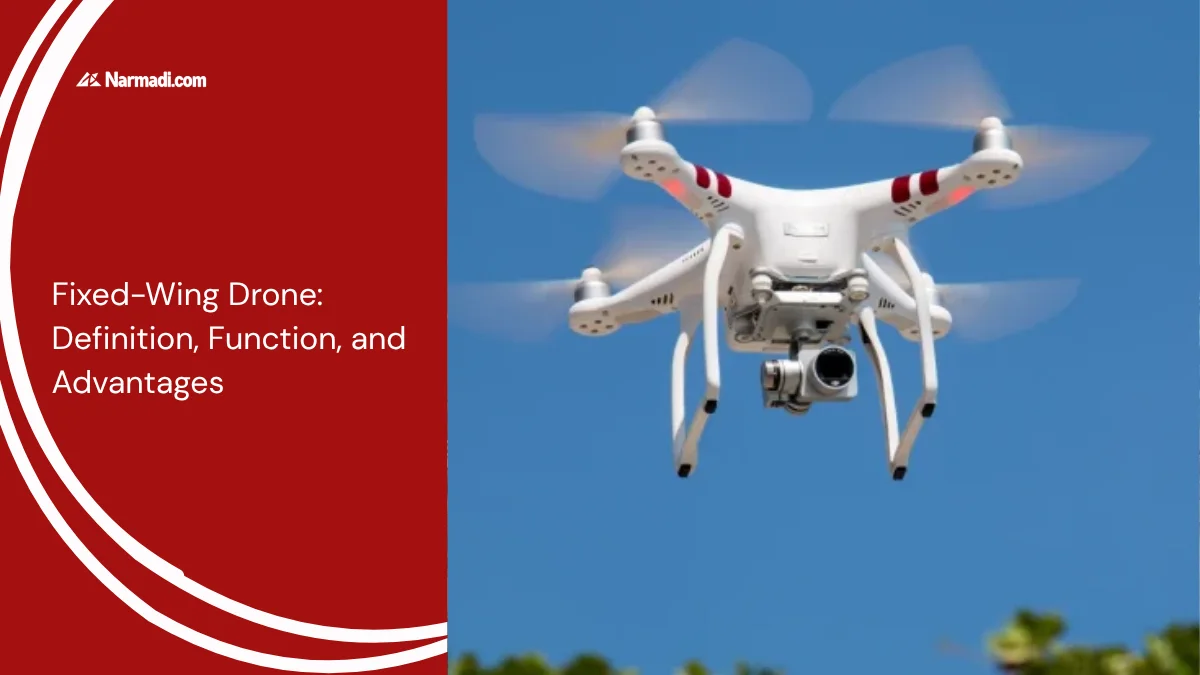
Fixed-wing drones are a type of drone that works like a conventional airplane. Fixed-wing drones rely on fixed wings to generate lift, allowing for efficient flight and long range.
This article will delve into the world of fixed-wing drones, from the definition, the diverse functions they perform in various industries, and their advantages.
What is a Fixed-Wing Drone?
A fixed-wing drone is just like an airplane, it has fixed wings on the right and left to fly. These drones are usually used for military purposes, such as surveillance, or used for mapping.
This drone has a fixed wing that is rigid, like an airplane, these drones need a runway to fly. These devices are suitable for those who need strong and long-lasting flight endurance and area coverage ability.
The Functions
Fixed-wing drones have several functions, including mapping and surveillance. Here are some of their main functions:
- Mapping: Used for mapping large areas efficiently and accurately.
- Surveillance and Security: Used for territorial and security surveillance, for example, for border patrol or perimeter surveillance.
- Inspection: Used for infrastructure inspections such as pipelines or bridges.
- Flying over large areas: Can be used in the agricultural industry to spray large areas.
The Advantages
Fixed-wing drones have several advantages, from long flight duration to safe landing when losing power. Here are some of their main advantages:
1. Long flight duration
One of the advantages of these drones is their ability to fly for a longer duration. Due to their better aerodynamic efficiency, these drones can fly longer on a single battery charge.
2. Wide range
Wide range is another advantage of this drone. In one flight, this type of drone can cover a longer distance and a wider area.
3. Good stability
The next advantage of this drone is its good stability; this happens because of the fixed-wing design. Even in the wind, this drone will remain stable, making it suitable for applications that require high accuracy.
4. High speed
Not only does the drone have wide area coverage, long flight duration, and good stability, but it also has a high speed. This drone can reach high speeds, making it possible to cover large areas quickly.
5. Safe landing when losing power
Another advantage of this drone is the ability to land safely when losing power. With the wings that this drone has, even if it loses motor power, it can still glide safely, so there is no need to worry about landing this drone even when it runs out of battery in the air.
For a broader comparison of operational benefits and limitations across all UAV types, explore our detailed breakdown of the Advantages and Disadvantages of Drones.
Long-Range Telemetry Protocols and Technical Safety Standards
Operating fixed-wing UAVs requires a robust long-range telemetry link and a reliable onboard power architecture. This ensures the devices can remain airborne over long distances and for extended periods.
These aircraft frequently conduct missions beyond visual line of sight (BVLOS) for geographic mapping and inspection of linear infrastructure. Therefore, it is critical to maintain continuous radio communication between the ground control station (GCS) and the onboard flight controller.
To ensure stability during long-distance flights, the fixed-wing system uses specialized transceivers operating at 2.4 GHz and 5.8 GHz, along with a telemetry module. This technology must meet specific technical safety standards before it can be marketed.
In this case, wireless transceivers must undergo Radio Frequency (RF) and Electromagnetic Compatibility (EMC) testing. Compliance verification ensures that the remote transmitters adhere to regulated power limits and do not interfere with other devices.
Additionally, there are electrical safety evaluation tests to assess the lithium battery management system (BMS) and the electronic speed controller (ESC). This is necessary to prevent thermal runaway during long flight missions.
Compliance with telecommunications and hardware safety standards ensures that fixed-wing UAVs are safe for commercial and industrial applications. These certifications serve as legal proof that the devices can enter international markets in their destination countries.