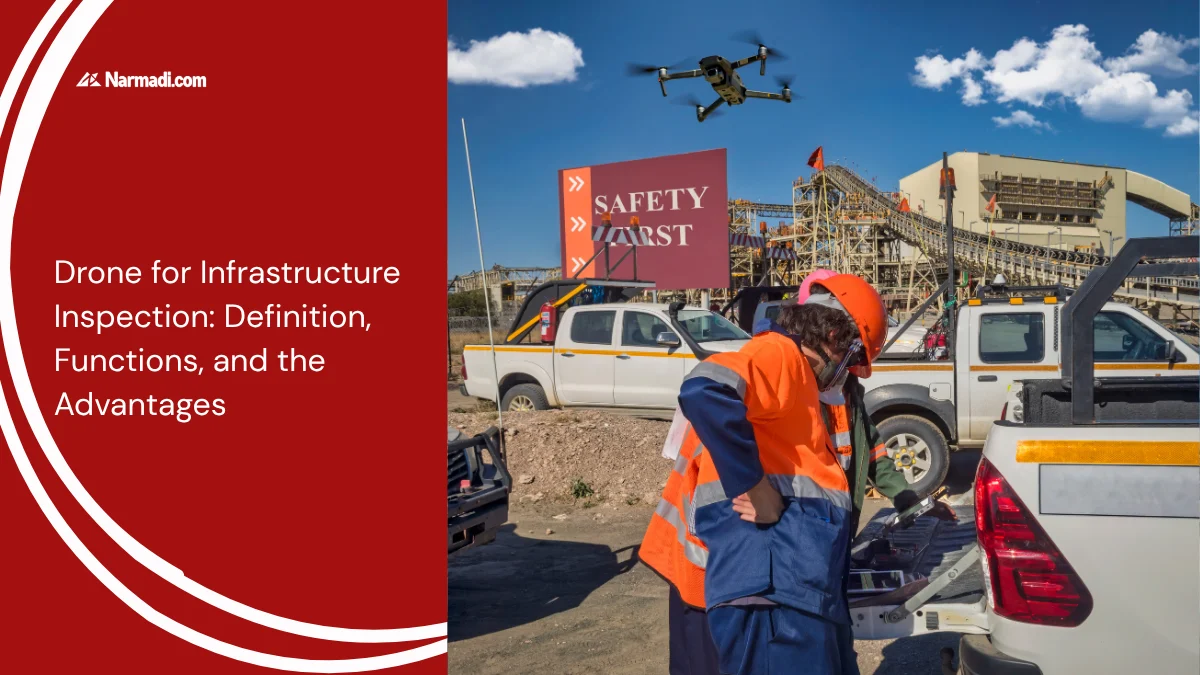

The use of drones as a recording tool for more efficient aerial image capture has benefited various sectors, one of which is infrastructure inspections. Drone for infrastructure inspection have some functions and advantages.
The functions of drones for infrastructure inspections include simplifying monitoring to reduce time and cost. Moreover, the advantages include the ability to reach difficult areas, rapid data capture, to spot potential damage early.
This article will give you information on drones for infrastructure inspections, including their definition, functions, and advantages that they have.
What is a Drone for Infrastructure Inspection?
Drones equipped with cameras and sensors help assess the condition of infrastructure, equipment, or the environment. Drones provide a safe, cost-effective, and efficient alternative to traditional inspection methods.
Infrastructure inspections such as bridges, roads, gas pipelines, and communication towers can be carried out using drones. This can help detect damage or other problems before they become more serious.
The Functions
Drones for infrastructure inspections have several functions that simplify monitoring and reduce time and cost. Here are some of their functions:
- Simplifies monitoring: Infrastructure conditions can be monitored regularly to detect damage or bottlenecks.
- Improves efficiency: Data can be collected quickly and efficiently through aerial monitoring, making data analysis easier and faster.
- Reduces risk: The risk of accidents and injuries to inspection workers can be reduced as aerial inspections of hazardous areas are no longer required with human labor.
- Reduced time and cost: With aerial monitoring, inspections can be conducted in less time and at a lower cost.
The Advantages
Drones for infrastructure inspections have several advantages, from the ability to reach difficult areas and rapid data capture to spotting potential damage early. Here are some of their main advantages:
1. Ability to reach difficult areas
One of the advantages of drones for infrastructure inspection is their ability to reach difficult areas. Inspections in areas that are difficult to reach or dangerous for humans, such as high bridges, power lines, or damaged buildings, can be carried out by drones. That way the inspections carried out also become safer and more efficient.
2. Generates accurate data
The data generated by drones is very accurate; this is also an advantage for infrastructure inspections. With more detailed and high-quality data, you can receive high-resolution images and videos, as well as the required thermal data. These data will certainly help you identify problems, thus making more informed decisions.
3. Rapid data capture
With their ease of use, data collected by drones can be quickly and efficiently generated. That way, the inspection team will find it easier to get the job done quickly.
4. More comprehensive inspections
An undeniable advantage of drones is their ability to conduct more comprehensive inspections. With drones, your inspection needs can be accessed on all parts of the infrastructure.
5. Spot potential damage early
With easy and fast drone monitoring, inspections can be done as often as you need. That way, material damage and degradation can be detected early. That way, preventive maintenance can be carried out, reducing future repair costs.
Thermal Imaging and NDT for Structural Integrity
Modern infrastructure inspections rely heavily on drones. This is because they are equipped with high-resolution thermal cameras and optical zoom sensors to assess structural conditions.
Thermal imaging plays a crucial role in detecting subsurface delamination, moisture ingress, and heating caused by electrical resistance. By collecting detailed radiometric data, advanced non-destructive testing (NDT) analysis can be performed remotely.
As a result, the structural integrity of bridges, pipelines, and communication towers is safely and sustainably maintained over time. In addition to infrastructure inspections, aerial mapping and similar spatial data are also used with drones in the construction industry to manage new building projects from the earliest stages.