
On Monday, May 27, 2025, the Mutual Recognition Agreement (MRA) between Indonesia and South Korea came into effect. This agreement was previously agreed upon and signed exactly one year ago, on May 27, 2024.
The signing of the MRA between Indonesia and South Korea was represented at that time by Nezar Patria, Deputy Minister of Communication and Information Technology of the Republic of Indonesia, and Do Hyun Kang, Deputy Minister of Science and Information Technology and Communication of South Korea.
The agreed MRA between Indonesia and South Korea is related to cooperation in the Information and Communication Technology (ICT) sector, especially for telecommunications device testing laboratories.
The enactment of the MRA between Indonesia and South Korea, is an important thing in international regulatory cooperation to improve the integration of certification globally, especially enabling the efficiency of certification between the two countries.
The Benefits of MRA between Indonesia and South Korea
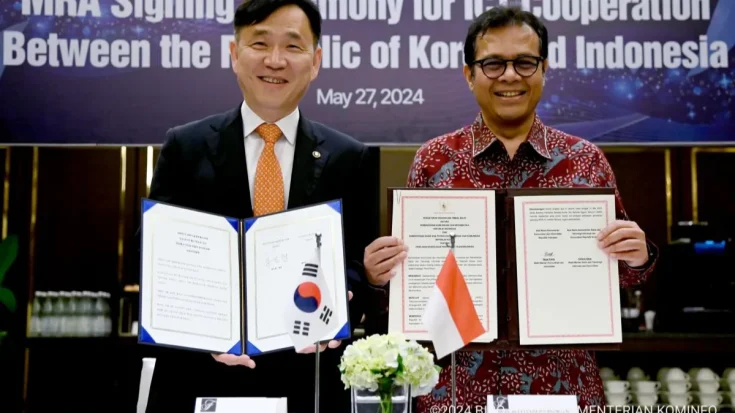
In the year since the MRA between Indonesia and South Korea was signed by the Deputy Ministers of both countries, it has gone through a trust-building phase to harmonize technical standards and ensure regulatory alignment in both countries.
With the implementation of this agreement, South Korean laboratories have officially been recognized and included in the list of Indonesian Foreign Testing Centers (In Indonesia called Balai Pengujian Luar Negeri or BULN).
The implementation of the MRA between Indonesia and South Korea certainly provides benefits for both countries. Here are some of the benefits of MRA for both countries:
Eliminating redundant testing
One of the benefits of the MRA between Indonesia and South Korea is the elimination of the need for redundant testing. With this agreement, Reports of Test Results (LHUs) from South Korean laboratories are now acceptable for certification of telecommunication devices in Indonesia and vice versa, LHUs from recognized test labs in Indonesia can be used in South Korea.
Time and cost efficiency
This arrangement automatically reduces the certification timeframe and cost for manufacturers and importers operating in both countries, as device testing can be done in the country of origin without retesting in the country of destination.
Boost telecommunications market
The MRA encourages the entry of telecommunications equipment into each country’s market as it removes repetitive testing requirements, making the process smoother.
Improving testing quality
This MRA will certainly encourage the improvement of the quality and capability of lab testing in Indonesia to be compatible with test results in South Korea.
Laboratory Standardization and Tariff Adjustments
The national authorities of Indonesia and South Korea will regulate the supervision of testing laboratories designated under the MRA.
This is done so that the laboratories maintain technical competence and produce test results that comply with each country’s standards. A list of recognized testing laboratories from South Korea can be found at this link.
Indonesia’s Director General of Digital Infrastructure has also regulated service fees that will be adjusted to the scope of technical evaluation recognized for certification of equipment tested under the MRA scheme.
Application for certification using the MRA scheme has been regulated in the provisions of Government Regulation No. 43 of 2023.
The MRA between Indonesia and South Korea is expected to facilitate increased international trade, the quality and competitiveness of Indonesian testing laboratories, and sustainable conformity assessment practices.
This cooperation will ultimately greatly contribute to a more robust and globally integrated certification system specifically for Indonesia and South Korea.
What the MRA Means for Manufacturers
For companies selling telecommunication devices in Indonesia or South Korea, the MRA can make certification simpler. Keep these points in mind.
1. Choose a Recognized Laboratory
Test reports are only accepted from laboratories recognized under the MRA. Check the official list before sending your product for testing.
2. Test Once, Use in Both Countries
With the MRA, LHUs from recognized South Korean laboratories can be used for certification in Indonesia, and vice versa. This can save time and cost.
3. Check the Service Fees
Indonesia’s Director General of Digital Infrastructure has regulated service fees for equipment tested under the MRA scheme. Check them when planning your budget.
4. Follow the Application Rules
Applications using the MRA scheme follow Government Regulation No. 43 of 2023.
Key Benefits in Short
- No redundant testing
- Shorter certification time
- Lower cost
- Easier market entry
- Better testing quality
Frequently Asked Questions
When did the MRA come into effect?
On May 27, 2025, one year after it was signed on May 27, 2024.
What is BULN?
Balai Pengujian Luar Negeri, the list of foreign testing centers recognized in Indonesia.
What is an LHU?
A Report of Test Results, issued by a testing laboratory.
Who supervises the laboratories?
The national authorities of Indonesia and South Korea.
Who signed the MRA?
Nezar Patria for Indonesia and Do Hyun Kang for South Korea, both serving as Deputy Ministers at that time.
In short, the MRA helps manufacturers test once and enter two markets more easily, as long as they use recognized laboratories and follow the application rules.
Need type approval for your product?
Tell us your product and target countries. A project handler replies with requirements, lead time and cost.
Request a quote