
Vietnam Type Approval Summary
Vietnam is one of the emerging industrial countries in Southeast Asia. As the industry emerged in this land of Blue Dragon, so did the economy there. This makes the country an interesting market to access. Those who want to access the Vietnamese market for their ICT products, have to meet some requirements to obtain the “MoST certification,” which is usually also called the “MIC certification.”
MoST stands for "Ministry of Science and Technology ", this is the official governmental body that's responsible for regulating the publishing, newspaper, and postal services such as internet, telecommunication, broadcasting, information technology, and other related fields.
Getting a MoST certification can be tricky. Although it accepts foreign test reports using international standards such as CE or FCC, in some cases MoST also obligates local tests especially if the test reports don't suffice their requirements. But, with long experience, expertise, and global relation in the certification niche, Narmadi Company is ready to help you deal with the complications of the MoST certification procedure, eliminate hassles during the process, and get you the certificate based on the expected target date.
Who Can Be an Applicant?
- Local representative
- Required
The applicant or certificate holder is a local company registered in Vietnam. The company may be a subsidiary of the manufacturer, an importer, a distributor, or the manufacturer’s local representative in Vietnam.
It should be noted that certificates held by local agents cannot be used for actual imports. This means that such certificates can only be used for marketing or promotional purposes. Furthermore, once the manufacturer has established a partnership with a local partner,
Application Method
- In-country testing
- Yes
- Paperwork only
- Yes
The process is divided into two stages: local testing or paperwork.
Local Testing
Obtaining type approval can be done by conducting local testing in Vietnam's domestic test lab, and the standard referred to during the test is the Vietnamese QCVN. After the test is finished, there will be an evaluation process to decide whether or not the product complies with the local standard.
Paperwork Only
Obtaining type approval can be done by using existing reports issued by overseas labs that are recognized by MoST. This method is called paperwork or document evaluation.
Sample Requirements
Local testing requirements in Vietnam mandate the submission of samples. At least two types of samples are required for this process.
Each sample is used for two different tests: Radio Frequency (RF) Testing and Electromagnetic Compatibility (EMC) Testing. However, you may need additional testing and samples depending on the product category and applicable regulations.
Document Requirements
Several requirements must be met, including:
- Radio Frequency (RF) test report
- Electromagnetic Compatibility (EMC) test report
- Application Form (to be prepared by agency and signed by the TA cert holder)
- Product’s Specification (to be provided by the client and re-edited by agency)
- Information on the Sample (to be prepared by agency)
- Valid ISO 9001:2015 certificate of the manufacturing factory (to be provided by the manufacturer)
- Factory declaration (to be prepared by agency and signed by the manufacturer)
- Declaration of sample shipment (to be prepared by agency and signed by the manufacturer)
- Business license of the TA certificate holder (to be provided by the TA certificate holder)
Submission process
- Submission
- Online
All prepared documents must be submitted through the Ministry of Science and Technology (MoST) portal. The authorities will then evaluate the documents. that you submitted
Following the evaluation, a decision will be made as to whether your documents are approved or rejected. A certificate will be issued immediately if the documents pass the evaluation. As for documents that are not approved, corrections must be made, and the documents must be resubmitted.
Lead Time of Certification
- Lead time
- 5–6 weeks
The entire certification process in Vietnam takes about eight weeks. This process is divided into two parts: local testing and document evaluation.
Local testing takes about five weeks, while document evaluation takes three weeks. This lead time will be on schedule if there are no technical issues or missing documents. The lead time will be extended if any obstacles arise during the application process.
Validity Period
- Validity
- 3 years
Manufacturers or importers have the right to market their products in Vietnam for three years. This is because the MoST certificate is valid for three years.
If a manufacturer wishes to continue importing and selling its products in Vietnam after this period, a certificate renewal is required. The process and documentation requirements are the same as for the initial certificate application.
Label Requirements
- Product label
- Required
- Approval mark
- Required
- E-labeling
- Not allowed
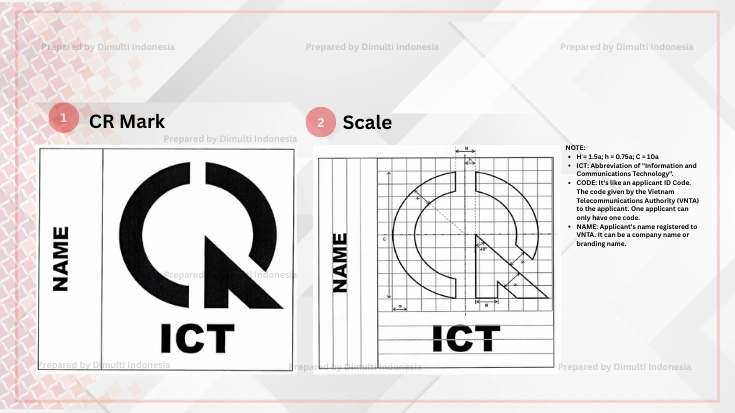
After the product is certified by MoST, applicants are mandatory to affix conformity marks or CR (Compliance Registration) Mark. Conformity marks can be affixed by printing the mark, attaching or sticking the marks directly on products surface or on the packaging.
If that is not possible, the mark can be printed on technical documents such as specification, user manual, or compliance sheet accompanying the product. Below is the formal CR Mark:
Certificate Example
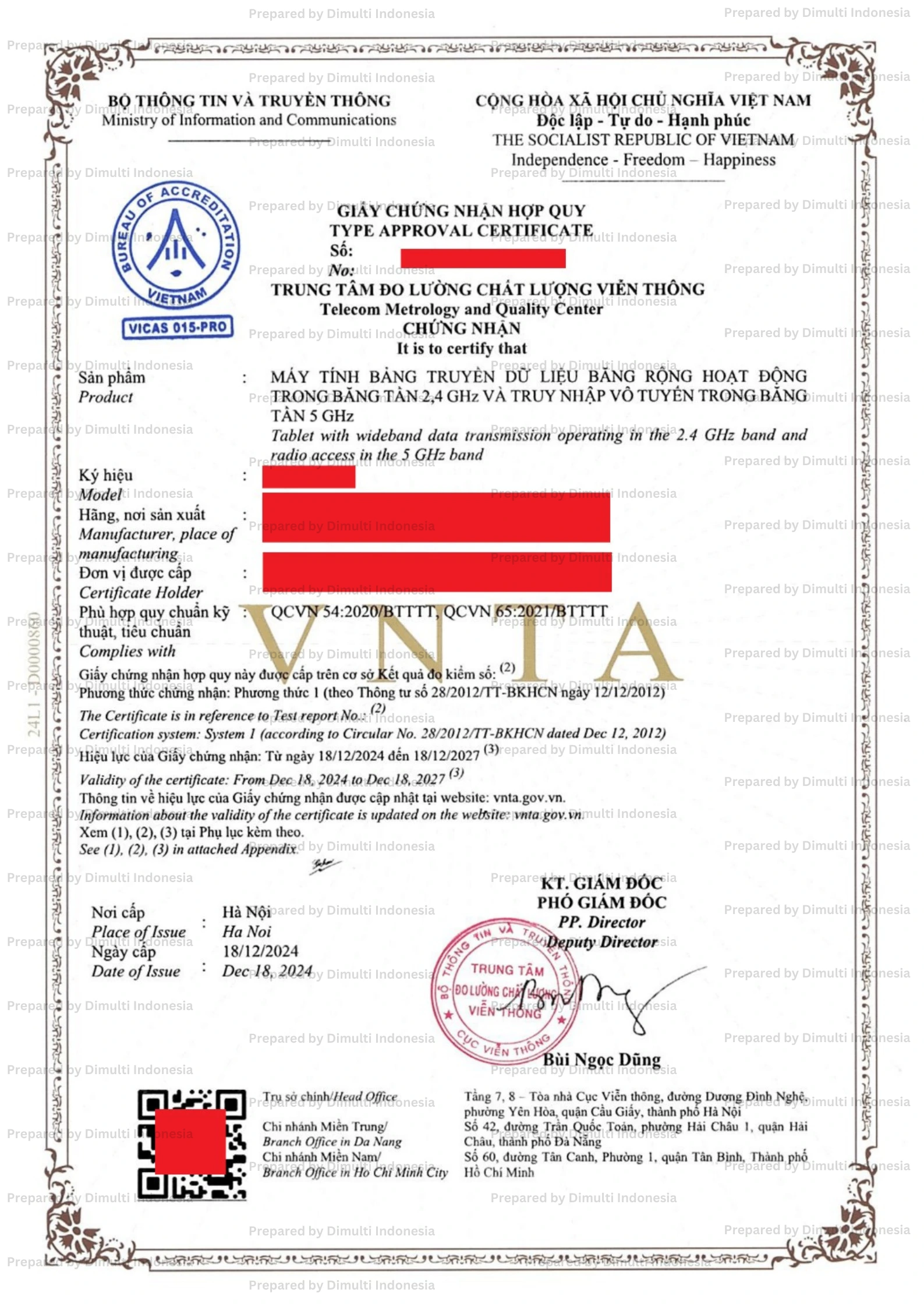
- Issued under
- Ministry of Science and Technology (MoST)
- Certificate
- MoST certification
- Validity
- 3 years
- Lead time
- 5–6 weeks
Alternative Country Names
Socialist Republic of Vietnam, Cộng hòa Xã hội chủ nghĩa Việt Nam, Viêt Nam, Vijetnam, Вьетнам, ベトナム, Viet Nam, 베트남, VN
Product Scope
This certification is not limited to telecommunication product only. But also mandatory to all products that have telecommunication features or radio frequency. Some examples of products that are mandatory to apply are:
Rules by Technology
Allowed, approval required
- Wi-Fi 2.4 GHz
- Wi-Fi 5 GHz
- Wi-Fi 6E (6 GHz)
- Wi-Fi 7
- Bluetooth Classic
- Bluetooth Low Energy
- NFC
- RFID
- UWB
- Zigbee
- Thread
- Z-Wave
- DECT
- 2G/3G
- 4G LTE
- 5G NR
- NB-IoT
- LTE-M
- LoRa / LoRaWAN
- Sigfox
- Automotive radar (77 GHz)
- Short-range radar (24 / 60 GHz)
- GNSS (GPS)
- Satellite communication
- Wireless charging (Qi)
- PMR / Walkie-talkie
- Amateur radio
- Passive Optical Network (PON)
- Wavelength Division Multiplexing (WDM)
- Coaxial Cable
- ISDN
- Ethernet
- VoIP
- IPv6
- Power Line Carrier
- Microwave Link
- Free Space Optics
- Digital Audio Broadcasting (DAB)
Talk to our project handler
Send your product details and we reply with the MoST requirements, lead time and cost.
Request a quote