
South Korea Type Approval Summary
South Korea is a very promising telecommunications market. In fact, it has become one of the industry giants and a major player as a leading global player. South Korea is often the global benchmark for the adoption of new generation technologies. Most recently, it became the first country to launch a 5G network and is currently leading the way in 6G development.
This is certainly inseparable from strong government support and advanced infrastructure. To access the South Korean telecom and wireless market, you must comply with a type of compliance instrument called “KC certification.”
The Korean Agency for Technology and Standards (KATS), part of the Ministry of Trade, Industry and Energy (MOTIE), is fully responsible for this certification. This agency acts as the regulator in establishing the regulatory framework for the introduction of new consumer products. This includes managing South Korean Type Approval.
Obtaining KC type approval certification can be challenging. However, there is no need to worry, as Narmadi Company can be the right partner for you to navigate the complexities of the certification process and remove obstacles. We will even ensure that you receive your certificate by your desired target date, thanks to our extensive experience, expertise, and global connections in the field of certification.
Who Can Be an Applicant?
- Local representative
- Not required
The applicant does not have to be a local company registered in South Korea. Foreign companies as manufacturers or importers can be certificate holders.
Application Method
- In-country testing
- Yes
- Paperwork only
- No
This certification requires local testing. This means that every device must be tested directly in a local laboratory. The tests cover Radio Frequency (RF) and Electromagnetic Compatibility (EMC).
Additionally, for certain products that are intended for use near the body during normal operation, Specific Absorption Rate (SAR) testing is also mandatory. The applicant must submit the required documentation both during and after the testing process.
This certification scheme will depend on the type of product and the type of technology used. There are three schemes for broadcasting and communications equipment:
- Conformity of Certification (CoC)
Conformity of Certification (CoC) is the most common certification scheme for broadcasting and communication products. Products that have a high likelihood of causing interference to the surrounding radio environment and a high likelihood of receiving interference from the surrounding environment are required to undergo this scheme.
- Registration of Compatibility
Registration of Compatibility is a certification scheme that must be obtained by all broadcasting and communication products that are not required to obtain a Certificate of Conformity (CoC). The process involves submitting a confirmation letter to verify the conformity of the product submitted to the RRA online.
- Interim Certificate of Conformity (IoC)
The Interim Certificate of Conformity (IoC) is a certification scheme applied to broadcasting and communication products that do not meet the technical conformity assessment criteria in South Korea. Conformity assessment will use standards from other countries.
Paperwork Only
There is no option for the paperwork method.
Sample Requirements
There are three samples required:
- One conducted sample for the RF test
- One normal sample for the EMC test
- One radiated sample for the SAR test
Document Requirements
This several documents requirements for the evaluation process:
- User’s manual,
- Test report RF, EMC, SAR (issued by the authorized testing agency or the testing agency in an MRA country),
- Appearance drawing,
- Part arrangement diagram or picture,
- Circuit diagram,
- Letter of representation
- User’s manual
- Test report (issued by the authorized testing agency or the testing agency in an MRA country)
- Appearance drawing
- Part arrangement diagram or picture
- Circuit diagram
- Letter of representation
More on Documents
For testing process, documents requirements are:
- Antenna specification. This document must contain the information about the maximum gain and the gain pattern
- Circuit diagram
- Part location (Or the inside photo of the product, which can be identified by the part number.
- Korean user manual
- Application form
- Testing guide (detail) & Program/software
Submission process
- Submission
- Online
Applications can be submitted in Korea via the RRA's online portal. Consequently, an authorized representative is required for the application process.
Lead Time of Certification
- Lead time
- About 8 weeks
In South Korea, the certification application process must be conducted through local testing. This is what makes the process somewhat time-consuming.
Typically, the entire process takes about eight weeks, starting from the testing and evaluation phase through to the issuance of the certificate.
Validity Period
- Validity
- Unlimited
Type approval certification in South Korea has no expiration date. As long as there are no changes to the RF features, importers may use it to market and sell the devices.
Label Requirements
- Product label
- Required
- Approval mark
- Required
- E-labeling
- Allowed
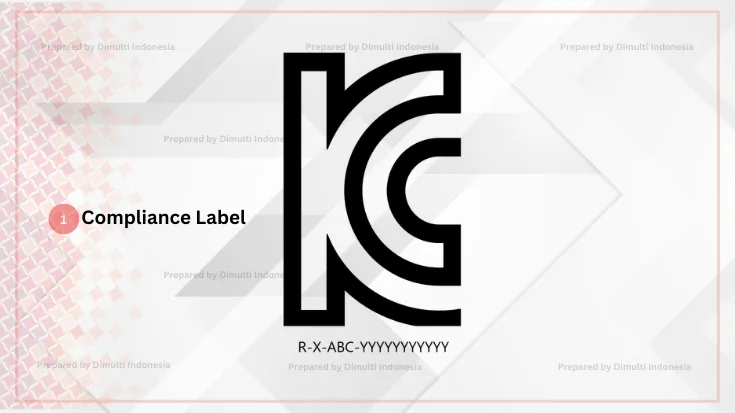
Certified telecom and wireless products must affix the KC Mark to the product. This label consists of two components, namely the KC symbol and a unique code underneath it. The following is an explanation of each code:
R: identifier for broadcasting and communication equipment
X: Authentication field identification number. This must be filled in with the certification scheme code, which can be: “C” for Certification, “R” for Registration, and “I” for Interim
ABC: Applicant identification code assigned by the RRA
YYYYYYY: Applicant's “Product Identification Code”
More on Labeling
E-labeling is also supported; however, a label format similar to that of the FCC must be provided during the application process.
Certificate Example
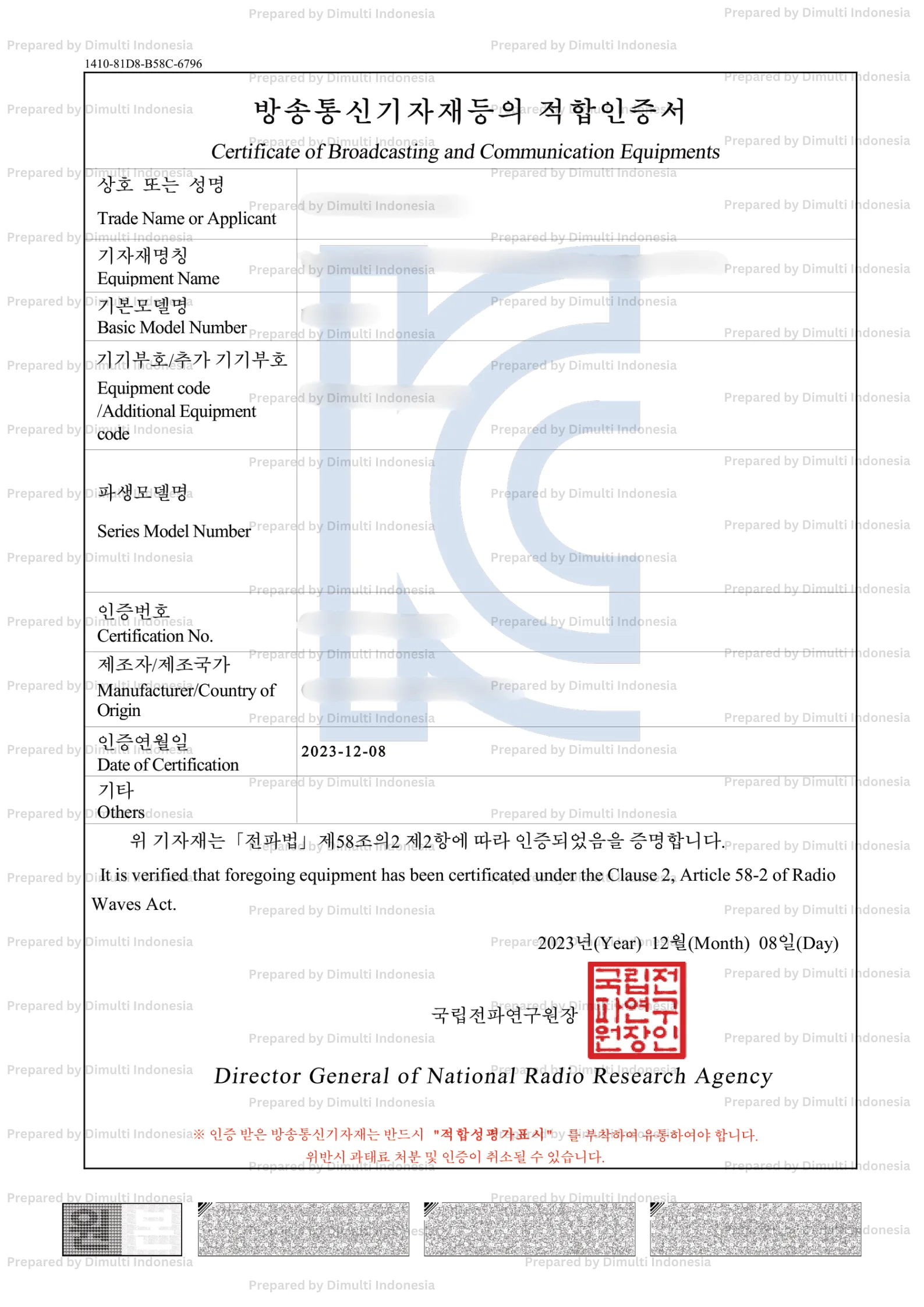
- Issued under
- The National Radio Research Agency (RRA)
- Certificate
- KC certification
- Validity
- Unlimited
- Lead time
- About 8 weeks
Alternative Country Names
Republic of Korea, Südkorea, Corée du Sud, Južna Koreja, Corea del Sud, Corea del Sur, Южная Корея, 大韓民国, Korea, Republic of, 남한, 남조선, Sydkorea, 韓国, 한국, KR
Product Scope
This certification is not limited to telecommunication products only. However, this certification is also mandatory for all products that have telecommunication features or radio frequency.
Some examples of products that are mandatory to apply for KC certification are:
Rules by Technology
Allowed, approval required
- Wi-Fi 2.4 GHz
- Wi-Fi 5 GHz
- Wi-Fi 6E (6 GHz)
- Wi-Fi 7
- Bluetooth Classic
- Bluetooth Low Energy
- NFC
- RFID
- UWB
- Zigbee
- Thread
- Z-Wave
- DECT
- 2G/3G
- 4G LTE
- 5G NR
- NB-IoT
- LTE-M
- LoRa / LoRaWAN
- Sigfox
- Automotive radar (77 GHz)
- Short-range radar (24 / 60 GHz)
- GNSS (GPS)
- Satellite communication
- Wireless charging (Qi)
- PMR / Walkie-talkie
- Amateur radio
- Passive Optical Network (PON)
- Wavelength Division Multiplexing (WDM)
- Coaxial Cable
- ISDN
- Ethernet
- VoIP
- IPv6
- Power Line Carrier
- Microwave Link
- Free Space Optics
- Digital Audio Broadcasting (DAB)
Talk to our project handler
Send your product details and we reply with the RRA requirements, lead time and cost.
Request a quote