
Thailand Type Approval Summary
Thailand is one of the strongest nations in Southeast Asia. Its status as the new industrialized country has boosted its GDP to US$505 billion (World Bank data 2018), which is the 8th largest economy in Asia, as well as the second-largest in Southeast Asia after Indonesia. To access the Thailand market, especially for ICT products, there's a compliance instrument that manufacturers must comply with. This compliance instrument is called "NBTC certification".
NBTC stands for "National Broadcasting and Telecommunications Commission", a government-owned regulatory body in Thailand that's responsible for setting up the regulation and policies regarding Information and Communication Technology. One notable event that has been handled by NBTC such as the restructuration of 3G, 4G, and 5G frequency bands as well as doing the frequency auction. Besides, NBTC also plays a role in licensing ICT products that will be sold or used in Thailand.
Securing NBTC certification can be difficult. Although it accepts foreign test reports based on international standards such as CE or FCC, there are situations where the NBTC mandates additional local testing, especially if the foreign reports don’t meet their specific requirements. With deep expertise, extensive experience, and global connections in the certification industry, Narmadi Company is fully prepared to help you navigate the challenges of the certification process, remove any hurdles, and ensure you obtain the certificate by your target date.
Who Can Be an Applicant?
- Local representative
- Required
Regarding the applicant, NBTC allows local representation service, or using the Thai agency name as the certificate holder. However, it is preferable to appoint a real importer to be the certificate holder, so the importer can use the certificate for actual sale and import activities.
Application Method
- In-country testing
- No
- Paperwork only
- Yes
This certification does not command local testing for product approval. As a result, certification can be obtained through a documentation-based handle, which includes assessing existing RF (Radio Frequency) and EMC (Electromagnetic Compatibility) reports, and other relevant test reports such as safety, EMF, and SAR test reports.
The NBTC permits the acknowledgment of universally recognized guidelines, such as CE certification, to fulfill the essential necessities. This streamlined handle gives adaptability for companies looking to enter the Singapore market without the requirement for extra local testing.
Paperwork Only
This certification can be processed through the paperwork method by evaluating the existing CE, FCC, CB, and more. Product testing on the Thailand NBTC is mandatory by the report from international labs accredited to ISO/IEC 17025.
Sample Requirements
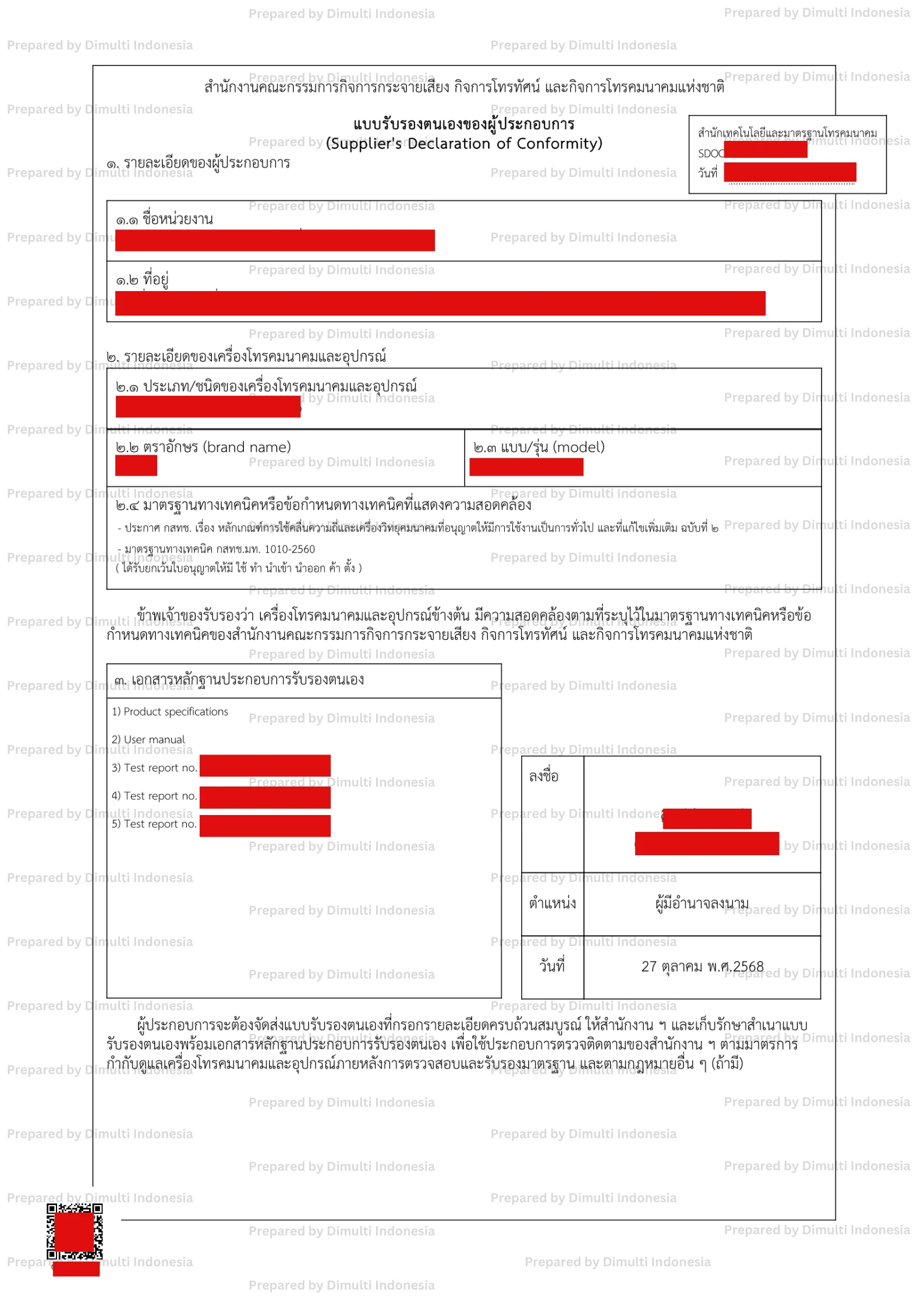
It does not need a sample (SDoC, Class A, or Class B).
Document Requirements
Applicants must prepare and submit the required documents. Here is a list of the required documents:
- Application form specified by the NBTC Office
- Company registration certificate of the applicants (less than 90 days old)
- ID card or passport of the authorized director issued by the Thai authority
- Applicant’s username and password issued by the Department of Business Development (DBD)
- Power of attorney authorization letter
- Catalogue or technical specification
- RF test report
- EMC test report
- Other relevant test reports such as safety, EMF, and SAR test reports
- Laboratory accreditation certificate
- NBTC certificate (if any)
- Equipment photos show front, back, sides, logo, and type/model of the equipment
Submission process
- Submission
- Online
Applications for NBTC type approval can be submitted online. However, there are two different methods depending on the type of application selected.
SDoC applications are submitted through the NBTC SDoC portal. Class A and Class B applications, on the other hand, are submitted via email.
Lead Time of Certification
- Lead time
- 4–8 weeks
Based on the official lead time specified in the NBTC circular, which is four to eight weeks after sample receipt.
Validity Period
- Validity
- Unlimited
NBTC certificate no validity time. It means that the certificate will be valid forever unless the product gets any modifications / changes.
Label Requirements
- Product label
- Required
- Approval mark
- Required
- Label registration
- Required
- E-labeling
- Not allowed
Once the product obtains an NBTC certificate, a conformity mark must be applied. The rules for applying this conformity mark are:
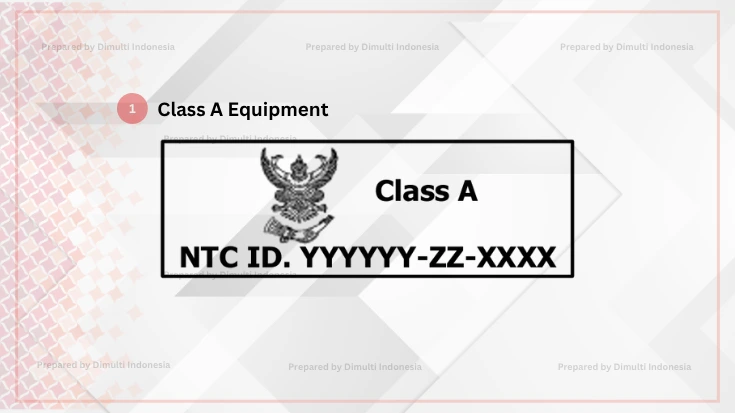
Class A equipment
For class A equipment, here is the conformity mark format:
Where YYYYYY is registration number (6 digits), ZZ is the year of registration (last 2 digits of the year), and XXXX is supplier code (4 digits)
Class B Equipment
For class B equipment, here is the conformity mark format:
Where YYYYYY is the registration number (6 digits), ZZ is the year of registration (last 2 digits of the year), and XXXX is the supplier code (4 digits)
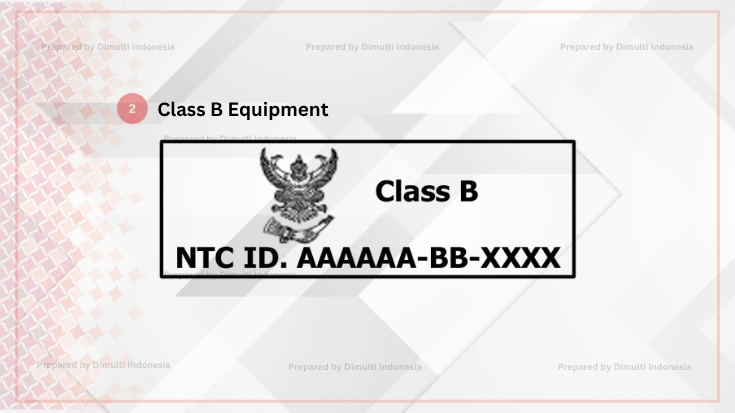
Both class A and class B labels must be affixed on the surface of the product, in a place that can be found easily and is visible. Labels must be affixed using a method that is reliable and can not easily be removed.
If the label can not be affixed to the product due to a certain reason, for example, because the product size is too small, it is allowed to affix the label on the packaging, or any material that comes with the product, such as a user manual or compliance sheet.
Products under Class A and Class B must be registered for the self-labelling process with NBTC; the importer must report label usage monthly to NBTC.
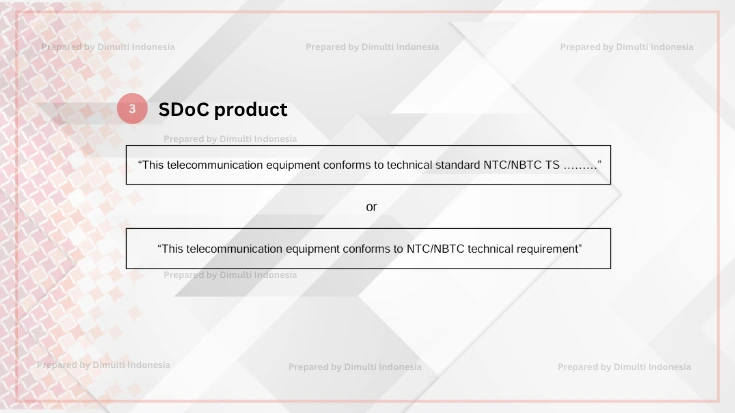
SDoC product
For the case of SDoC, the supplier is also mandatory to affix labels stating that the product has complied with certain Thai standards. The wording can follow the following format:
This statement must be affixed to the user manual or any other supplementary documents that come with the product, such as a specification sheet or a compliance sheet of the product.
More on Labeling
E-labeling is not acceptable. It must be in physical form.
Certificate Example
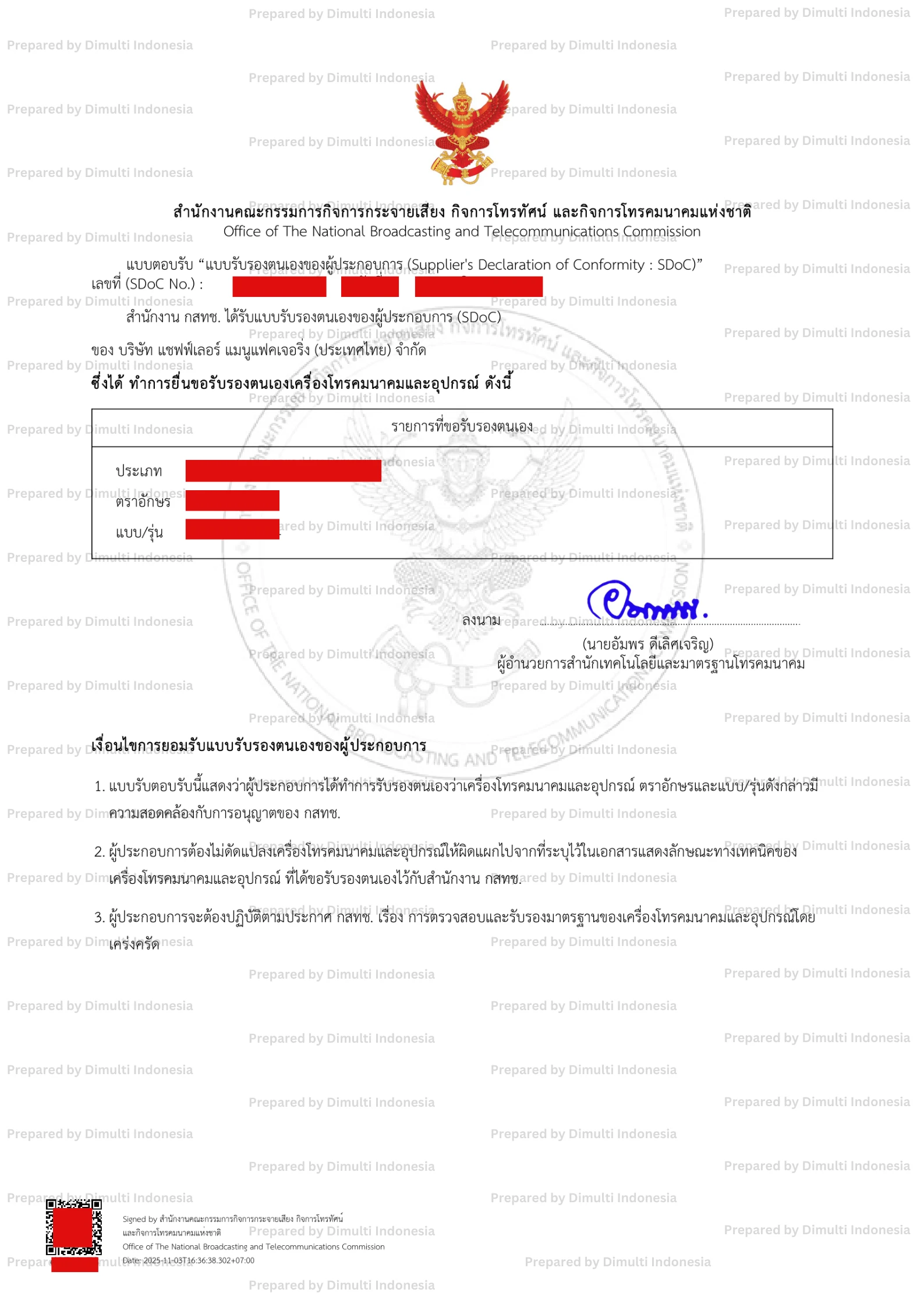
- Issued under
- National Broadcasting and Telecommunications Commission (NBTC)
- Certificate
- NBTC certification
- Validity
- Unlimited
- Lead time
- 4–8 weeks
Alternative Country Names
Prathet, Thai, Kingdom of Thailand, ราชอาณาจักรไทย, Ratcha Anachak Thai, Thaïlande, Tajland, Tailandia, Таиланд, タイ, 태국, TH
Product Scope
This certification is not limited to telecommunication product only. But this certification is also mandatory to all products that have telecommunication features or radio frequency. Some examples of products that are mandatory to apply NBTC certification are:
Rules by Technology
Allowed, approval required
- Wi-Fi 2.4 GHz
- Wi-Fi 5 GHz
- Wi-Fi 6E (6 GHz)
- Wi-Fi 7
- Bluetooth Classic
- Bluetooth Low Energy
- NFC
- RFID
- UWB
- Zigbee
- Thread
- Z-Wave
- DECT
- 2G/3G
- 4G LTE
- 5G NR
- NB-IoT
- LTE-M
- LoRa / LoRaWAN
- Sigfox
- Automotive radar (77 GHz)
- Short-range radar (24 / 60 GHz)
- GNSS (GPS)
- Satellite communication
- Wireless charging (Qi)
- PMR / Walkie-talkie
- Amateur radio
- Passive Optical Network (PON)
- Wavelength Division Multiplexing (WDM)
- Coaxial Cable
- ISDN
- Ethernet
- VoIP
- IPv6
- Power Line Carrier
- Microwave Link
- Free Space Optics
- Digital Audio Broadcasting (DAB)
Talk to our project handler
Send your product details and we reply with the NBTC requirements, lead time and cost.
Request a quote