
Indonesia Type Approval Summary
Indonesia is undoubtedly interesting for many manufacturers. Its strategic geographical location combined with their emerging economic and demography bonus make this country not only plays as a global manufacturer, but also a big and potential market. To access Indonesian market, especially for ICT products, there's a compliance instrument that manufacturer must comply with. This compliance instrument is called "DJID certification", or usually also called as "SDPPI certification" or "Postel Certification".
DJID stands for "Direktorat Jenderal Infrastruktur Digital", or "Directorate General of Digital Infrastructure" in English. This is an institution under the Ministry of Communication and Digital Affairs of Indonesia with responsibility of establishing communication technology standard, performing product testing through its local laboratories, issuing compliance certificate called "DJID Certificate", and monitor the certified products in the market.
Getting DJID approval certification can be tricky. Although it accepts foreign test reports using international standard such as CE or FCC, in some cases DJID also obligates local test especially if the test reports don't suffice their requirements. But, with the long experience and expertise in DJID type approval niche, Narmadi Company is ready to help you dealing with the complication of DJID certification procedure, eliminating hassles during the process, and get you the certificate based on expected target date.
Who Can Be an Applicant?
- Local representative
- Required
Certificate holder must be a local company that is registered in Indonesia. It can be distributor, importer, or brand representative.
Application Method
- In-country testing
- Yes
- Paperwork only
- Yes
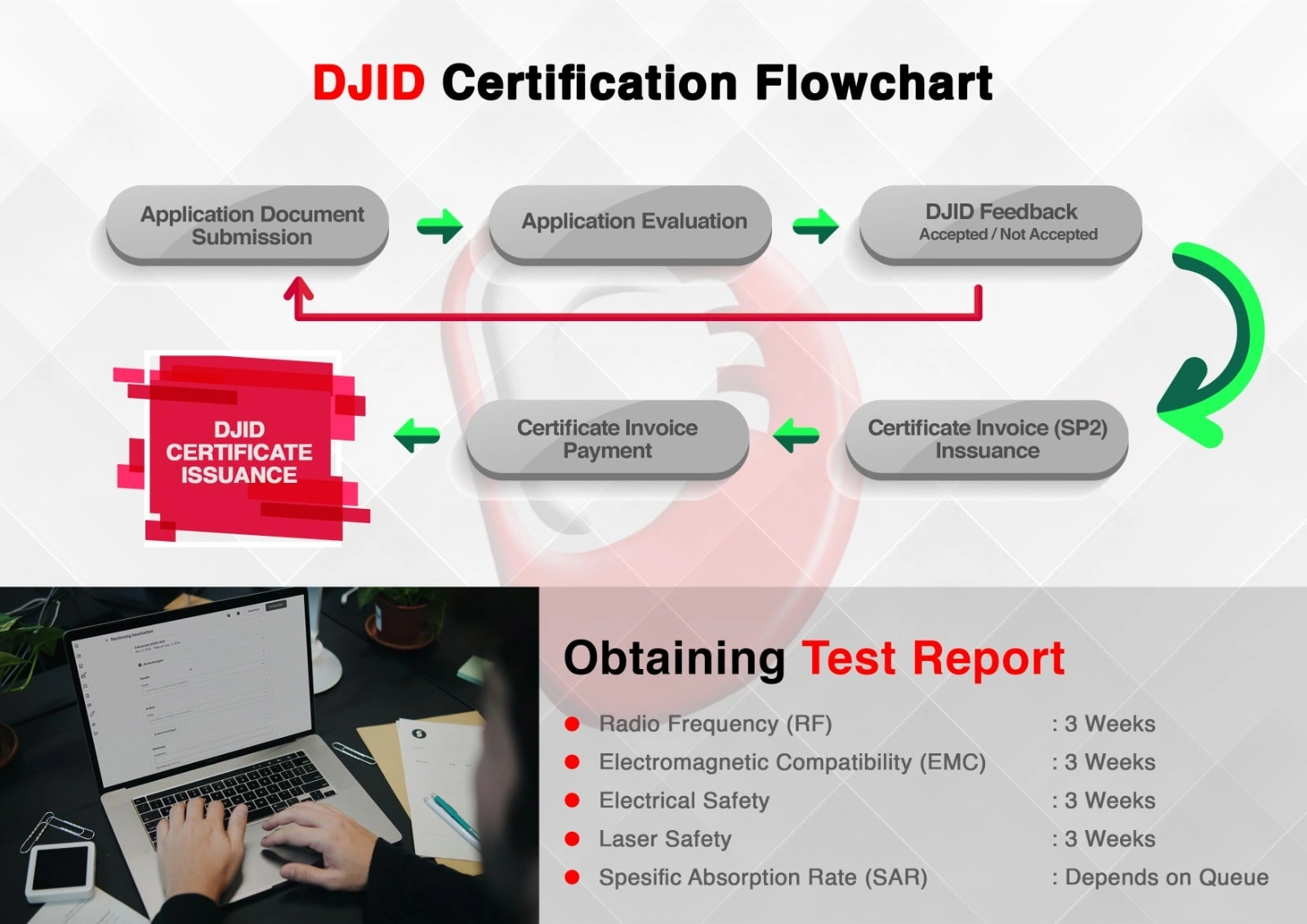
The process of obtaining Indonesia DJID Certificate for ICT products is divided into two stages: Obtaining Test Reports and Application Submissions. The requires test reports are:
- Radio Frequency (RF) test Report
- Electromagnetic Compatibility (EMC) test report
- Electrical Safety test report >> only mandatory for product supplied by direct AC power
- Laser Safety test report
- Specific Absorption Rate (SAR) test report >> only mandatory for tablet or mobile phone
Obtaining test reports can be done by doing local testing in Indonesian domestic test lab or using existing reports issued by overseas labs that are recognized by DJID. Below is the flowchart of making DJID certificate.
Local Testing
Currently, RF, EMC, and electrical safety testing at a local lab is optional, especially if the product already has a test report issued by a DJID-recognized international test lab. For Laser safety and SAR, testing must be done at a local lab in Indonesia. In 2027, DJID plans to make local testing mandatory and the only method to apply for type approval certification.
Paperwork Only
Document evaluation or paperwork can be done if the product has RF, EMC, and Electrical Safety test reports issued by an overseas lab that is recognized by DJID. Other documents are still attached. This process is only allowed until the end of 2026.
Sample Requirements
For EMC and Electrical Safety Test the samples required are normal (commercial product). For RF Test, especially product with radio frequency from 920 MHz and above typically testing Lab request conducted sample (sample with RF cable affixed to the RF module inside) with test software. For product with radio frequency under 920 MHz typically testing Lab request normal or radiated sample. SAR test required radiated samples with test software. And for Laser Safety test, we need one host device (switch or router) with one pair compatible SFP transceiver.
Document Requirements
The document requirements that must be submitted are product specification, product photos, self-conformity declaration letter, MOU or distributor agreement (between certificate holder or applicant and brand owner), RF, EMC, Laser Safety (for products that have optical interface), and Electrical Safety Test Reports.
Submission process
- Submission
- Online
All documents for Indonesian type certification applications must be submitted through the DJID e-certification website. The authorities will evaluate all documents within 24 hours, depending on the application queue.
After that, DJID will decide whether to approve the certification. If the certification is approved, you must make the payment before the certificate can be issued. If it is not approved, the documents will be returned to the applicant for correction and resubmission.
Lead Time of Certification
- Lead time
- Local Testing around 5 weeks and Paperwork is about 3-5 week.
DJID certificates will be issued after completing the local testing or paperwork process. The lead time for local testing is approximately five to six weeks. On the other hand, the lead time for paperwork or document evaluation is approximately three to five business days.
Validity Period
- Validity
- 3 years
Validity is 3 years from the issuance date of the certificate. If after 3 years the goods are still being manufactured, assembled, or imported for being used or sold in Indonesia, they must be recertified again. If the goods are no longer manufactured, assembled, or imported for being used or sold in Indonesia after 3 years, recertification is not needed. The existing stock in Indonesia still can use the old certificated until it runs out.
Label Requirements
- Product label
- Required
- Approval mark
- Required
- Label registration
- Required
- E-labeling
- Allowed
ICT product that has been certified by DJID is mandatory to affix DJID label on product and packaging. This label consists of three components:
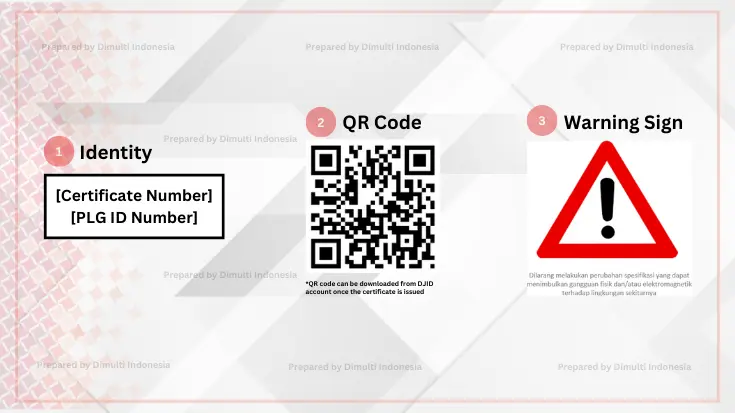
All these three label components must be affix on product and on packaging. In the case that product size is too small making it impossible to affix the label on it, it is allowed to affix on packaging only.
More on Labeling
DJID permits the use of electronic labels for devices with digital displays. However, a QR code must still be included on the physical packaging.
Certificate Example
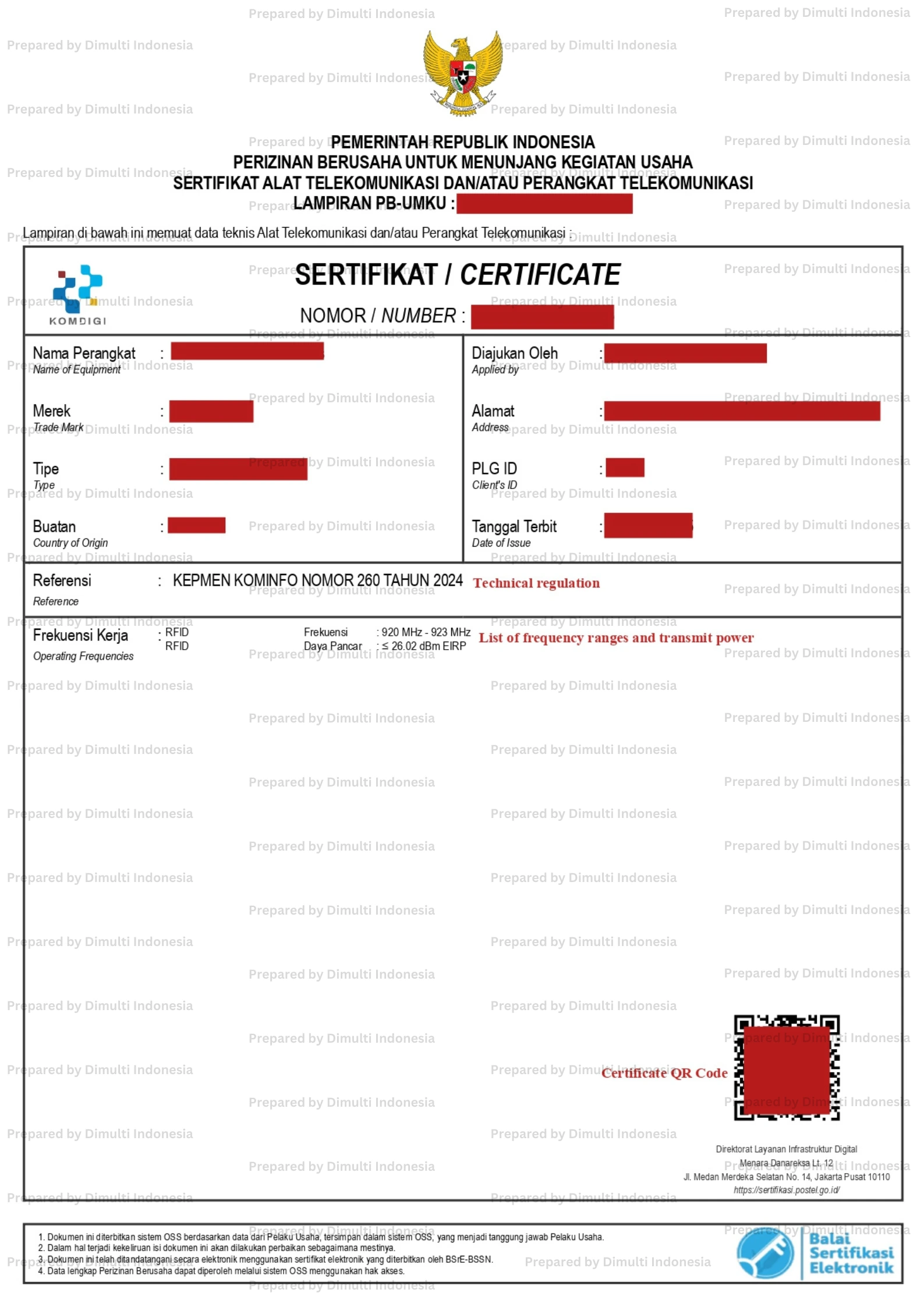
- Issued under
- Direktorat Jenderal Infrastruktur Digital / Directorate General of Digital Infrastructure (DJID)
- Certificate
- DJID Certification
- Validity
- 3 years
- Lead time
- Local Testing around 5 weeks and Paperwork is about 3-5 week.
Alternative Country Names
Republic of Indonesia, Republik Indonesia, Indonesien, Indonésie, Indonezija, Индонезия, インドネシア, 인도네시아, ID
Regulations and Standards
List of technical regulation and standard used in DJID certification process would be published by Narmadi team on PMS page.
For other technologies and regulation that are not mentioned here, you can get more detailed information about it by contacting our contact windows.
Product Scope
DJID certification is not limited to telecommunication product only. But this certification is also mandatory to all products that have telecommunication features or radio frequency. Some examples of products that are mandatory to apply DJID type approval and certification are:
Rules by Technology
Allowed, approval required
- Wi-Fi 2.4 GHz
- Wi-Fi 5 GHz
- Wi-Fi 6E (6 GHz)
- Wi-Fi 7
- Bluetooth Classic
- Bluetooth Low Energy
- NFC
- RFID
- UWB
- Zigbee
- Thread
- Z-Wave
- DECT
- 2G/3G
- 4G LTE
- 5G NR
- NB-IoT
- LTE-M
- LoRa / LoRaWAN
- Sigfox
- Automotive radar (77 GHz)
- Short-range radar (24 / 60 GHz)
- GNSS (GPS)
- Satellite communication
- Wireless charging (Qi)
- PMR / Walkie-talkie
- Amateur radio
- Passive Optical Network (PON)
- Wavelength Division Multiplexing (WDM)
- Coaxial Cable
- ISDN
- Ethernet
- VoIP
- IPv6
- Power Line Carrier
- Microwave Link
- Free Space Optics
- Digital Audio Broadcasting (DAB)
Talk to our project handler
Send your product details and we reply with the DJID requirements, lead time and cost.
Request a quote