
Singapore Type Approval Summary
Singapore maybe small, but it is one Asia's power house especially in the southeast region. However, on the economic side, Singapore is popularly known as highly developed free market country with the tittle as most-open economy in the world. Tax rate is very low compared to the neighboring countries. This is why many companies set up their APAC region headquarter in Singapore. To access the Singapore market, especially for ICT products, there's a compliance instrument that manufacturers must comply with. This compliance instrument is called "IMDA certification".
IMDA, which is shorted from "Infocomm Media Development Authority". This is a governmental organization under Ministry of Digital Development and Information of Singapore. Some obligations hold by IMDA such as issuing policies, regulation, or programs related to telecommunication standard, as well as establishing user's data protection scheme from online falsehood and manipulation. In terms of product approval, IMDA also issued compliance certificate called "IMDA Certificate" as a proof that certain ICT product is already approved, and allowed to be used and/or traded within Singaporean region.
Obtaining IMDA certification can be challenging. While it recognizes foreign test reports based on international standards like CE, there are cases where the IMDA requires additional local testing, particularly if the foreign reports don't meet their specific standards. With vast expertise, extensive experience, and global networks in the certification field, Narmadi Company is well-equipped to guide you through the certification process, overcome any obstacles, and ensure you receive the certificate by your desired deadline.
Who Can Be an Applicant?
- Local representative
- Required
Advisable to use an importer or distributor as the certificate holder. But if distributor or importer information is still not available, a local company in Singapore can be the certificate holder. However, please also check the product type. If the product falls under M2M (Machine to Machine) classification, certificate must be issued under the name of real importer or distributor.
Application Method
- In-country testing
- No
- Paperwork only
- Yes
IMDA certification applications are divided into five types: Enhanced Simplified Equipment Registration (ESER), Simplified Equipment Registration (SER), General Equipment Registration (GER), General Equipment Registration by Certification Bodies (GER-CB), and Confirmation of Conformity (COFC).
These five types of certification are grouped based on different product categories. Although they involve different types of certification, the recommended application method remains the same: paperwork or document evaluation.
Local Testing
Product testing is not mandatory because IMDA accepts International test reports such as CE or FCC. So, please make sure the product already has the reports before applying. Otherwise, product tests based on CE or FCC will be required in order to create the test report.
Paperwork Only
Paperwork or document evaluation is the recommended method for applying for type approval certification in Singapore. IMDA certificate can be processed through the paperwork method by evaluating existing CE, FCC, CB, and more.
Sample Requirements
IMDA does not require samples to be sent to Singapore. This is because local testing is not mandatory.
Instead of worrying about sample requirements, you need to focus on the completeness of the documents you must submit. One of these is a test report from an international lab, which you must already have.
Without a test report, you cannot submit your application. You need to have the testing done first to obtain the test report required for the application.
Document Requirements
Document requirements for type approval certification in Singapore differ by application type.
Enhanced Simplified Equipment Registration (ESER)
- Conformity assessment
- Product brochure
- Supplier’s Declaration of Conformity (SDoC)
Simplified Equipment Registration (SER)
- Conformity assessment
- Supplier’s Declaration of Conformity (SDoC)
- Photographs of equipment
- Product brochure
- EU-Type Examination Certificate (EU-TEC)
- User manual
- Safety information
General Equipment Registration (GER)
- Supplier’s Declaration of Conformity (SDoC)
- Photographs of equipment
- General information about the product
- Product brochure
- Test reports
- User Guide
General Equipment Registration by Certification Bodies (GER-CB)
- A certificate issued by a certification body recognized by IMDA
- Photographs of equipment
- General information or product brochure
Confirmation of Conformity (COFC)
- Supplier’s Declaration of Conformity (SDoC)
- Photographs of equipment
- Product brochure
- Test reports acceptable according to IMDA standards
Submission process
- Submission
- Online
Submit the documents to IMDA Portal.
Lead Time of Certification
- Lead time
- 3 days (M2M: 2–3 months)
The lead time is commonly 3 days. But for M2M (Machine to Machine) certification, lead time can be 2-3 months.
Validity Period
- Validity
- 5 years
The certificate is valid for 5 years. Minimizing the effort required to maintain product compliance during its lifecycle. Certification can be renewed up to 30 days before it expires.
Label Requirements
- Product label
- Required
- Approval mark
- Required
- E-labeling
- Allowed
ICT product that has been certified by IMDA is mandatory to affix IMDA label on product or packaging. Products must include Dealer Registration Number and Complies to IMDA Standards. This the example of IMDA label:
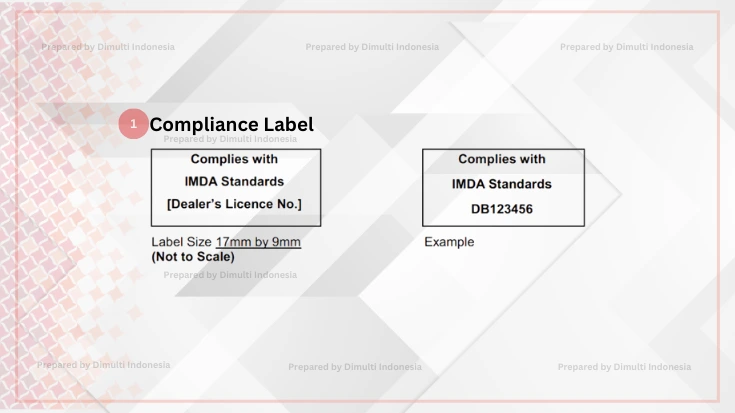
The label must be affixed on product or on packaging. As an alternative, the licensee can choose for electronic compliance labeling by showing the label on the device's built-in screen or including it in the digital version of the user manual.
If this method is chosen, the license is required to supply clear instructions or a leaflet that guides consumers on how to locate the electronic label for verification purposes.
More on Labeling
IMDA permits the use of e-labels that can be displayed on the equipment’s built-in screen or display.
Certificate Example
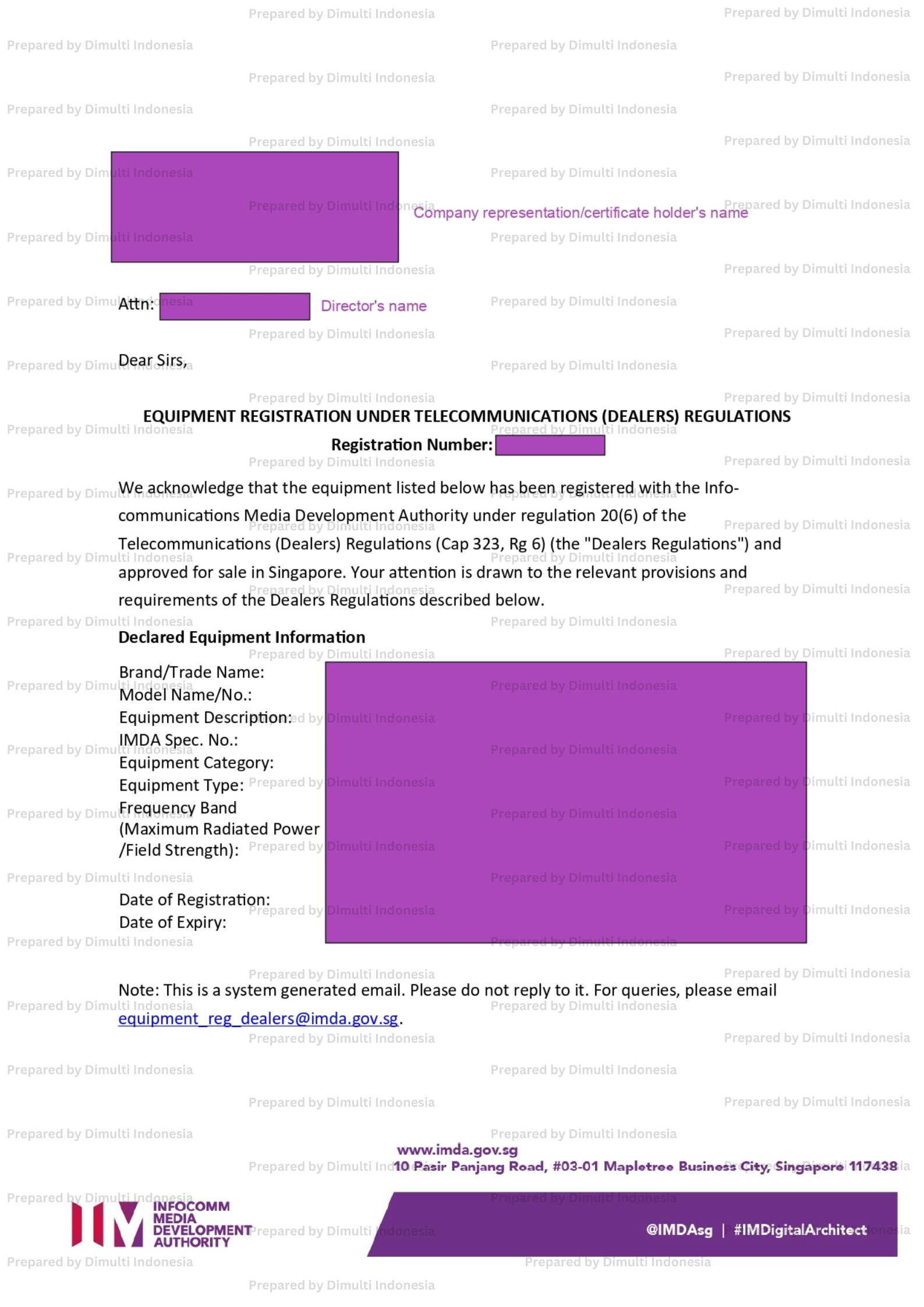
- Issued under
- Infocomm Media Development Authority (IMDA)
- Certificate
- IMDA Certification
- Validity
- 5 years
- Lead time
- 3 days (M2M: 2–3 months)
Alternative Country Names
Singapura, Republik Singapura, Singapur, Singapour, Сингапур, シンガポール, 싱가포르, SG
Product Scope
IMDA certification is not limited to telecommunication product only. But this certification is also mandatory to all products that have telecommunication features or radio frequency. Some examples of products that are mandatory to apply IMDA certification are:
Rules by Technology
Allowed, approval required
- Wi-Fi 2.4 GHz
- Wi-Fi 5 GHz
- Wi-Fi 6E (6 GHz)
- Wi-Fi 7
- Bluetooth Classic
- Bluetooth Low Energy
- NFC
- RFID
- UWB
- Zigbee
- Thread
- Z-Wave
- DECT
- 4G LTE
- 5G NR
- NB-IoT
- LTE-M
- LoRa / LoRaWAN
- Sigfox
- Automotive radar (77 GHz)
- Short-range radar (24 / 60 GHz)
- GNSS (GPS)
- Satellite communication
- Wireless charging (Qi)
- PMR / Walkie-talkie
- Amateur radio
- Passive Optical Network (PON)
- Wavelength Division Multiplexing (WDM)
- Coaxial Cable
- ISDN
- Ethernet
- VoIP
- IPv6
- Power Line Carrier
- Microwave Link
- Free Space Optics
- Digital Audio Broadcasting (DAB)
Not allowed
Talk to our project handler
Send your product details and we reply with the IMDA requirements, lead time and cost.
Request a quote