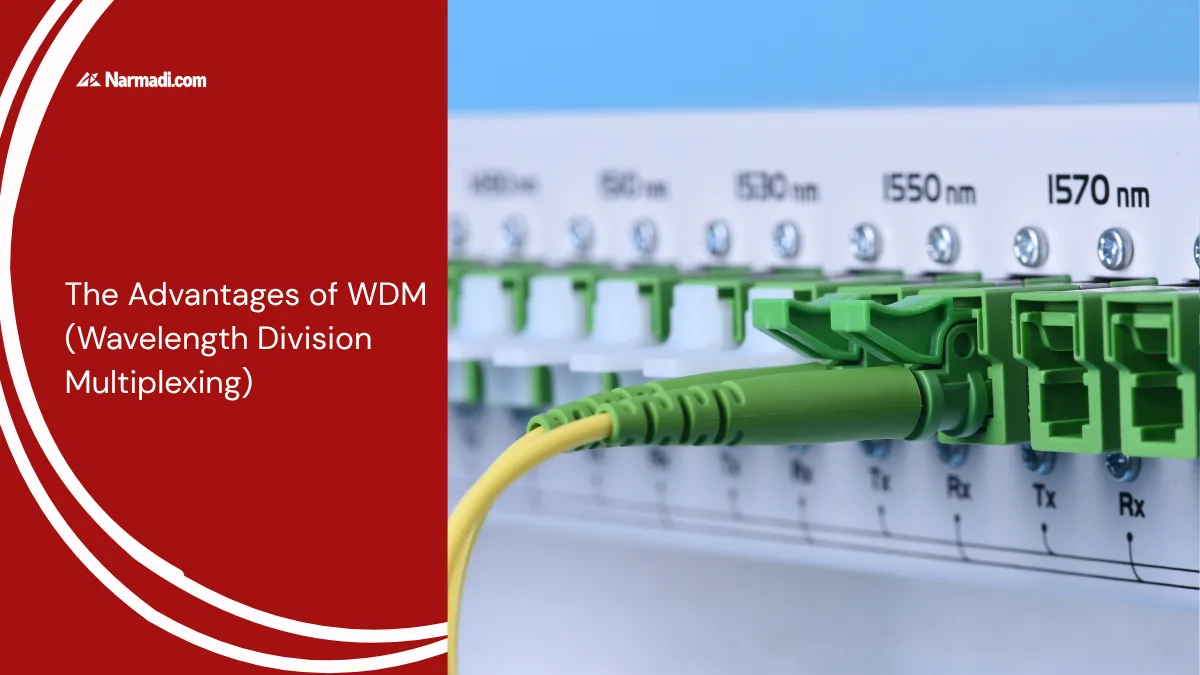
Wavelength Division Multiplexing (WDM) is becoming a very important technology today, due to its ability to transmit large amounts of information efficiently, as the main advantages of WDM.
The advantages of WDM are attractive for modern communication networks, from increased network capacity and efficient use of optical fiber, to increased security.
This article will discuss the main advantages of WDM, highlighting its impact on network capacity, efficiency, flexibility, scalability, and security.
Why Is Wavelength Division Multiplexing Essential for Modern Infrastructure?
Before discussing the advantages of Wavelength Division Multiplexing (WDM), it’s worth understanding why it has become so essential today. WDM plays a significant role in modern infrastructure due to its ability to transform fiber-optic communications.
This technology overcomes the limitations of conventional fiber-optic configurations, which often require the installation of new physical cables to expand bandwidth capacity. It does this by combining multiple data streams into a single optical fiber. Each stream is assigned a different light wavelength.
The Advantages of WDM
Wavelength Division Multiplexing (WDM) has several key advantages, especially in terms of increased network capacity and efficient use of optical fibers. Here are some of the main advantages of WDM:
1. Increased network capacity
The main advantage of WDM is the enhanced network capacity. This technology allows the transmission of multiple light signals of different wavelengths over a single optical fiber, thus increasing the network capacity significantly.
2. Fiber optic usage efficiency
Fiber optic usage efficiency is another advantage of WDM. It can maximize the use of existing optical fibers, thereby reducing costs and improving network efficiency.
By increasing network capacity, WDM can also save operational and infrastructure costs without the need to build new infrastructure.
3. Flexibility and reliability
WDM provides flexibility in managing the network, allows easy addition or removal of channels, and provides higher reliability.
4. Scalability
WDM is perfect for networks that require scalability, as it can be easily scaled up to meet growing bandwidth requirements.
5. Increased security
Another important advantage of WDM is the increased security of use. Each WDM signal has a different wavelength, so data will be safer from interference or interference.
Best Practices for Implementing WDM Solutions
WDM in enterprise infrastructure will be most effective when implemented correctly. Network engineers can follow these implementation best practices:
- Evaluate Distance vs. Channel Density Requirements: Use Coarse Wavelength Division Multiplexing (CWDM) for short-distance metro links. Alternatively, use Dense Wavelength Division Multiplexing (DWDM) for long-distance backbones with high capacity.
- Monitoring Optical Loss and Attenuation: Maintain signal clarity by integrating Erbium-Doped Fiber Amplifiers (EDFAs) and dispersion-compensating devices.
- Planning for Modular Expansion: For seamless future network expansion, choose a multiplexer (MUX/DEMUX) with spare channels. That way, there’s no need for a complete hardware overhaul.
Understanding the advantages of WDM helps us see why this technology is so widely adopted. In fact, for high-speed telecommunications networks and modern enterprise data centers, there is currently no alternative to this technology.
It drastically increases network capacity, reduces infrastructure costs, and provides secure data pathways. WDM is essential for meeting your organization’s future bandwidth needs to ensure a robust digital infrastructure.